Built to order
Will the pledges carry the building?
A building campaign is decided on numbers that rarely sit on the same page: what was pledged, how much of it will arrive and when, what the builder will draw each month, what a lender will carry, and what the general fund can afford afterward. A committee usually sees a total set against a total. The trouble is in the months.
This model walks the project month by month on your church's own numbers. It shows the month cash is tightest, the most the church will ever owe, what happens if pledges come in at 80 cents on the dollar, and the largest project your own rules allow. Then it prints a brief for the finance committee that shows every assumption. Everything below is computed live, in your browser, by the same engine the real one runs.
Redbud Fellowship is invented, and so is every number on this page: a $1,796,500 project, with $1,083,000 pledged by 156 giving units in 4 bands. The model uses totals by band only; no donor's name is entered anywhere. The four limits are this invented church's own rules, not industry figures. This is a planning model, not financial, legal, tax or lending advice. Nothing you change here is saved or sent.
The two questions a committee asks first. Drag the share of pledges that arrive, or move the start, and the whole plan is walked again. Every other input is on the Assumptions tab.
Project cash and loan balance, month by month
Project cash on hand Loan balance The church's loan limit Construction months Point at a month, or tap one, to read it.
Against the church's own rules
Four limits, each set on the Assumptions tab. A rule that fails names the month and the amount.
The month-by-month ledger behind the chart
Self-checks
Each check re-adds the ledger from its own rows and does not trust the totals the model kept while it ran.
Pledges that do not arrive, against costs that run over
Three questions, each answered by a search
Each button runs the plan as it stands now, over and over, until it finds the edge. Nothing is looked up; the count of runs is shown with the answer.
How big can the project be?
The largest project cost at which every rule still passes, keeping the plan's mix of hard cost, soft costs and furnishings.
How soon can construction start?
The earliest start month at which every rule passes. Starting later lets more gifts arrive first, and costs more if the builder's price escalates.
How much shrinkage can it take?
The lowest share of pledged dollars at which the plan still passes, to a tenth of a point, and the rule that gives way below it.
What comes out
One document from one run of the engine: the plan as first loaded above. It is written to be handed across a table, read in ten minutes, and argued with.
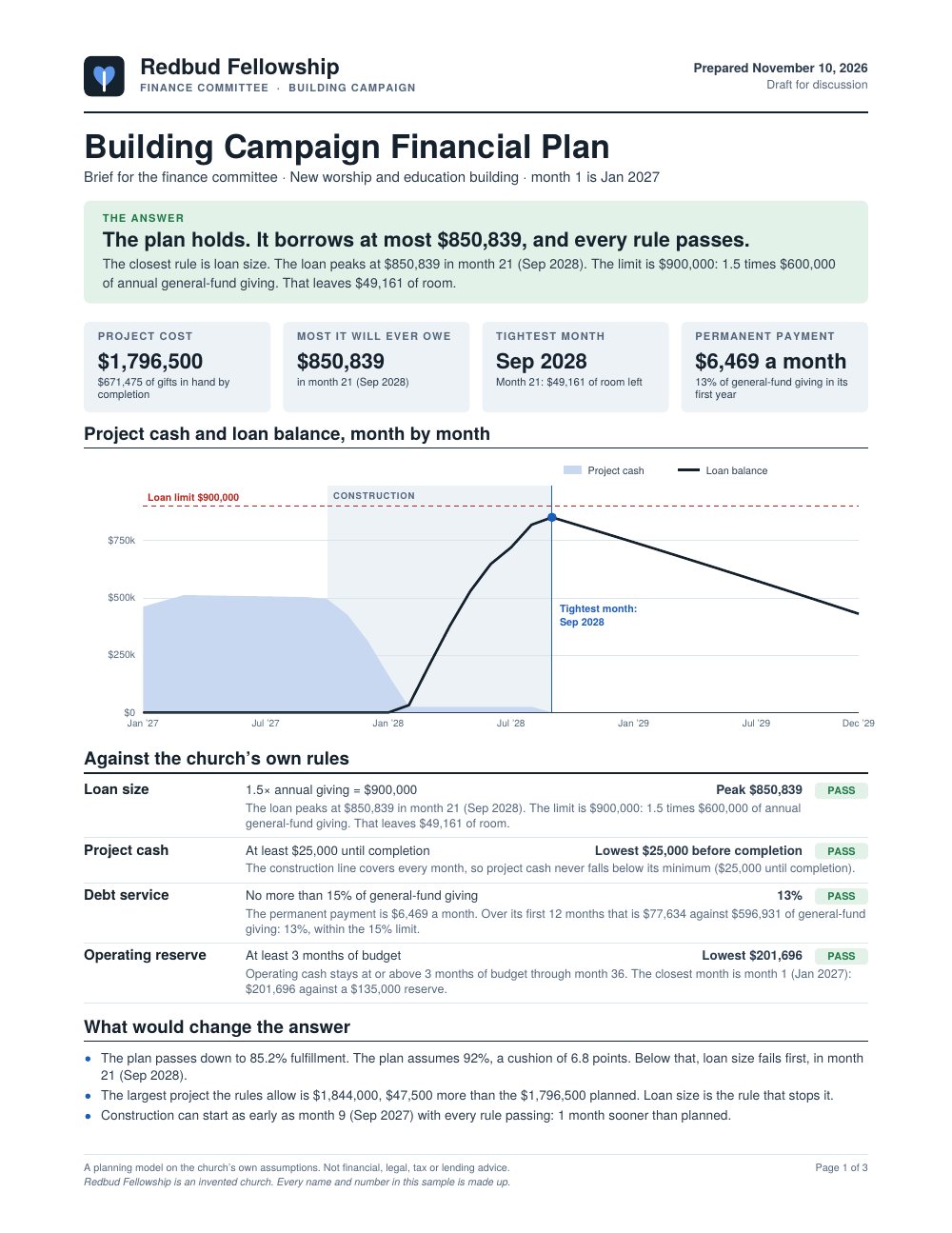
Download the sample brief (PDF, 3 pages)
Page one is the answer. The plan holds. It borrows at most $850,839, and every rule passes. Then the chart, each rule with its plain reason, and what would change the answer: how far pledges can shrink, how large the project can be, how soon it can start.
Page two is every assumption. Where the money comes from and where it goes at completion, the stress grid (3 of 12 cases hold on this plan), the pledge bands, and each input in the words a committee uses.
Page three is the work. The ledger for all 36 months of the plan window, what the 7 self-checks found, what the document is and is not, and a place to sign.
How it works
Month by month, to the cent
Pledges arrive band by band on the timing you choose, at your own estimate of how much will arrive. Construction draws follow an S-curve, slow then fast then slow, with retainage held to completion. A construction line is drawn only in the months cash runs short, then converts to a permanent loan the general fund carries.
Money is kept in whole cents. Anything spread across months adds back to its total exactly.
Tested against your rules, not ours
Four limits: the loan against annual giving, the payment against giving, a minimum in the project fund, and an operating reserve. Each one is yours or your lender's to set, and each can be switched off.
When a rule fails, the model names the month and the amount. Three searches then answer how big, how soon, and how much shrinkage, by running the whole plan again and again.
Then it checks itself
7 independent checks run on every plan: sources equal uses to the cent, the loan and both cash balances roll forward month to month, the loan amortizes to zero, receipts never exceed pledges times fulfillment, and the cost draws add to the project cost.
The count is on the first tab. On the sample plan it is 7 of 7, and this page would not have been published otherwise.
Read this before you rely on it
- This is a planning model on your church's own assumptions. It is not financial, legal, tax or lending advice. Your lender's actual terms and your church's CPA govern.
- How many pledged dollars will arrive is your own estimate. The model does not supply one and will not run without yours. No rate on this page is offered as typical.
- The four limits are inputs. The values loaded belong to an invented church. Ask your lender what theirs are before a committee leans on the word “passes.”
- It needs totals by band, never names. No donor's name or individual pledge is entered, stored or printed on this page, and the full build will be made the same way.
- It models one construction line that converts to one permanent loan, with simple timing curves. It does not model bonds, the sale of a property, grants with conditions, or taxes. A plan that passes here is a plan that matches what was entered, nothing more.
- The “what this is” wording on this page and in the brief is draft wording: a placeholder for a CPA, a lender and an attorney to review before a church relies on it.
What the full build adds
This page is the engine and its screens. The program around them is what a treasurer and a committee will use for the three or four years a campaign runs. None of the following is on this page; it is planned work.
Scenarios, saved and compared
The full build will save each version of the plan with a name and a date, and set any two side by side: the builder's first price against the revised one, the cautious pledge estimate against the hopeful one.
Actuals against the plan, every month
During the campaign and the build, the treasurer will enter what was received and what was paid each month. The model will re-run from the real balances and show whether the tightest month has moved, while there is still time to act on it.
Pledge totals, imported
The full build will read band totals from the export your giving records already produce, so nobody retypes them. Names will stay in your giving system; only totals by band will cross. Which systems it will read is one of the first things we will ask.
A read-only view for the committee and the lender
Planned: a link that shows the current plan and its brief without the means to change either, so the committee and the loan officer are reading the same numbers on the same day.
Connected to the builder's quote
The project cost will be read from the builder's quote rather than typed in, so a revised price or a change order will move the plan the day it arrives.
Bring the numbers your committee already has.
The pledge totals by band, the builder's estimate, the lender's term sheet if there is one, and last year's giving and budget. We will load them, walk the plan with you, and show you the tightest month and what moves it. If the honest answer is to wait a few months or build a little less, the model will say so, and so will we.