Built to order
Sunday's sermon, ready for the week by Monday.
The sermon is preached once and then mostly disappears. Getting it onto the website with a summary, cutting it into chapters, writing the small-group questions, making something for families to take home, and posting a line or two during the week is hours of somebody's week, so it often does not get done, and nobody can find the message on Romans from two years ago.
This tool is built for that Monday morning. The full build will take Sunday's recording, draft the page and the documents from the transcript, and then stop and wait for the pastor. It never writes a sermon and never adds teaching. What runs live below is the part that keeps it honest: the engine that reads every Scripture reference, checks every draft against what was actually preached, and will not let a draft be approved while anything in it is not in the sermon.
Redbud Fellowship is invented, and so are its pastor, its speakers and all 7 sermons on this page. The transcripts are original and condensed. The summaries, guides, sheets and posts were prepared ahead of time: in the full build they will be drafted automatically from the transcript on a server, and a page like this one cannot call such a service and should not pretend to. Everything else here is the real engine, running live in your browser: the reference reader, the check against the sermon, the approval rule, the chapters, the search and the documents. Scripture is quoted from the World English Bible, which is in the public domain. Nothing you change is saved or sent.
Chapters
Scripture in this sermon
Transcript
Plainly a reference Read from context (“verse 6”) Not sure, so not indexed
Drafts waiting for the pastor
Prepared ahead of time for this page. Marked words are what the engine checked: a Scripture reference, or words in quotation marks presented as said in the sermon.
May this week publish?
It reads spoken forms (“First John chapter four, verse seven”), abbreviations, lists and ranges, and “verse 12” after a chapter was named. It is built not to be fooled by “Mark my words” or “3 for 16.”
High confidence Medium Passed over No such passage
Scripture index
Every passage cited in any sermon, in Bible order, with the sermon and the minute. Built by the reader, not typed by anyone.
How your church writes things
However a reference was said or typed, the page, the documents and the index write it this one way.
An approval carries a name. With no name, nothing can be approved.
Sets the planned length printed on the discussion guide.
How strict the checking is
Stricter means fewer passages indexed from the transcript and more left for a person to confirm.
A quoted word or two (“rejoice”) is not held to the transcript unless you say so.
A post over the limit is marked long on its draft.
Rules with no switch
A Scripture reference in a draft must be one the sermon cites. Words in quotation marks must be words that were said. A draft with anything flagged cannot be approved. Nothing publishes until every draft is approved, and an edit after approval takes the approval back.
What comes out
Two of the week's documents, from one run of the engine: the discussion guide after the pastor's fix and approval, and the family take-home sheet. Each prints on one page under the church's name.
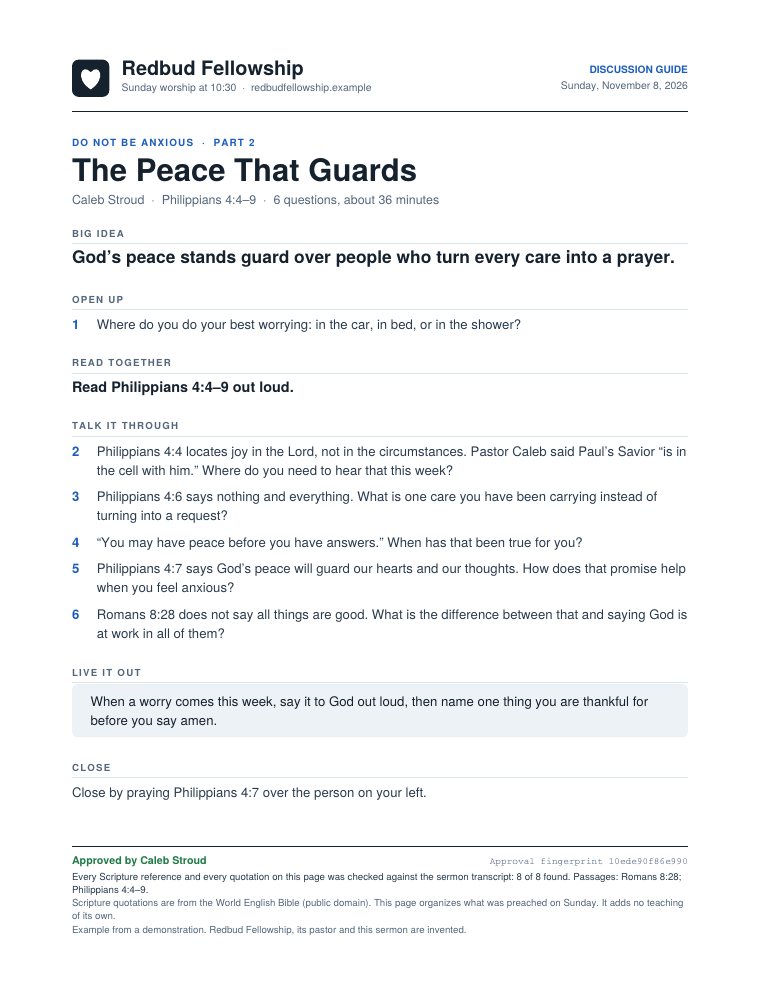
Download the sample (PDF, 2 pages)
The discussion guide: 6 questions, planned for about 36 minutes, with 8 of 8 references and quotations found in the sermon, approved by the pastor.

The family take-home sheet: one sentence, one passage, one line from the sermon, a question for each age, and one thing to do before next Sunday.
How it keeps to what was preached
It reads Scripture the way people say it
“First John chapter four, verse seven.” “Rom. 8:28-30.” “Look at verses 5 through 8.” All 66 books, their abbreviations and spoken forms, lists and ranges, and a bare “verse 12” read against the chapter already named.
Every reference is checked against the chapter and verse table, so Romans 17 is caught, and every one is written back one way, so the index and the search agree.
Every draft is checked against the transcript
A Scripture reference in a guide, a sheet or a post must be one the sermon cites. A sentence in quotation marks must be words that were said. Anything else is flagged, with the reason and, when it is close, the minute of the nearest match.
Across the 7 sample sermons that is 129 items in 28 drafts, and 1 flagged: the one planted for this page.
Nothing publishes without the pastor
A draft with anything flagged cannot be approved. An approval carries the pastor's name and a fingerprint of the exact words, so changing one word afterward, in the draft or in the transcript, takes it back.
The week goes out only when every draft is approved. The engine re-checks that rule a second way on every run.
Read this before you rely on it
- The check covers Scripture references and quotations. It does not judge whether a summary sentence or a question is faithful to the sermon. That is the pastor's reading, which is why nothing publishes without it.
- A transcript made by software will contain mistakes, and a misheard verse number is the kind that matters. The full build will let the office correct the transcript, and a correction re-checks every draft.
- The recordings, the transcripts and everything made from them belong to the church.
- Licensing is yours to settle, and we will ask about it first. Music in a recording and quotations from a copyrighted Bible translation are both covered, or not, by licenses the church holds. This page quotes only the World English Bible. Nothing here is legal advice.
- The sample sermons are invented and condensed. They are ordinary pastoral preaching on well-known passages, written to exercise the engine, not to teach.
What the full build adds
This page is the engine and its screens. The program around them is what a church office will use every Monday. None of the following is on this page; it is planned work.
Upload the recording
The full build will take Sunday's audio or video file from wherever your church already records it. Where that is, and how large the files run, is one of the first things we will ask.
An automatic transcript
Planned: a speech-to-text step will turn the recording into a timestamped transcript, which the office will be able to correct before anything is drafted from it.
Drafts written from the transcript
The full build will draft the summary, the guide, the sheet and the posts from the transcript, instructed to use only what was preached, and then hand each draft to the same check you just watched. The pastor will still approve every one.
Publish to your website, and a podcast feed
Planned: on approval, the sermon page will go to your existing website and the episode to a podcast feed. How it reaches your site depends on what your site is built on, so that is a discovery question, not a promise made here.
Bring one Sunday.
Tell us where the recordings live, what your website runs on, and which of these four documents your church would use. We will walk through one of your own sermons with you and say plainly what it would take to do this every Monday, and what it would not do.