Tools · Hiring & Labor Costs
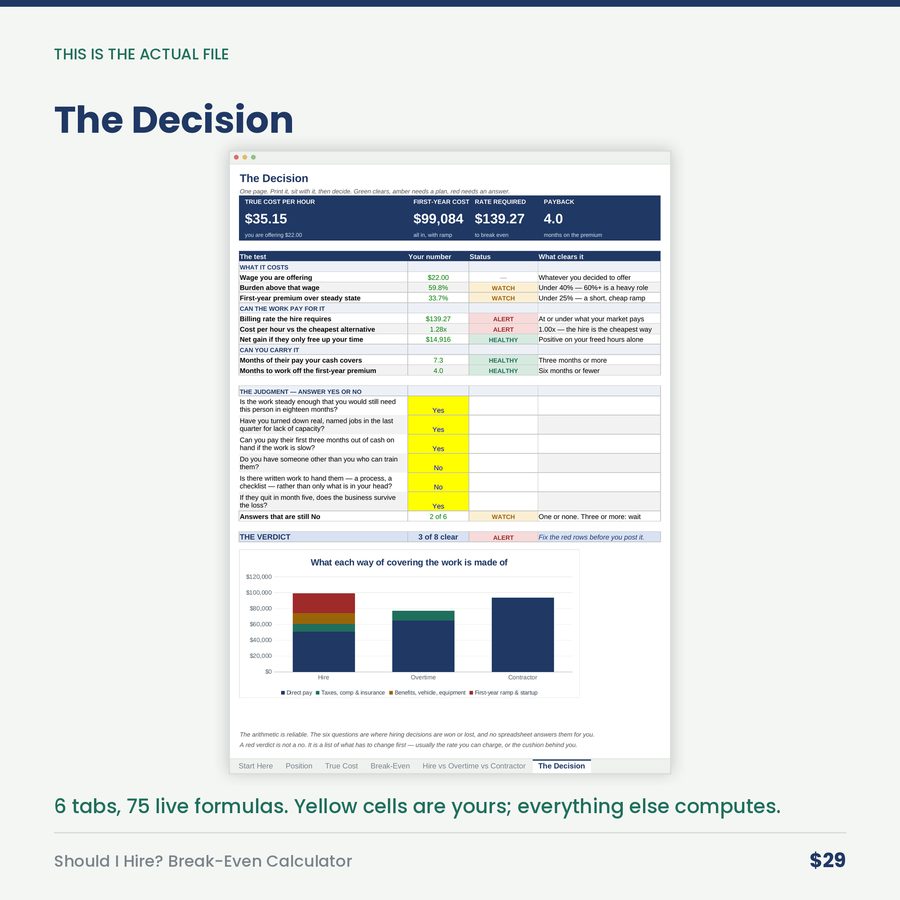
Should I Hire? Break-Even Calculator
"I think I need to hire someone." That sentence has ended more small businesses than any recession.
$29 one-off
Buy — $29Should-I-Hire-Break-Even-Calculator.xlsx · 6 tabs, 75 live formulas, no macros
Instant download, nothing ships. Works in Excel, no subscription. If it does not do what you needed, tell me and I will make it right.
Not because hiring is wrong — because the wage is the smallest part of the number, and almost nobody runs the real one before they make the offer.
Here is the real one.
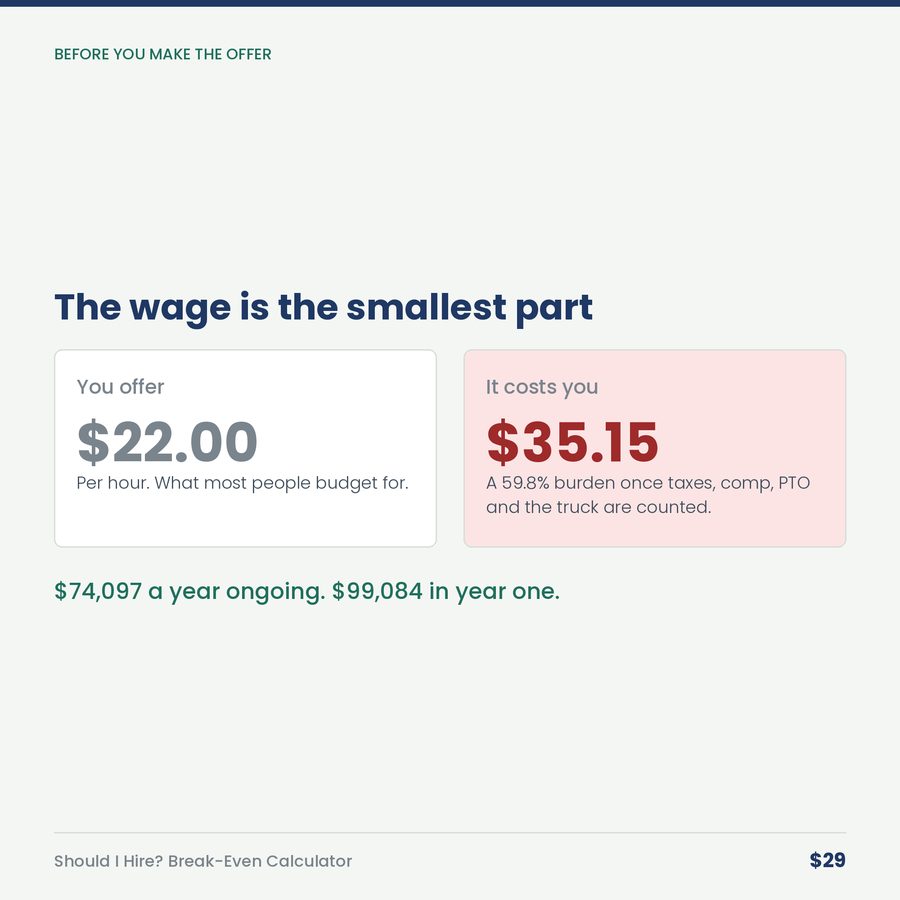
You offer $22 an hour. Add payroll taxes. Add workers comp — which for a trade can be 9% or 15%, not the 2% you assumed. Add the liability bump, the health contribution, the truck, the phone, the ten days of PTO and six holidays you pay for and get no work from.
That hour costs you $35.15. A 59.8% burden on top of the wage. Annually, $74,097.
And year one costs more than that. Recruiting. Tools and equipment to get them started. Four months of ramp at roughly half productivity, during which you pay full freight for partial output. Six hours a week of your own time training them — time you could have billed.
All in, first year: $99,084.
So what do they have to produce?
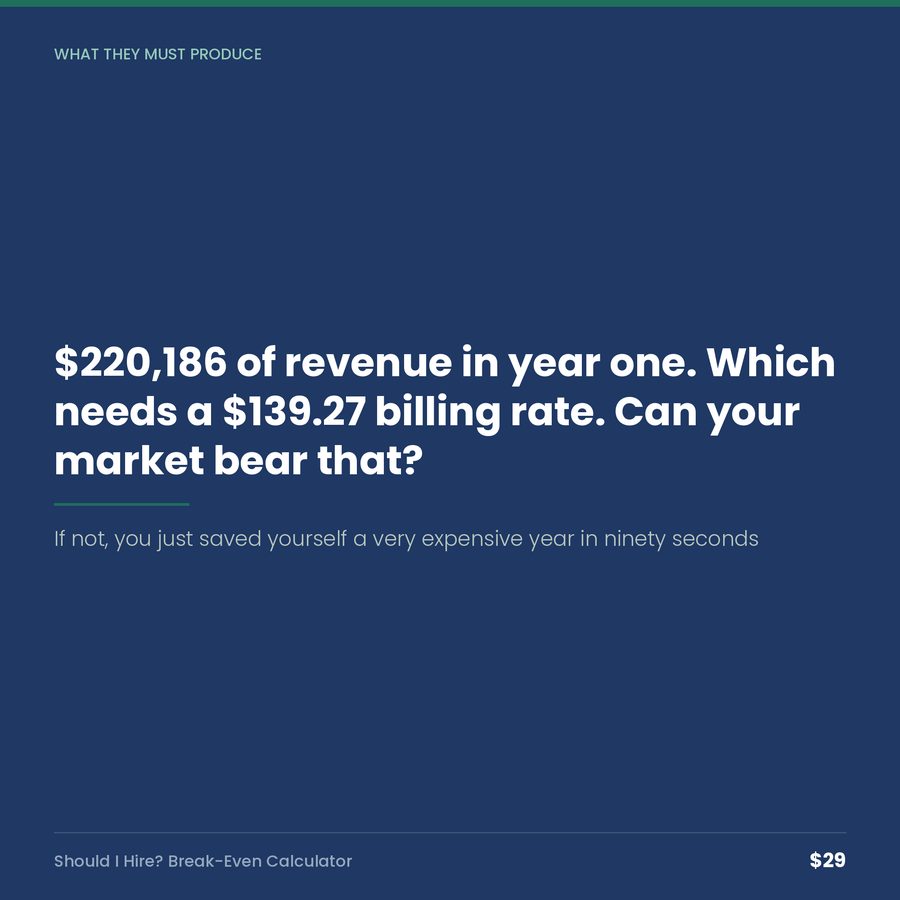
At a 45% gross margin, this person must generate $220,186 of revenue in year one just to break even. If they do billable work at 75% utilization, that means you need to charge $139.27 an hour for their time.
Can your market bear that rate? If not, you just saved yourself a very expensive year, in about ninety seconds.
Then it asks the question most calculators won't.
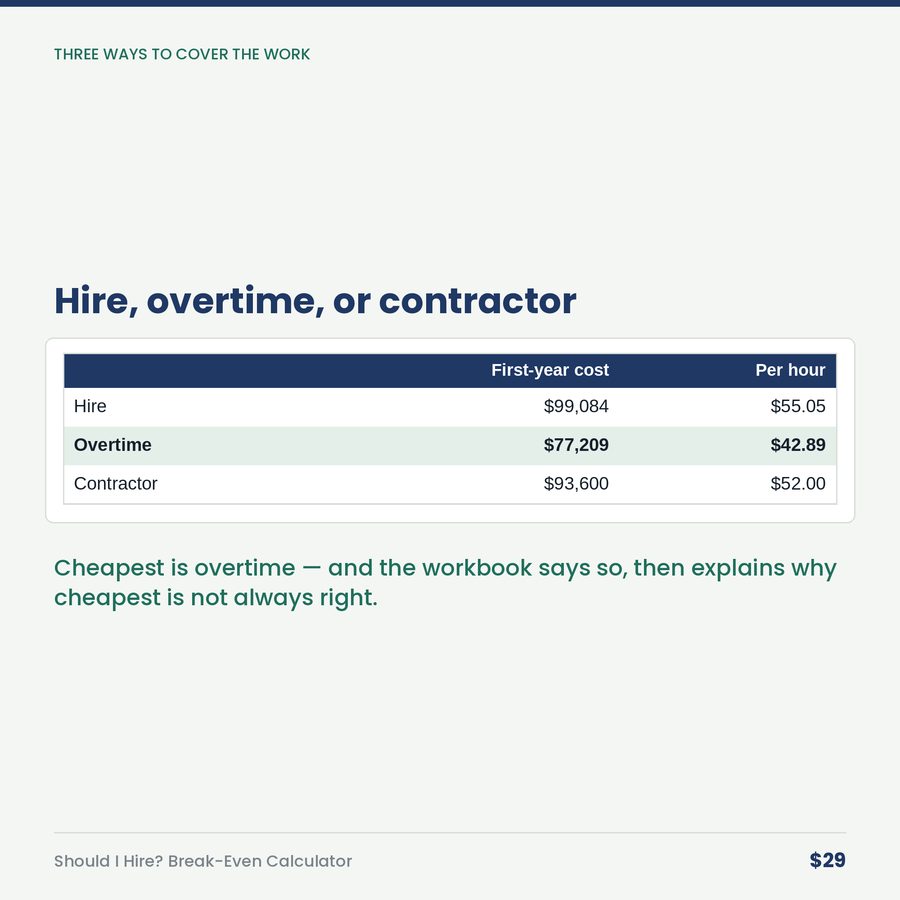
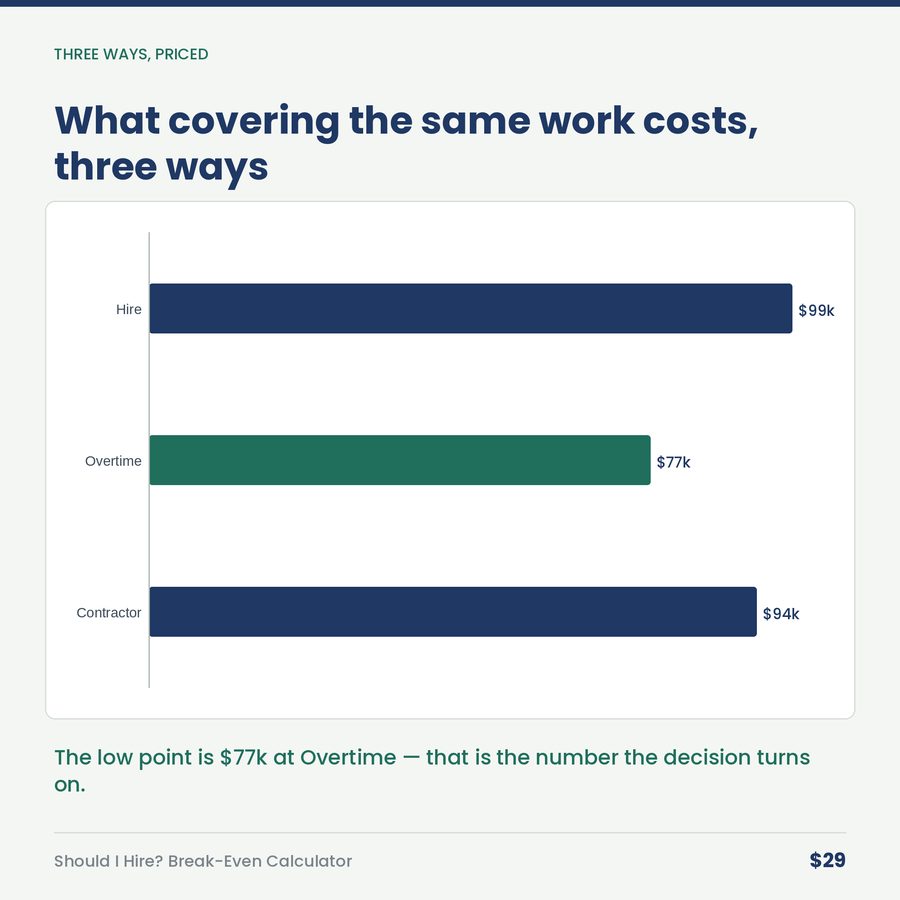
Should you hire at all? The workbook prices the same 1,800 hours of work three ways — hire, overtime, and contractor — and tells you which is cheapest.
In the example loaded in the file, overtime wins on cost: $42.89 an hour against $55.05 for the hire. The workbook says so plainly, and then tells you exactly why cheapest isn't always right: overtime burns people out, a contractor is right for uncertain or seasonal work, and a hire's real advantage usually appears in year two once the ramp is behind you.
And then the page you'll actually remember.
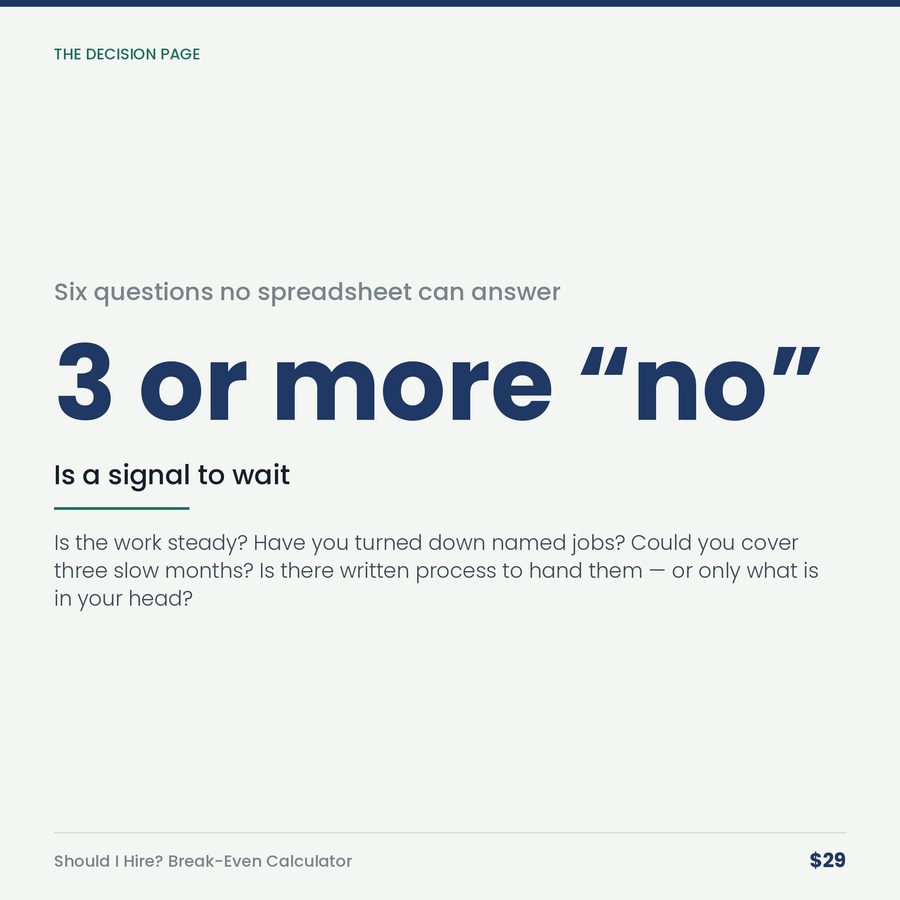
Six questions, printed on one page, that no spreadsheet can answer for you:
Is the work steady enough that you'd still need this person in eighteen months? Have you turned down real, named jobs this quarter for lack of capacity? Could you pay their first three months out of cash on hand if the work is slow? Is there written process to hand them — or only what's in your head?
Three or more "no" answers is a signal to wait.
Built for
Contractors and trades · shops and small manufacturers · agencies and consultancies · clinics and practices · restaurants and retail · any owner staring at a job they can't take and wondering whether the answer is another pair of hands.
What you get
One .xlsx file, six tabs, instant download. Excel, Google Sheets, Apple Numbers, LibreOffice. No macros, no add-ins, no subscription.
A realistic mid-skill trades hire is already loaded so you can see it working, then type over it.
A look inside
More in Hiring & Labor Costs
What Should I Pay My Salespeople? (rebuilt Sept 8, 2026)
Most comp arguments are secretly about one number — on-target earnings — when the real decision is how risk is
$34
What Turnover Is Really Costing You (rebuilt Sept 8, 2026)
When someone quits, the visible costs are a job ad and a few interviews. The invisible ones are where the mone
$32
The Bad Hire Bill: Cost Calculator, Hiring Scorecard & 90-Day Gates
A bad hire never sends an invoice — so you remember it as "a rough few months." Itemized, the sample one cost
$24