Tools · Buying & Suppliers
Inventory Reorder & Cash Calculator
Two-thirds of the money on your shelves may not be working.
$29 one-off
Buy — $29Inventory-Reorder-and-Cash-Calculator.xlsx · 4 tabs, 334 live formulas, no macros
Instant download, nothing ships. Works in Excel, no subscription. If it does not do what you needed, tell me and I will make it right.
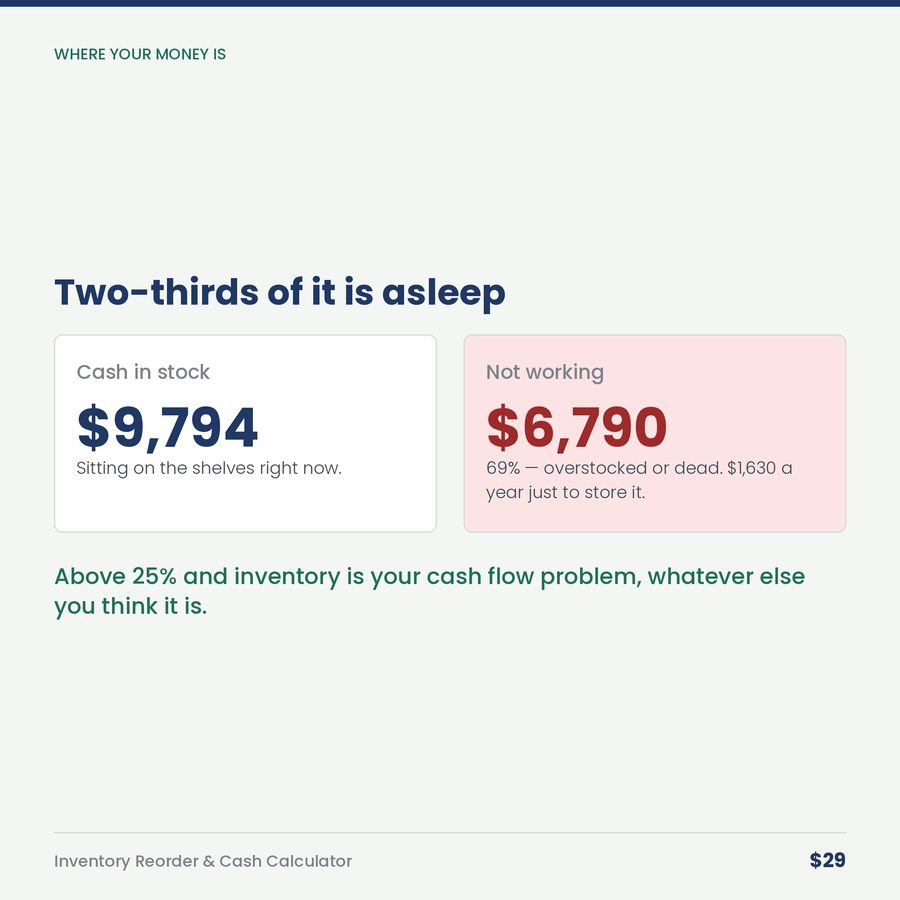
In the example loaded in this file, a small supply business has $9,794 sitting in stock. Of that, $6,790 is doing nothing — $4,760 overstocked, $2,030 dead. It costs them $1,630 a year just to keep storing it.
They didn't do anything stupid. They ordered by feel, like almost everybody does.
Too little stock and too much stock are the same money problem with opposite symptoms. Run out and you turn away sales and pay rush freight. Overbuy and your cash sits on a shelf, and some of it will never sell. Most small businesses swing between the two and never notice it's one problem.
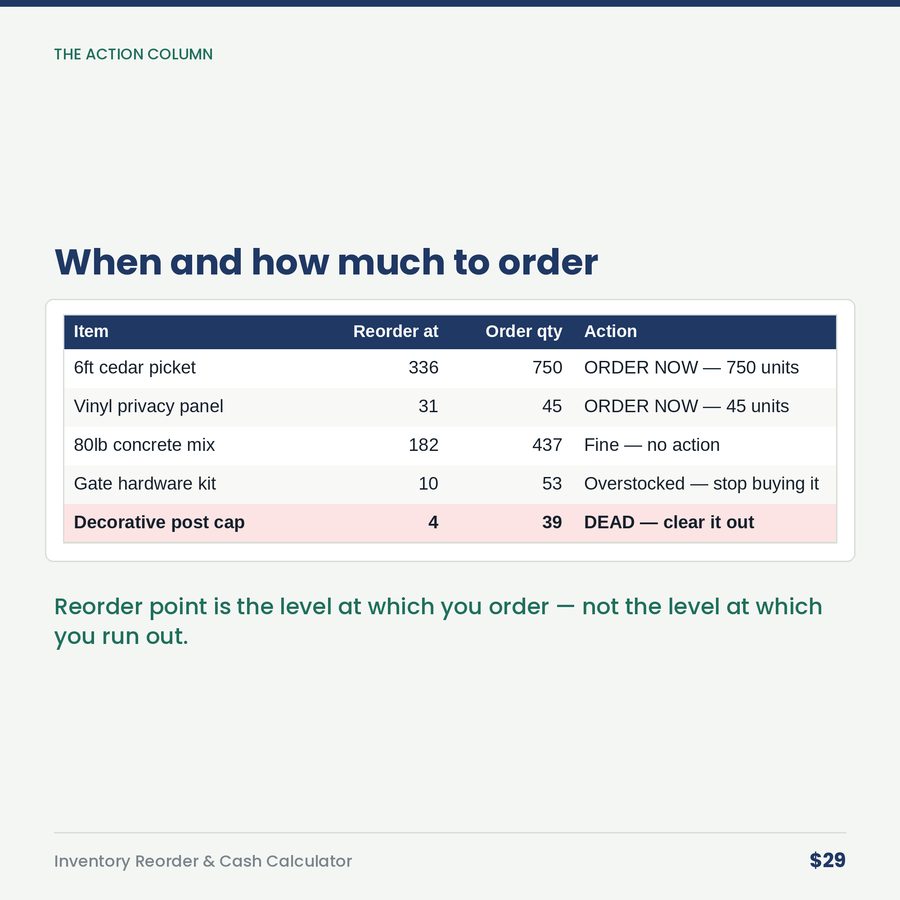
This tells you exactly when and how much to order.
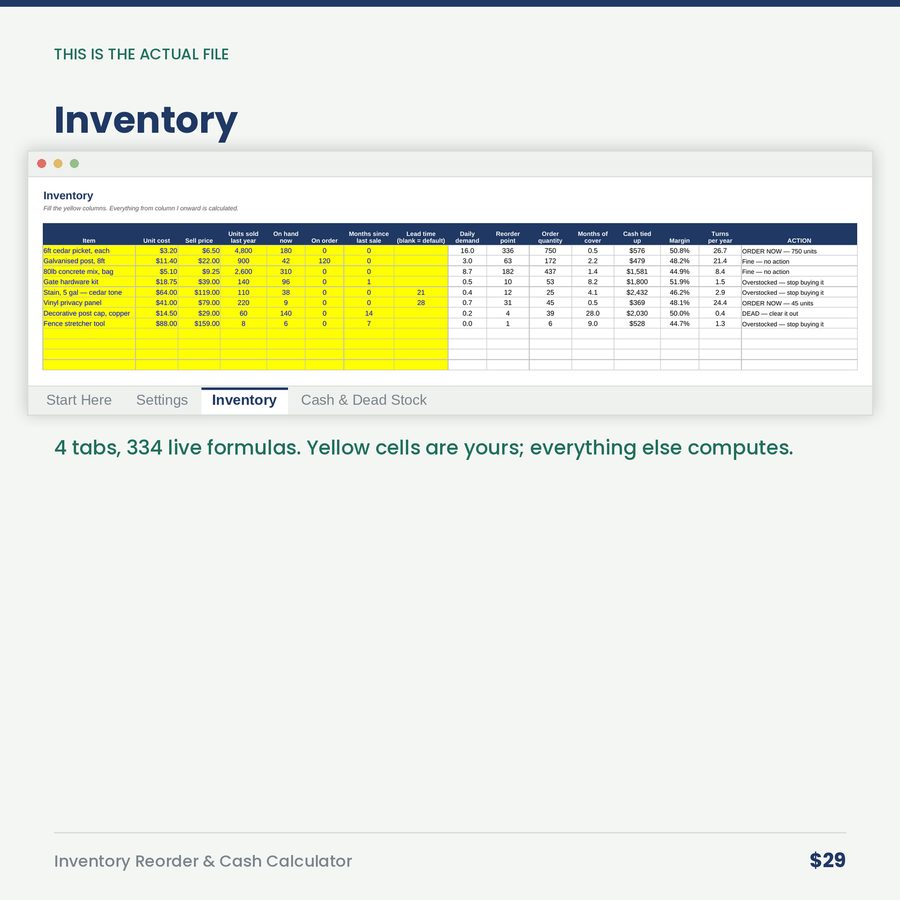
Enter each item once — cost, price, what you sold last year, what's on the shelf, what's on order. The workbook returns:
- Your reorder point — the level at which you place the order. Not when you run out. It's the demand you'll see while you wait for delivery, plus a buffer. Most owners reorder when the shelf looks empty, which is already too late by exactly one lead time.
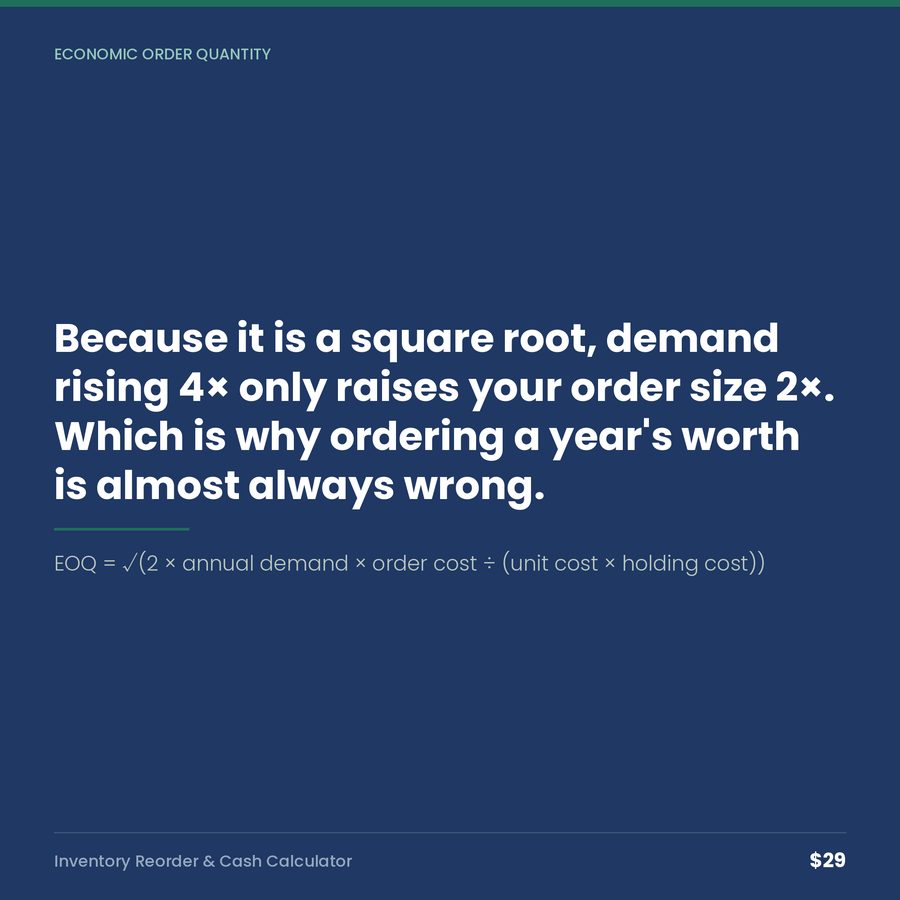
- Your order quantity — the economic order quantity, which balances the cost of ordering too often against the cost of holding too much. Because it's a square root, demand rising 4× only raises your order size 2×. That's why ordering "a year's worth" is almost always wrong.
- Months of cover, cash tied up, margin, and turns for every item
- A plain instruction: ORDER NOW — 750 units · Getting low — order within the week · Overstocked — stop buying it · DEAD — clear it out
And then it shows you the money.
Total cash in stock. What it costs you every year to hold. How much is locked in overstock, how much in dead stock, and what share of your inventory isn't working. Above 25%, inventory is your cash flow problem — whatever else you think it is.
About that holding cost
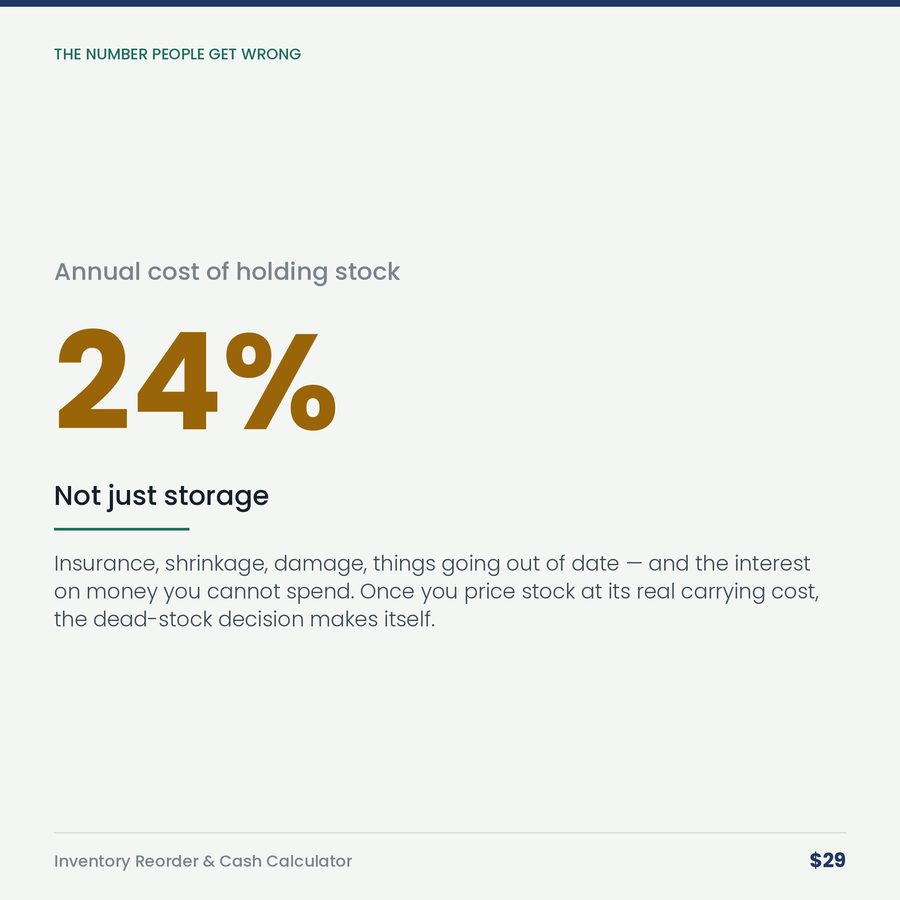
It's the number people get most wrong. It isn't just storage. It's insurance, shrinkage, damage, things going out of date — and the interest on money you can't spend. Twenty to thirty percent a year is normal, and almost every owner assumes far less. Once you price stock at its real carrying cost, the dead-stock decision makes itself.
How to clear dead stock, in order
Return it — ask the supplier even a year later, even for a restocking fee; it's the only route that returns most of your money. Bundle it with something that sells. Discount it hard, once, with an end date — a slow trickle of markdowns takes a year and teaches customers to wait. Give it to a customer who'll remember. Write it off and get it out of the building.
The hardest part isn't the arithmetic. It's admitting the money is spent. Every month you keep dead stock you pay to store your own mistake — and at a 24% holding cost that's a real ongoing charge, not a metaphor.
One honest warning
These formulas assume reasonably steady demand. If yours is genuinely seasonal — a garden center, a beach shop — run a separate copy for each season using that season's figures, or the reorder points will be wrong in both directions at the worst possible times. The workbook says so on page one.
Built for
Trade counters and supply houses · hardware, feed and farm stores · workshops holding parts · e-commerce and wholesale · salons and clinics with retail lines · anyone who buys stock before they sell it.
What you get
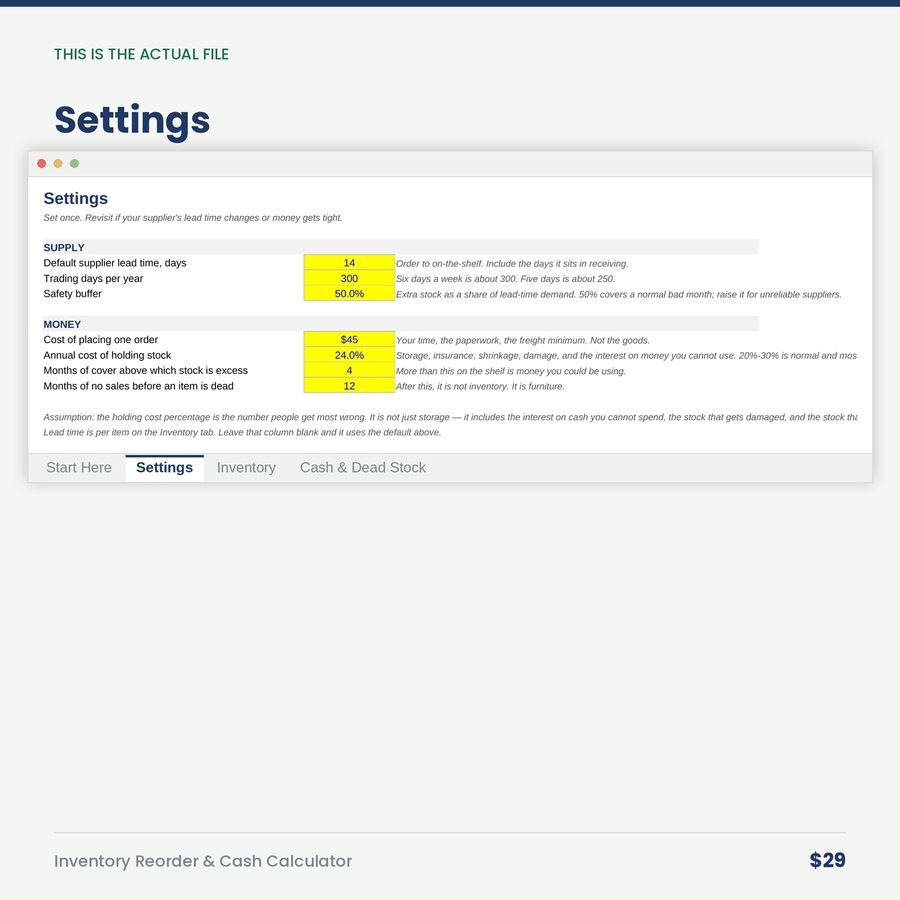
One .xlsx file, four tabs, 40 item rows, instant download. Excel, Google Sheets, Apple Numbers, LibreOffice. No macros, no add-ins, no subscription. Per-item lead times supported — leave the column blank to use your default.
Eight realistic items are already loaded so you can see it working, then type over them.
A look inside
More in Buying & Suppliers
Supplier Savings & Negotiation Toolkit
You spend your energy on sales. Meanwhile 45 cents of every dollar walks straight back out to your suppliers —
$29
The Dead Stock Finder: Inventory Cash Audit & Markdown Plan
Inventory feels like wealth and spends like a wall. Here's the audit that finds the cash asleep on your shelf
$24
The Vendor Scorecard: Supplier Comparison & Review System
Every buying decision eventually collapses into the quote — because the quote is easy to compare and everythin
$27