Tools · Buying & Suppliers
Supplier Savings & Negotiation Toolkit
You spend your energy on sales. Meanwhile 45 cents of every dollar walks straight back out to your suppliers — and most of those prices haven't been questioned since the day you started buying from them.
$29 one-off
Buy — $29Supplier-Savings-and-Negotiation-Toolkit.xlsx · 5 tabs, 142 live formulas, no macros
Instant download, nothing ships. Works in Excel, no subscription. If it does not do what you needed, tell me and I will make it right.
Here's why that matters more than it feels like it should.
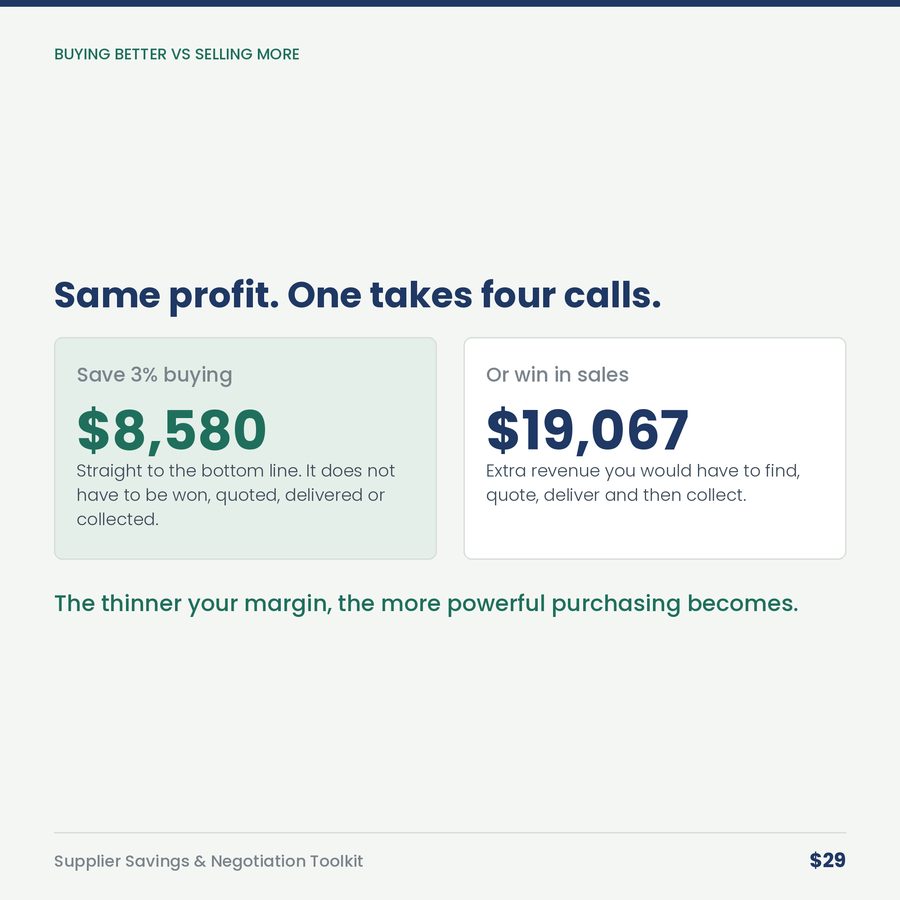
A dollar saved on purchasing is a whole dollar of profit. It doesn't have to be won, quoted, delivered or collected. It just stops leaving.
A dollar of extra revenue is worth only your margin on it — and it costs you time, capacity and effort to get.
In the example loaded in this file:
> ### A 3% saving on purchasing = $8,580 > ### The same profit as $19,067 of extra sales
Four phone calls, against a quarter of selling — using capacity you may not even have.
And the thinner your margin, the stronger this gets. At a 30% gross margin the same saving needs half as much again in extra sales to match it. If your margins are thin, you should be buying better before you sell harder.
Score your suppliers properly
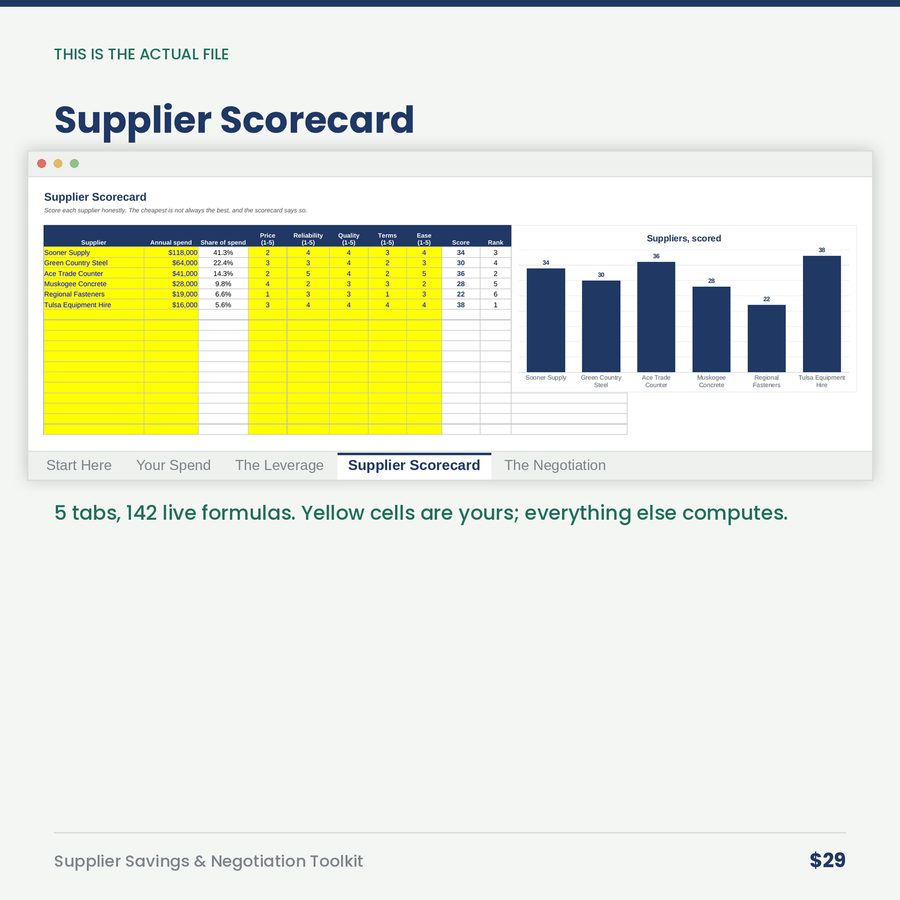
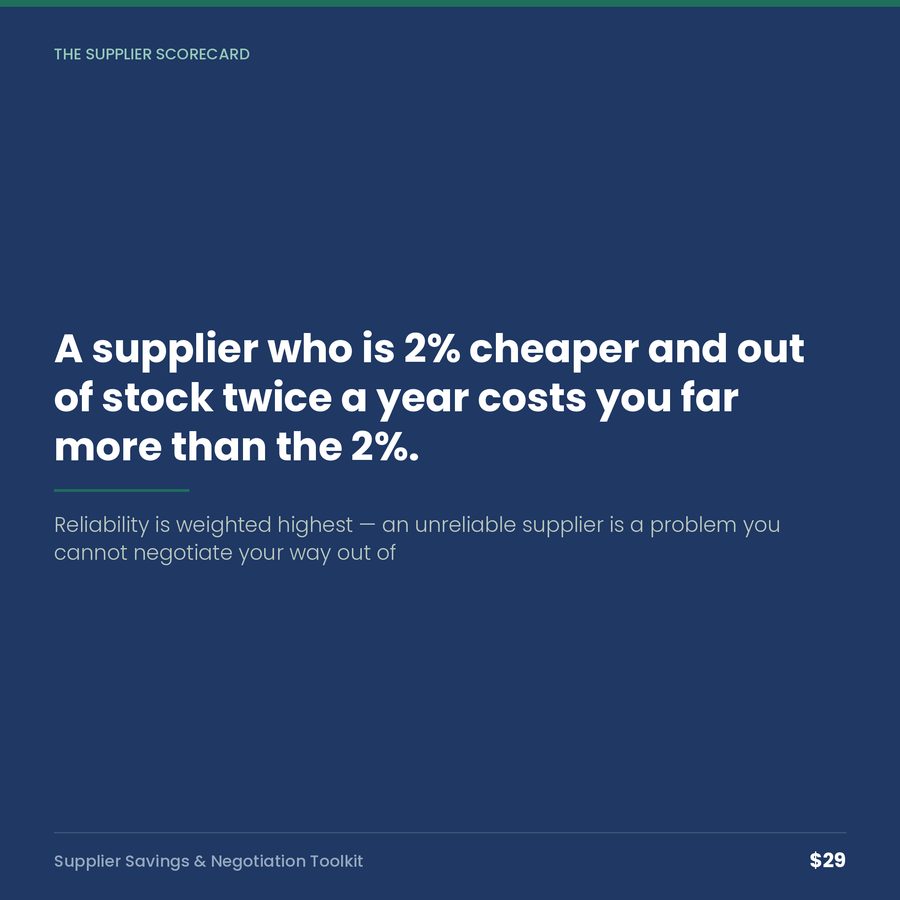
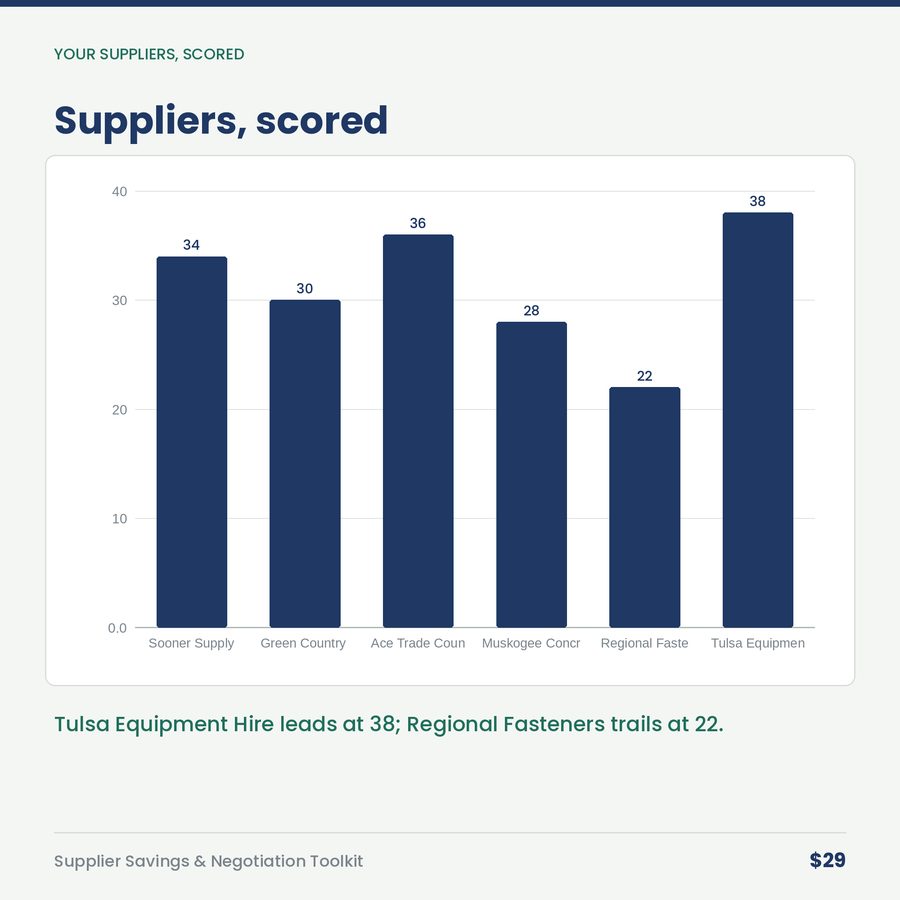
Price, reliability, quality, terms and ease of dealing — with reliability weighted highest, because a supplier who's 2% cheaper and out of stock twice a year costs you far more than the 2%, in delayed jobs, wasted trips, and customers told a date you then missed.
Every supplier gets an action: negotiate first · get two quotes · fix the reliability or replace them · keep and protect · review annually.
And the sequencing that saves you a year of wasted effort: start with the biggest spend, not the worst supplier. Three percent off your largest account beats twenty percent off your smallest — and it's usually an easier conversation, because you matter to them.
Then ask for things in the right order
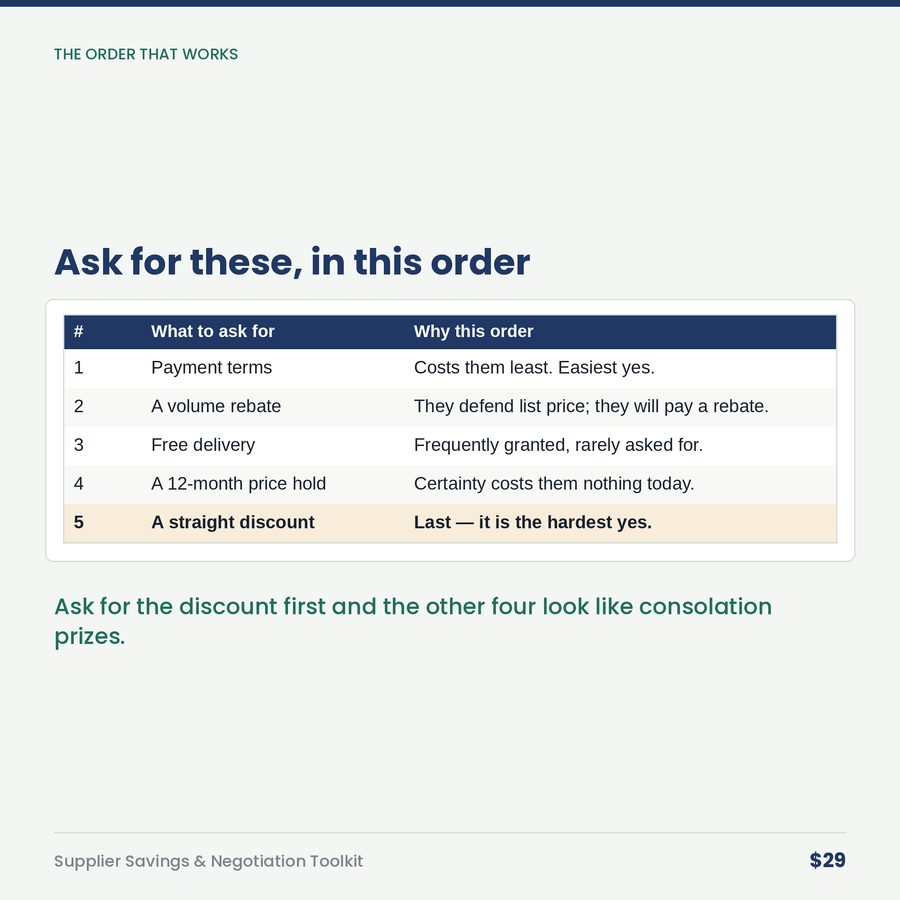
Most owners open with "can you do better on price?" — the hardest possible yes. Here's the order that actually works:
1. Payment terms. Costs them least, easiest to grant, and 21 days to 45 is real money to you. 2. A volume rebate, not a lower list price. Suppliers defend list prices fiercely and will often pay a rebate instead. Same money to you. 3. Free or discounted delivery. Frequently granted, rarely asked for. 4. A twelve-month price hold. Certainty is worth real money in a rising market, and costs them nothing today. 5. A straight discount — last. Because it's the hardest yes, and asking first makes the other four look like consolation prizes.
What you can trade — paying faster, consolidating spend, forecasting your needs, and one nobody thinks of: being easy to deal with. Clean orders, one contact, no chasing. Suppliers quietly price awkward customers higher and nobody ever tells them.
And exactly what to say: "We've grown and I'm reviewing all our supply arrangements this quarter. You're one of our largest and I'd rather keep it that way. What can you do on terms and on price for the volume we're doing?"
Then stop talking. The first number is theirs to say.
What not to do: never open with a threat to leave — it works once, damages the relationship permanently, and you may need them in two weeks. Never bluff about a competitor's quote. Never accept a volume commitment you can't comfortably meet — a discount that makes you buy more than you need is a cost pretending to be a saving.
And the thing worth knowing before you pick up the phone
Most suppliers expect to be asked, have a discretionary band they can move within, and are mildly surprised how rarely small customers use it.
The worst outcome of asking politely, once a year, is that nothing changes.
Built for
Contractors and trades · workshops and manufacturers · retail and hospitality · anyone who buys materials, stock or subcontracted work — which is most businesses, and almost none of them negotiate.
What you get
One .xlsx file, five tabs, 25 supplier rows, instant download. Excel, Google Sheets, Apple Numbers, LibreOffice. No macros, no add-ins, no subscription.
Six realistic suppliers are already scored as a worked example. Type over them.
A look inside
More in Buying & Suppliers
The Dead Stock Finder: Inventory Cash Audit & Markdown Plan
Inventory feels like wealth and spends like a wall. Here's the audit that finds the cash asleep on your shelf
$24
The Vendor Scorecard: Supplier Comparison & Review System
Every buying decision eventually collapses into the quote — because the quote is easy to compare and everythin
$27