Tools · Operations & SOPs
The One-Page Plan & Operating Rhythm
You wrote a business plan once. Twenty pages, one weekend. When did you last open it?
$26 one-off
Buy — $26The-One-Page-Plan-and-Operating-Rhythm.docx · 9 pages, editable Word) + print-ready PDF
Instant download, nothing ships. Works in Excel, no subscription. If it does not do what you needed, tell me and I will make it right.
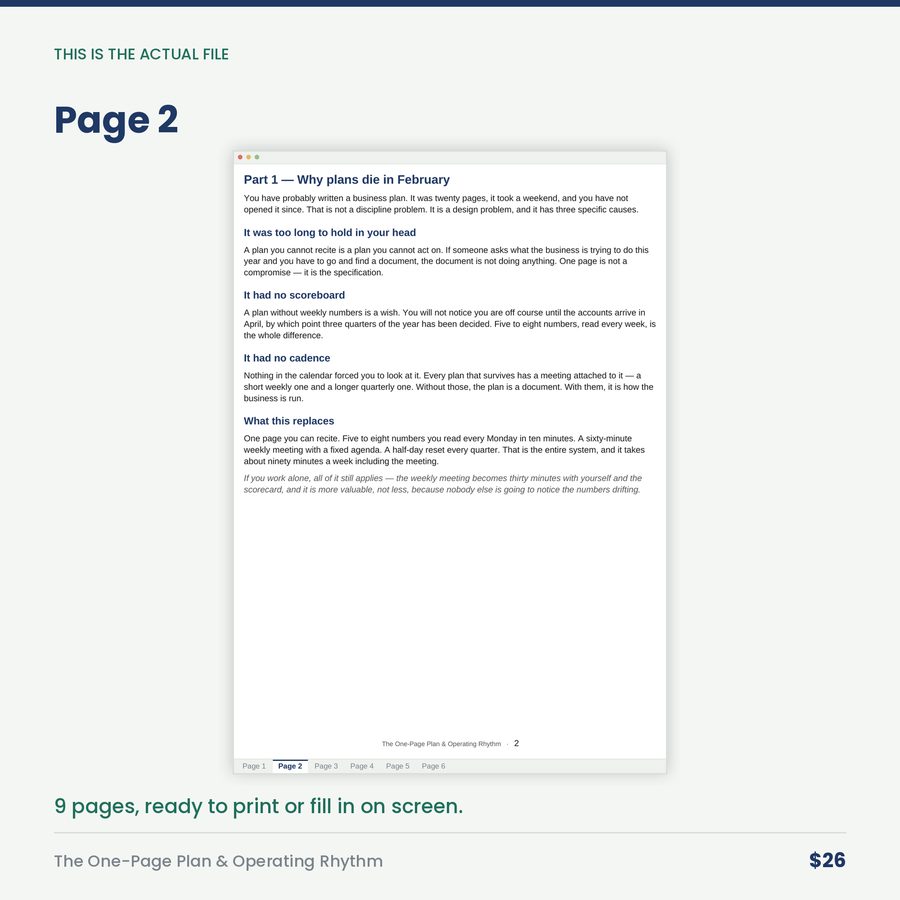
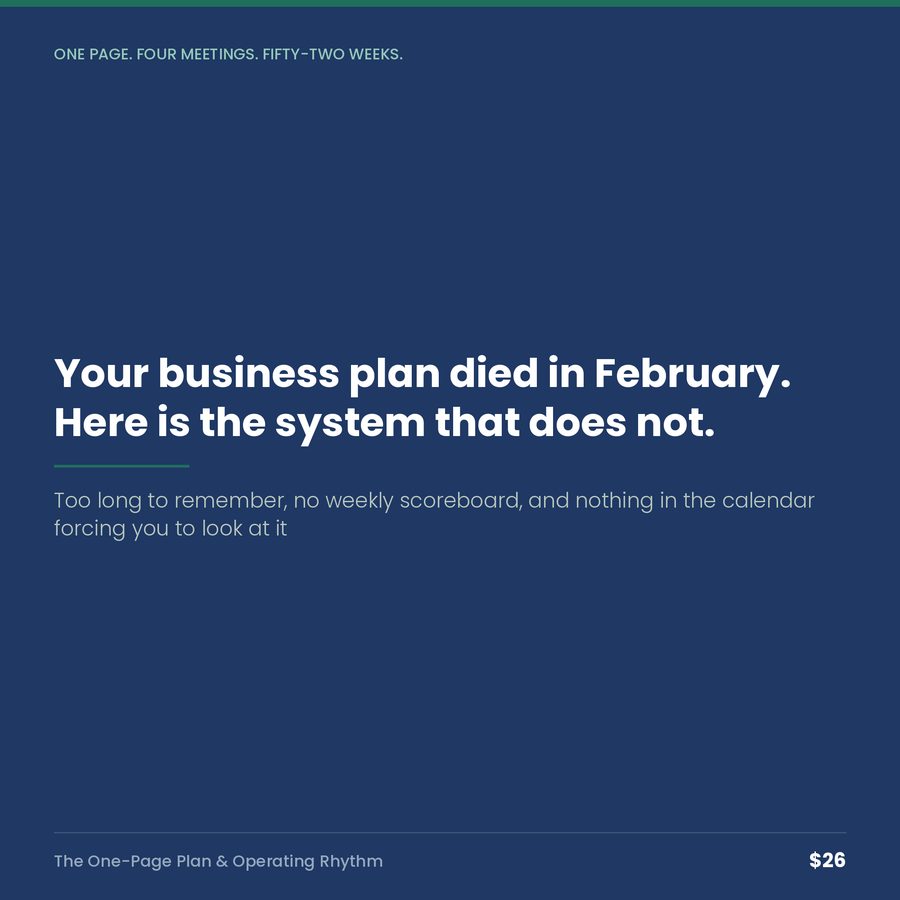
That's not a discipline problem. It's a design problem, and it has three specific causes.
It was too long to hold in your head. A plan you can't recite is a plan you can't act on. If someone asks what the business is trying to do this year and you have to go and find a document, the document isn't doing anything.
It had no scoreboard. A plan without weekly numbers is a wish. You won't notice you're off course until the accounts arrive in April — by which point three quarters of the year has already been decided.
It had no cadence. Nothing in the calendar forced you to look at it.
Here's what replaces it.
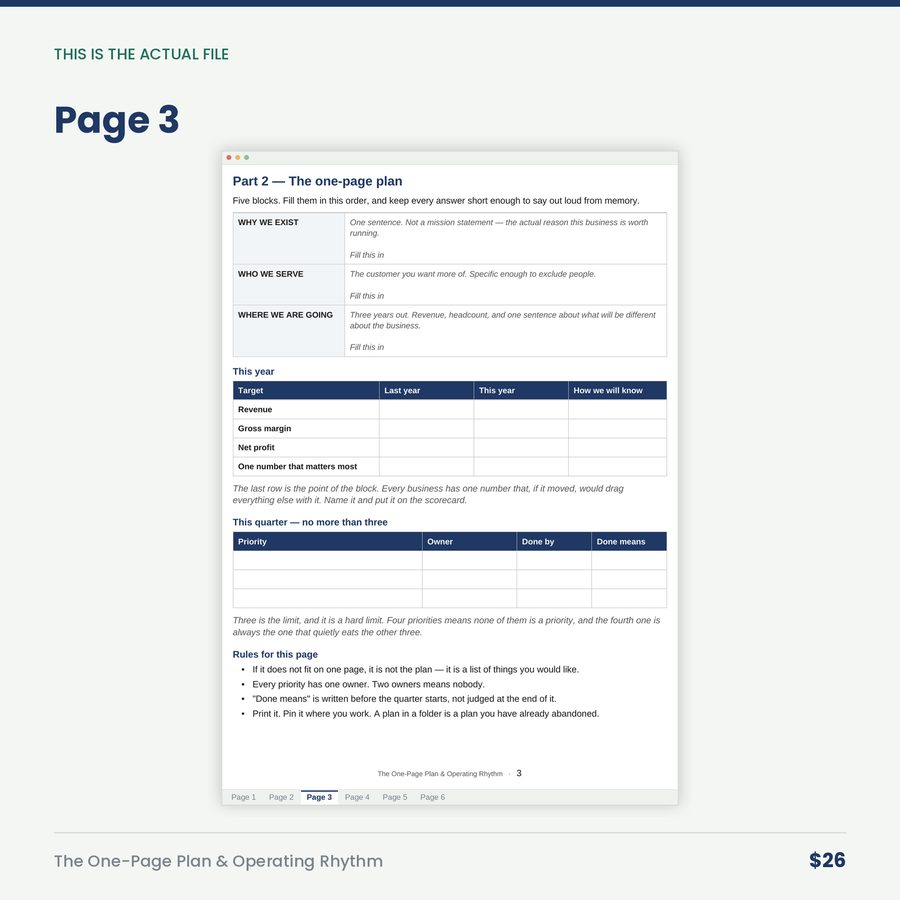
One page. Why we exist. Who we serve. Where we're going in three years. This year's four targets — including the one number that matters most, the one that if it moved would drag everything else with it. And no more than three priorities for this quarter, each with one owner, one date, and "done means" written before the quarter starts.
Three is a hard limit. Four priorities means none of them is a priority, and the fourth one is always the one that quietly eats the other three.
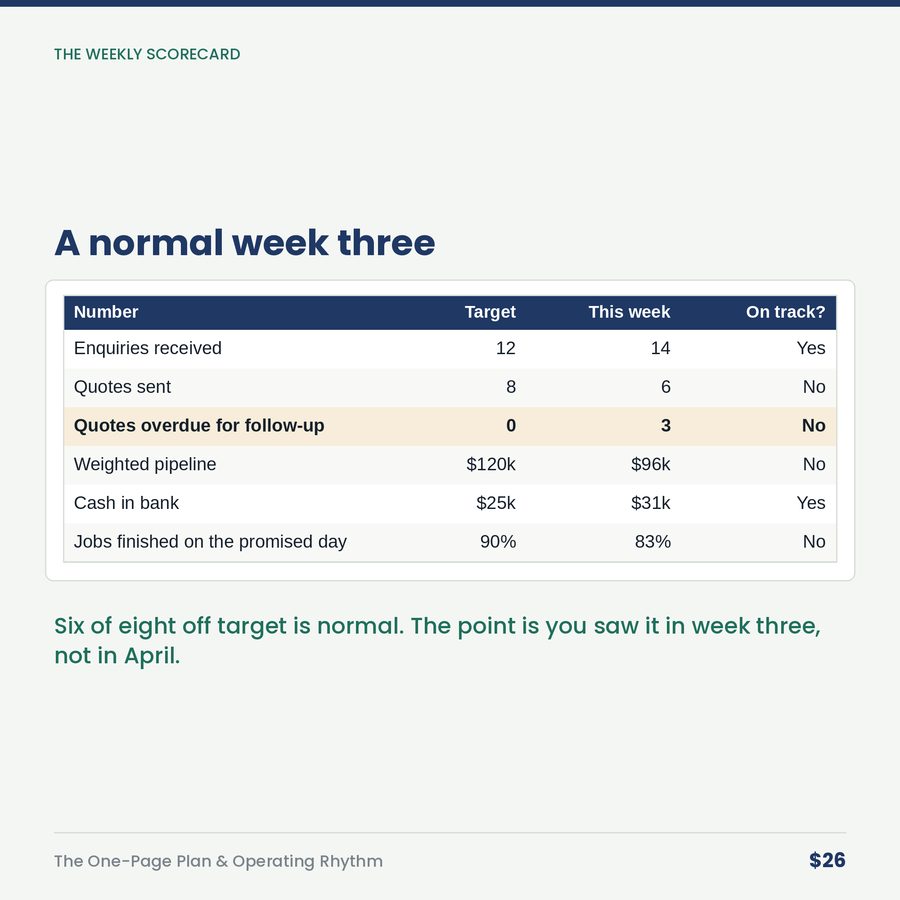
A weekly scorecard. Five to eight numbers, same day every week, ten minutes. At least two that predict revenue rather than report it. At least one about cash, because cash is what stops businesses. At least one about promises kept.
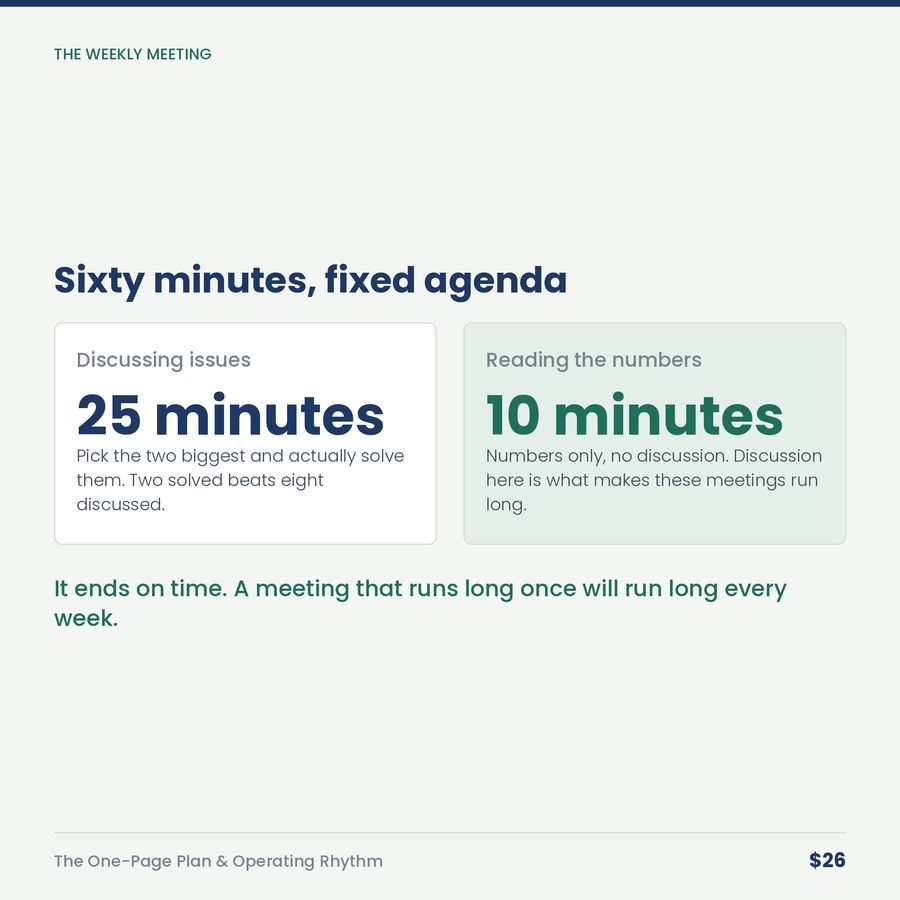
A sixty-minute weekly meeting with a minute-by-minute agenda — and the reason each block is there. Five minutes of good news, ten minutes reading the numbers with no discussion, twenty-five minutes solving the two biggest issues rather than discussing eight, five minutes assigning actions with a name and a date.
A half-day quarterly reset with five questions, including the two most owners never ask: what are we doing that we should stop? and if I were away for a month starting Monday, what would break first?
And a completely filled-in example, so you can see how specific to be. A fencing contractor whose one number that matters most is quote follow-up rate — 38% today, 70% target — because the business was losing quotes to silence, not to price. Every other target on his page is downstream of that one.
His scorecard shows six of eight numbers off target. That's a normal week-three scorecard, and the document says so. The point isn't that everything is green. It's that he could see it in week three instead of in April.
And then the part nobody else includes: what to do when you fall off.
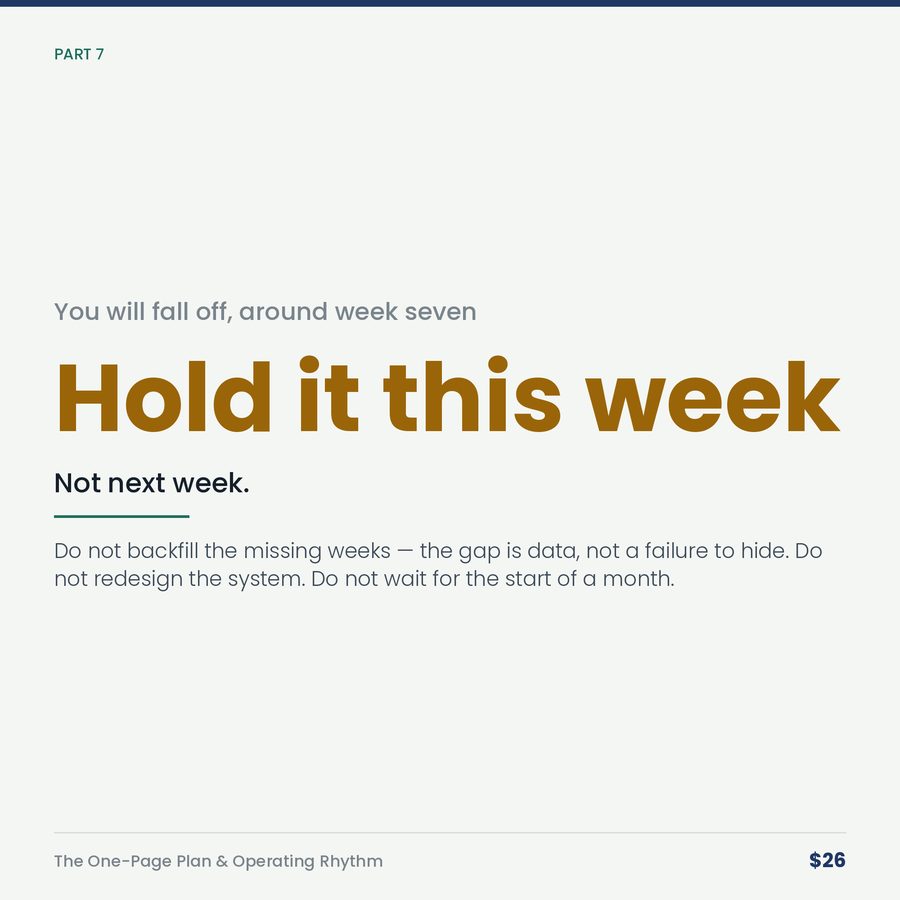
You will. Almost everyone does, around week seven, after a genuinely busy two weeks eats the meeting twice in a row.
Don't backfill the missing weeks — the gap is data, not a failure to hide. Don't redesign the system; the system isn't why you stopped. Don't wait for the start of a month, which is just a longer gap with a better excuse.
Hold the meeting this week. Collect the numbers you can get in five minutes. Cut the scorecard to five if eight was too many. It probably was.
Works if you're on your own, too. The weekly meeting becomes thirty minutes with yourself and the scorecard — and it matters more, not less, because nobody else is going to notice the numbers drifting.
Built for
Owner-operators with two to twenty people · contractors and trades · agencies and consultancies · shops and practices · anyone who is busy every week and can't say what changed this quarter.
What you get
Nine pages, US Letter. Editable Microsoft Word (.docx) so you can print the one-page plan and the scorecard every quarter with your own name on them, plus a print-ready PDF. Word, Google Docs, Pages, LibreOffice. Instant download.
A look inside
More in Operations & SOPs
The 20-Minute SOP System
You are the only person who knows how it's done. That's not a strength — it's a ceiling.
$24
What Rework Is Really Costing You (rebuilt Sept 8, 2026)
Rework never appears on a payroll report — but the sample shop pays it like a wage: $45,552 a year.
$34
If I'm Not Here Tomorrow: The Owner's Continuity File
Your business runs on things that live only in your head. This file is where they go instead.
$24