Tools · Operations & SOPs
The 20-Minute SOP System
You are the only person who knows how it's done. That's not a strength — it's a ceiling.
$24 one-off
Buy — $24The-20-Minute-SOP-System.docx · 10 pages, editable Word) + `The-20-Minute-SOP-System.pdf` (print-ready
Instant download, nothing ships. Works in Excel, no subscription. If it does not do what you needed, tell me and I will make it right.
You can't take a week off. A new hire takes three months to get useful instead of three weeks. And if you ever sell, a buyer is paying for a job with overheads, not a business.
You already know the answer is to write things down. You have probably tried. Most owners have: bought a template, wrote three procedures over a long weekend, put them in a folder, never opened them again.
That failure has three specific causes, and none of them is laziness.
They were written for an auditor instead of a worker. They were written from memory at a desk instead of while doing the job. And they were too big to ever finish — because "document the business" is not a task anyone completes.
This fixes all three.
Part 1 — The method. Narrate the job into your phone while you do it. Not from memory. You don't actually know how you do the job; you know how you think you do it, and the steps that have become invisible to you are precisely the ones a new person will get wrong. Six steps, twenty minutes, one usable procedure the first time.
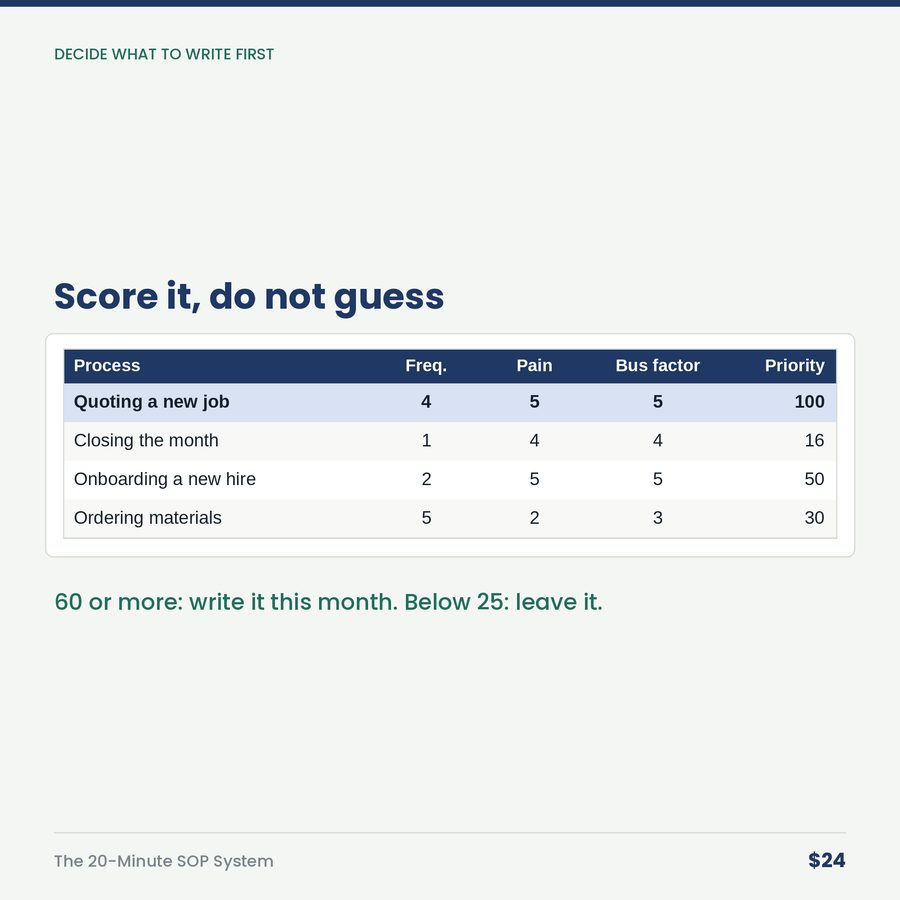
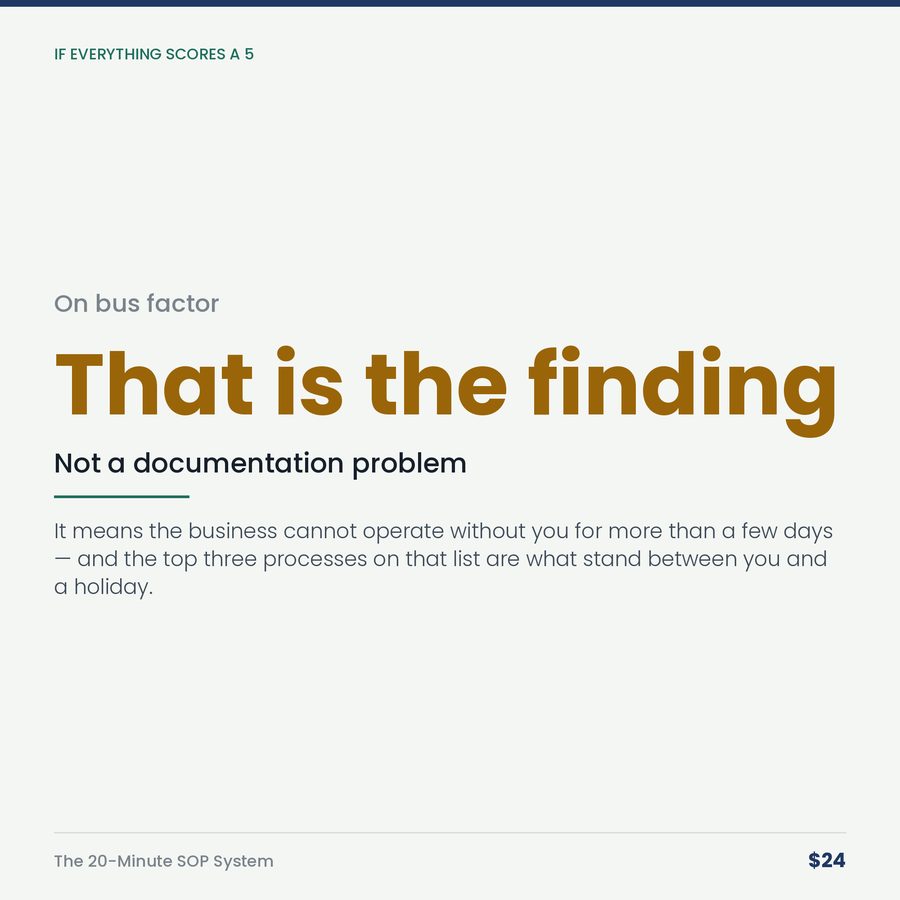
Part 2 — What to write first. A scoring matrix: frequency × pain × bus factor. Score your processes, write the highest one. It stops the two things that kill every documentation effort — trying to write everything, and writing the easy ones first.
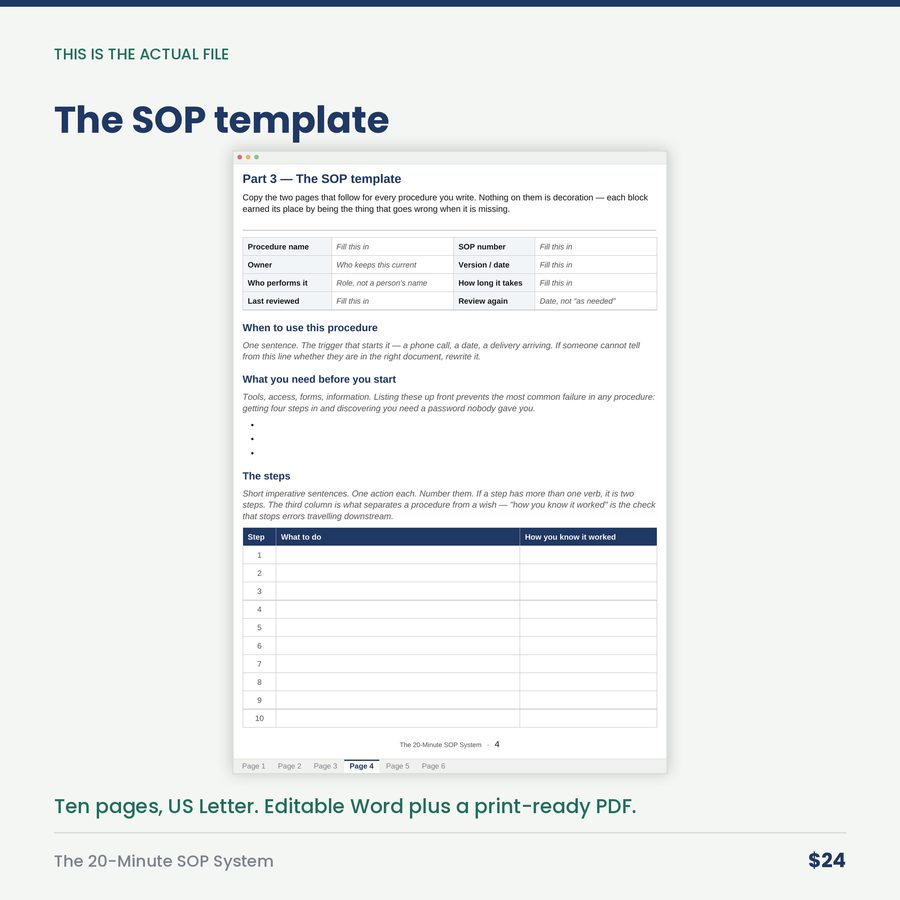
Part 3 — The template. Two pages, with a header block, a step table that includes a "how you know it worked" column, decision points pulled out where people can see them, escalation rules, and a Common Mistakes section — the most useful block in any real SOP and the one almost every template on the market leaves out.
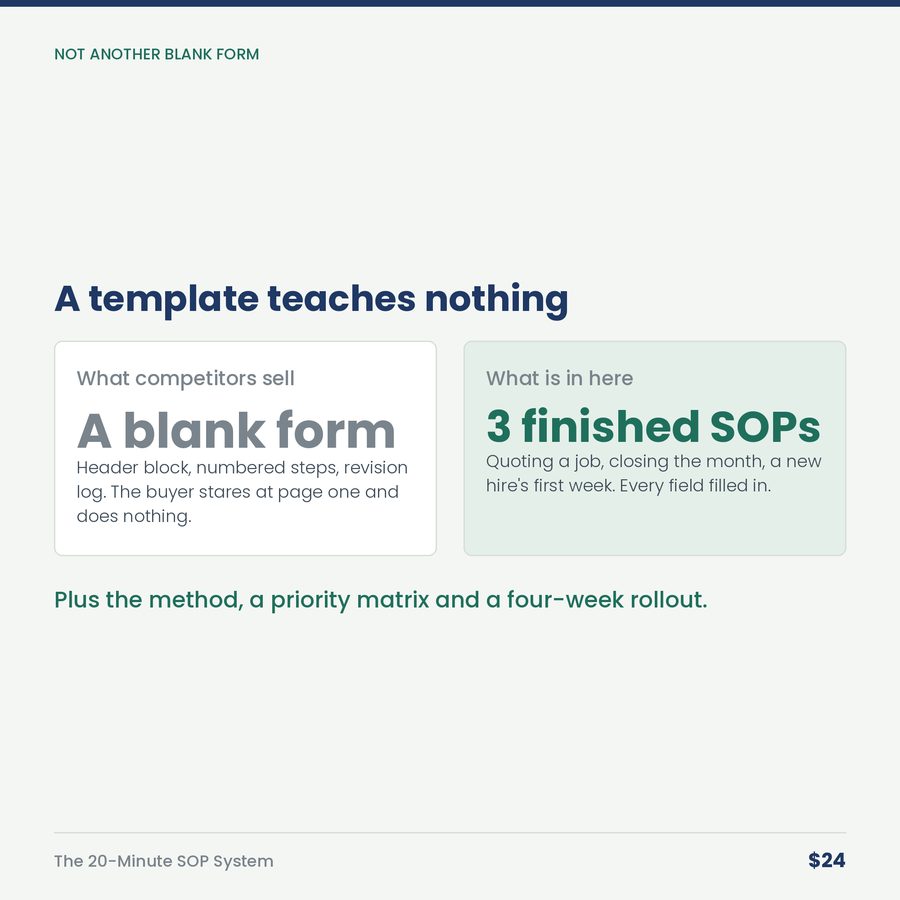
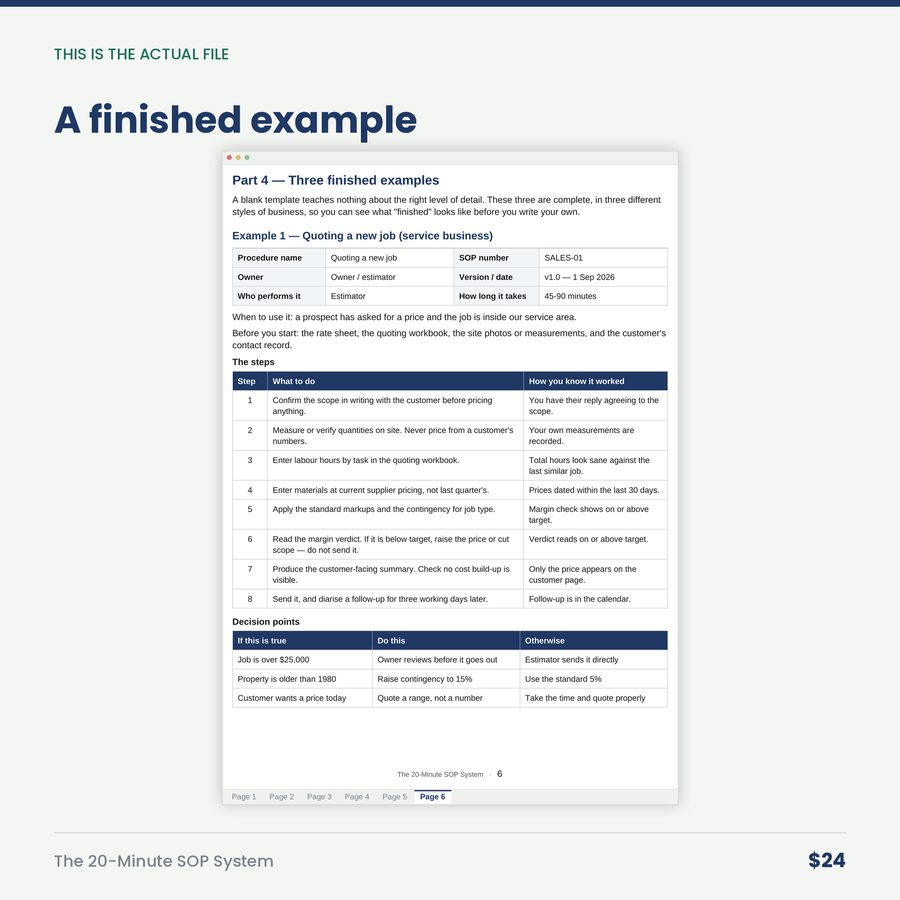
Part 4 — Three complete, finished examples. Quoting a new job. Closing the month. A new employee's first week. Every field filled in, in three different styles of business, so you can see what "done" looks like before you write your own. A blank template teaches you nothing about how much detail is enough.
Part 5 — A four-week rollout that ends with four working procedures and a habit — not forty procedures and a folder nobody opens.
Part 6 — How to keep them from going stale, including a thirty-minute quarterly review built around one question: if that person left tomorrow, what would break first? Answer it honestly every quarter and the answer gets smaller each time.
Built for
Owner-operators with two to twenty people · contractors and trades · agencies and consultancies · clinics and practices · shops and restaurants · anyone about to hire, about to take a holiday, or about to find out how much of the business lives in one head.
What you get
Ten pages, US Letter — and nothing padding them out. Editable Microsoft Word (.docx) so you can put your own name and logo on it and copy the template for every procedure you write, plus a print-ready PDF. Opens in Word, Google Docs, Pages, and LibreOffice. Instant download.
A look inside

More in Operations & SOPs
The One-Page Plan & Operating Rhythm
You wrote a business plan once. Twenty pages, one weekend. When did you last open it?
$26
What Rework Is Really Costing You (rebuilt Sept 8, 2026)
Rework never appears on a payroll report — but the sample shop pays it like a wage: $45,552 a year.
$34
If I'm Not Here Tomorrow: The Owner's Continuity File
Your business runs on things that live only in your head. This file is where they go instead.
$24