Tools · Hiring & Labor Costs
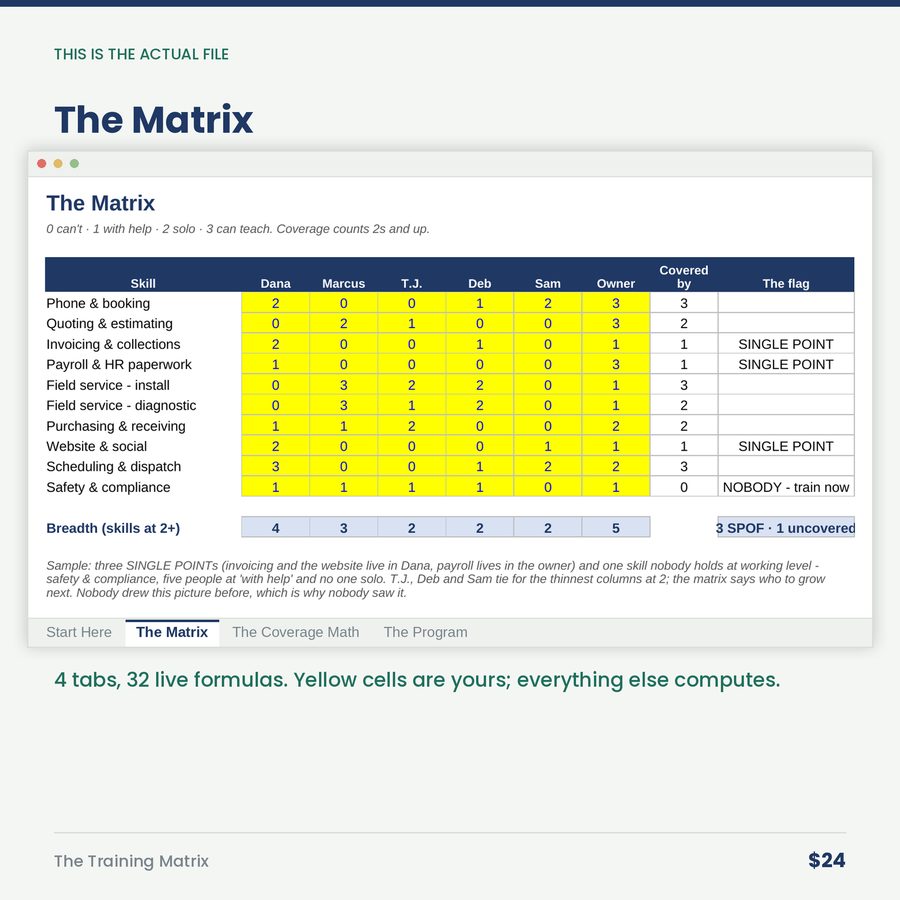
The Training Matrix: Who Can Do What, and Where One Absence Stops the Shop
Invoicing lives in Dana. Payroll lives in you. Nobody drew the picture — so nobody sees it until the two-weeks notice.
$24 one-off
Buy — $24The-Training-Matrix.xlsx · 4 tabs, 32 live formulas, no macros
Instant download, nothing ships. Works in Excel, no subscription. If it does not do what you needed, tell me and I will make it right.
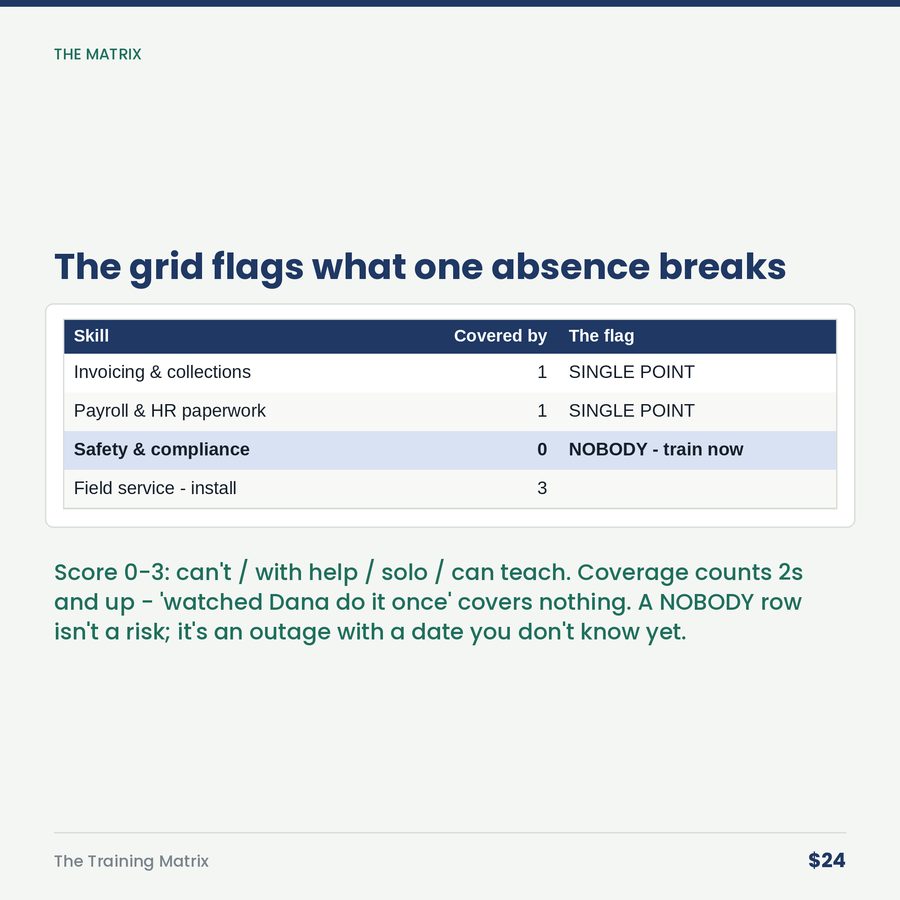
Score every skill and every person 0–3 (can't / with help / solo / can teach). Coverage counts the 2s and up — "watched Dana do it once" covers nothing. The grid flags what one absence breaks: the sample finds three SINGLE POINTs and one skill nobody runs at working level.
How it works
- The Matrix — 10 skills × your people. SINGLE POINT and NOBODY flags compute themselves; the breadth row shows whose column is thinnest and who carries the shop
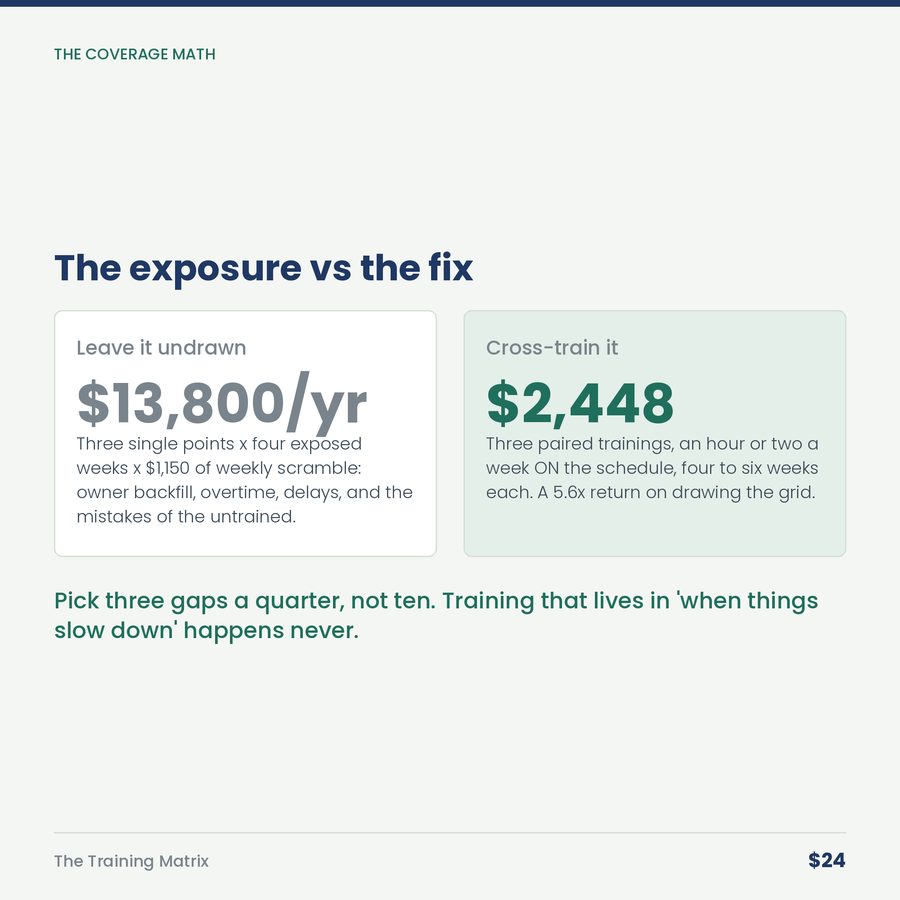
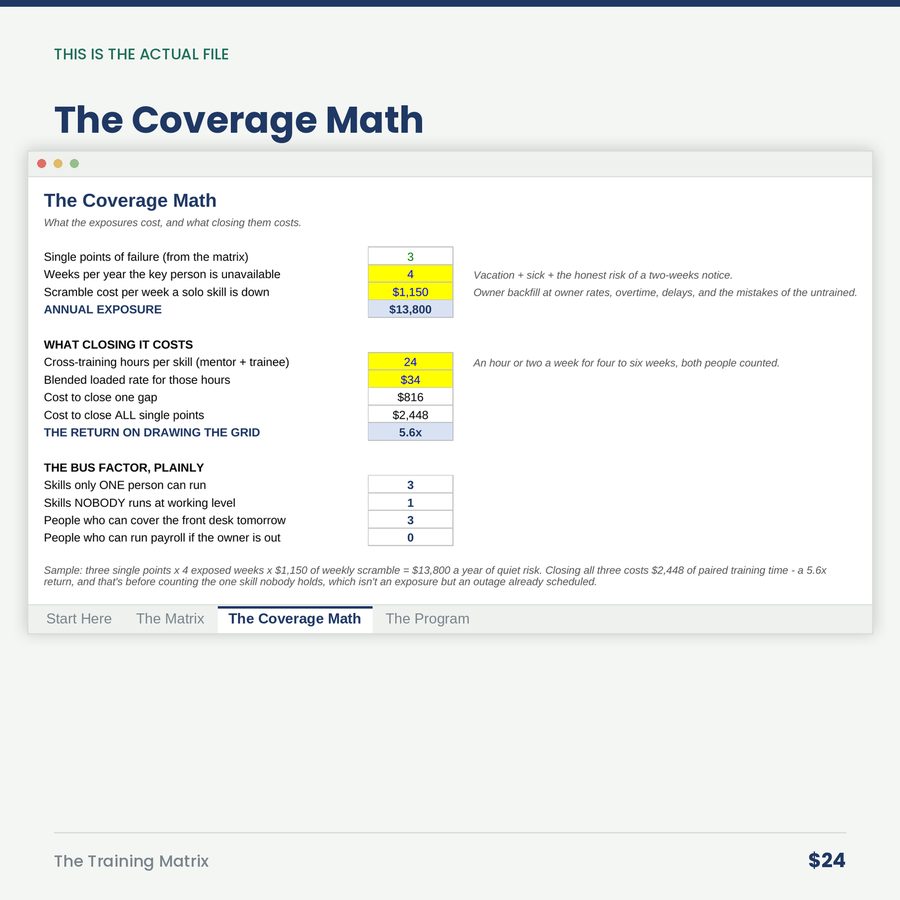
- The Coverage Math — three exposures × four exposed weeks × $1,150 of weekly scramble = $13,800 a year of quiet risk, against $2,448 of paired training: a 5.6× return on drawing the grid
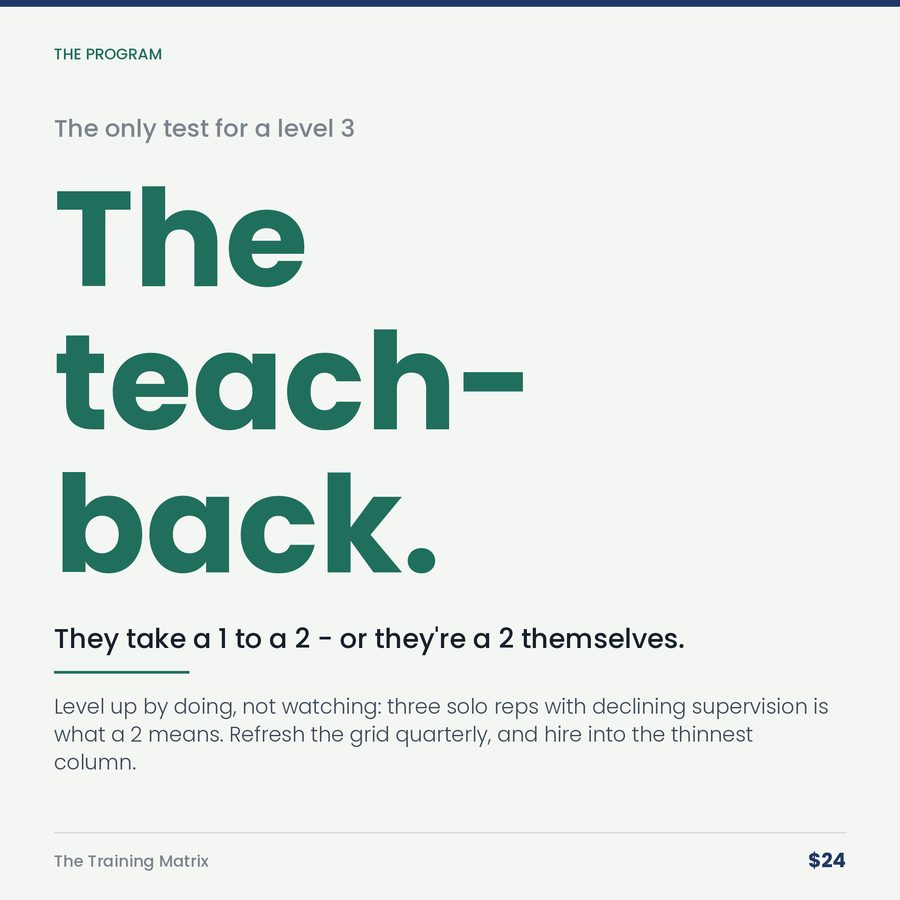
- The Program — pick three gaps a quarter; pair mentor and trainee ON the schedule; level up by doing (three solo reps with declining supervision); the teach-back test; NOBODY rows jump the queue — they're outages with a date you don't know yet; refresh quarterly, hire by column
Built for
Any team small enough that skills live in people instead of departments: shops · restaurants · offices · crews · practices. Also the fairest raise conversation in the building — breadth is visible, and so is who carries it.
What you get
One .xlsx file, four tabs, instant download. Excel, Google Sheets, Apple Numbers, LibreOffice. No macros, no subscription. Skills, people, levels and rates all yours.
A look inside
More in Hiring & Labor Costs
Should I Hire? Break-Even Calculator
"I think I need to hire someone." That sentence has ended more small businesses than any recession.
$29
What Should I Pay My Salespeople? (rebuilt Sept 8, 2026)
Most comp arguments are secretly about one number — on-target earnings — when the real decision is how risk is
$34
What Turnover Is Really Costing You (rebuilt Sept 8, 2026)
When someone quits, the visible costs are a job ad and a few interviews. The invisible ones are where the mone
$32