Tools · Big Money Decisions
What Is My Business Worth?
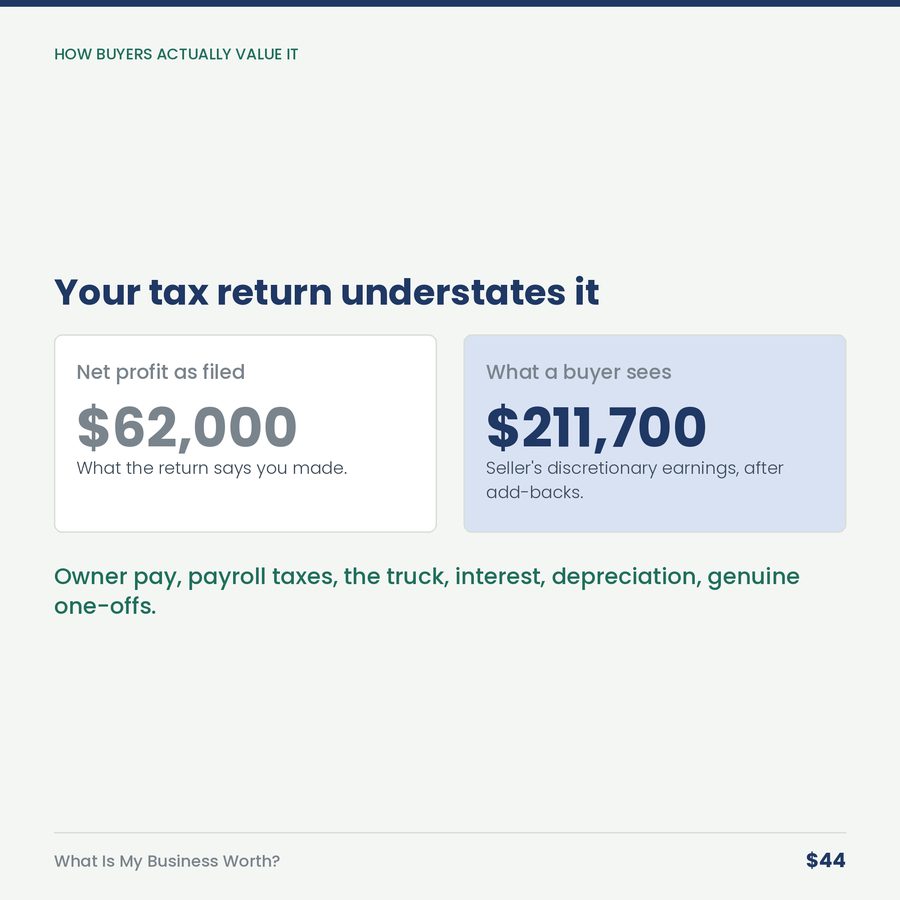
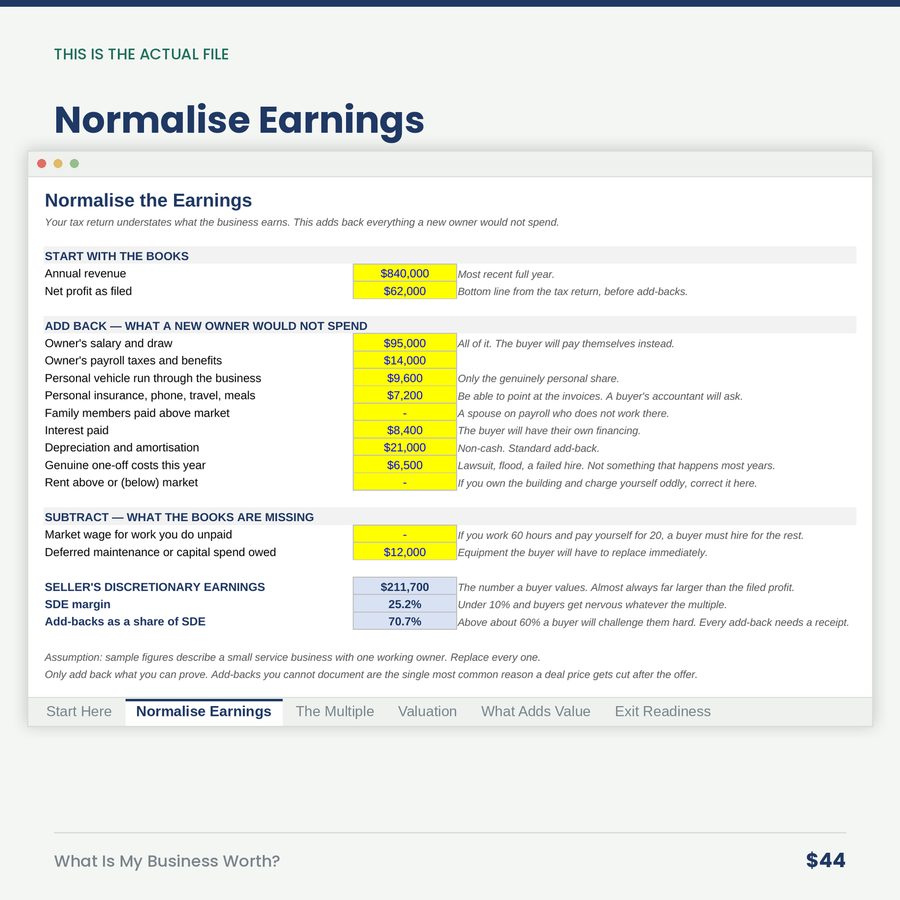
Your tax return says you made $62,000. A buyer would say you made $211,700.
$44 one-off
Buy — $44What-Is-My-Business-Worth.xlsx · 6 tabs, 69 live formulas, no macros
Instant download, nothing ships. Works in Excel, no subscription. If it does not do what you needed, tell me and I will make it right.
Both are true. They're answering different questions.
Small businesses aren't valued on filed profit. They're valued on seller's discretionary earnings — the total financial benefit the business delivers to one working owner. That means adding back your salary and draw, your payroll taxes, the truck the business pays for, the phone, the interest, the depreciation, and any genuine one-off costs — then subtracting what the books quietly leave out, like the hours you work unpaid and the equipment a buyer will have to replace on day one.
In the example loaded in this file, that turns $62,000 into $211,700.
Then a buyer applies a multiple. And the multiple is about risk, not industry.
Seven factors, weighted the way buyers actually weigh them:
Revenue stability · growth trend · customer concentration · owner dependence · recurring revenue · documented processes · quality of the books.
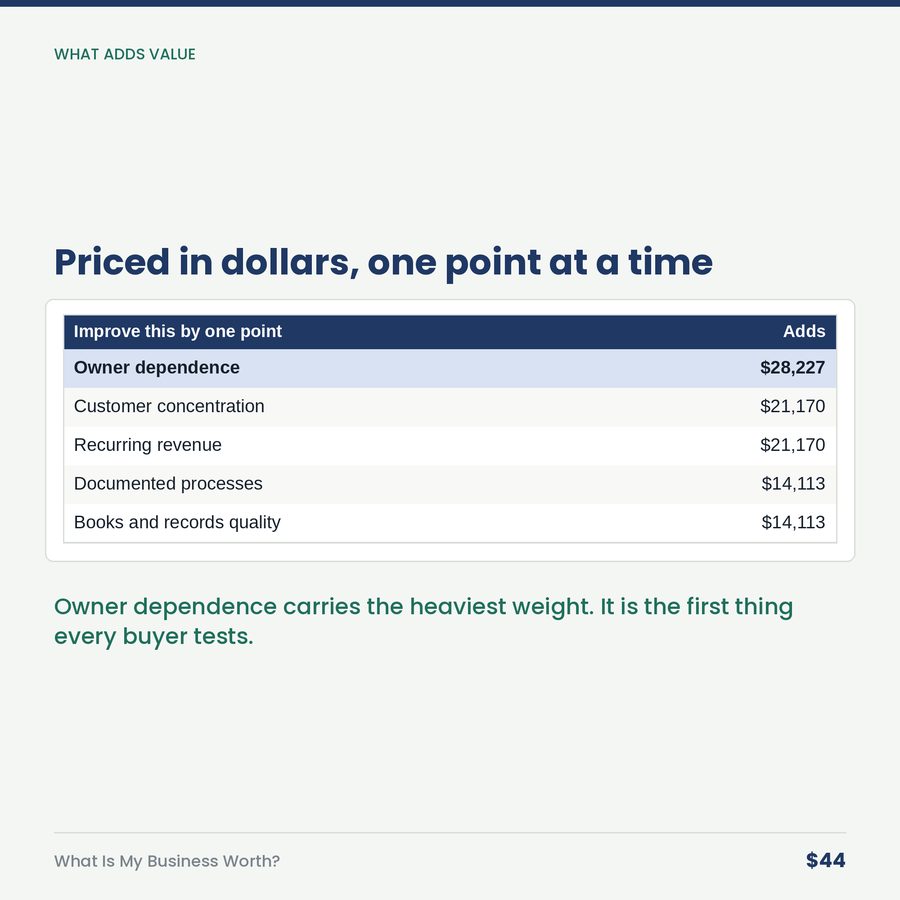
Owner dependence carries the most weight, because it's the first thing every buyer tests and the largest discount applied to businesses this size. A business that can't run without you is a job you're trying to sell.
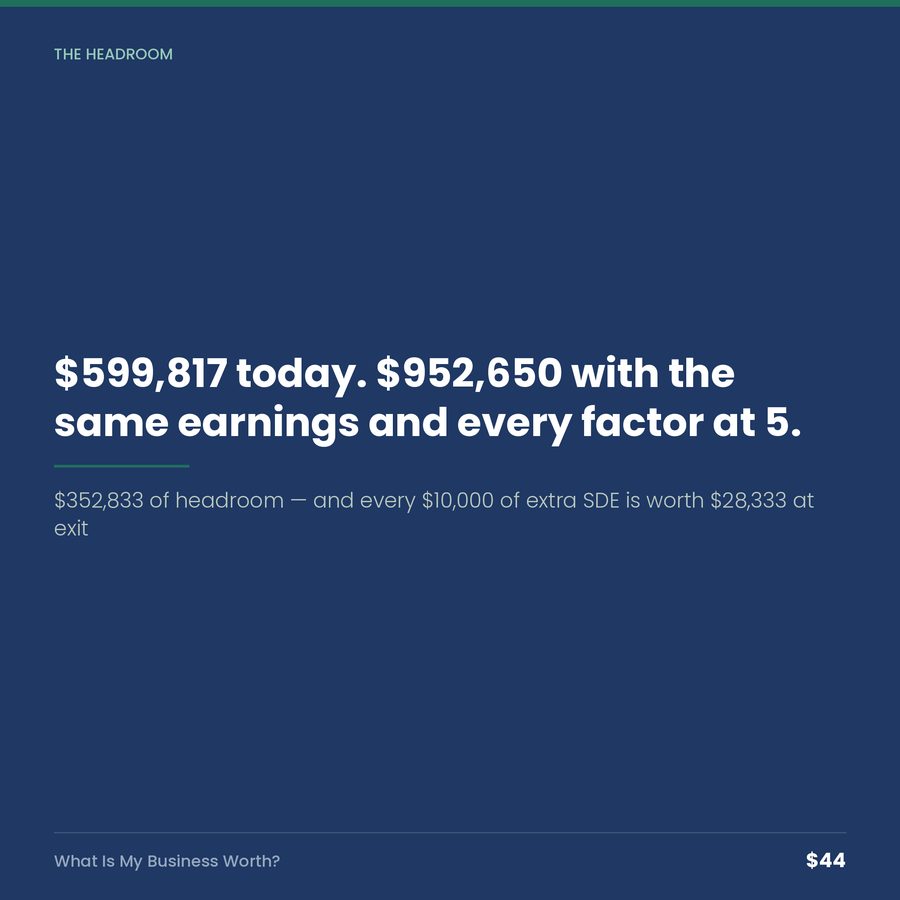
The sample scores 40 out of 90 — a 2.83× multiple, and a value of $599,817, with a range of $509,844 to $689,789 and an asset floor of $177,000 underneath it.
But the tab you'll actually keep coming back to is the next one.
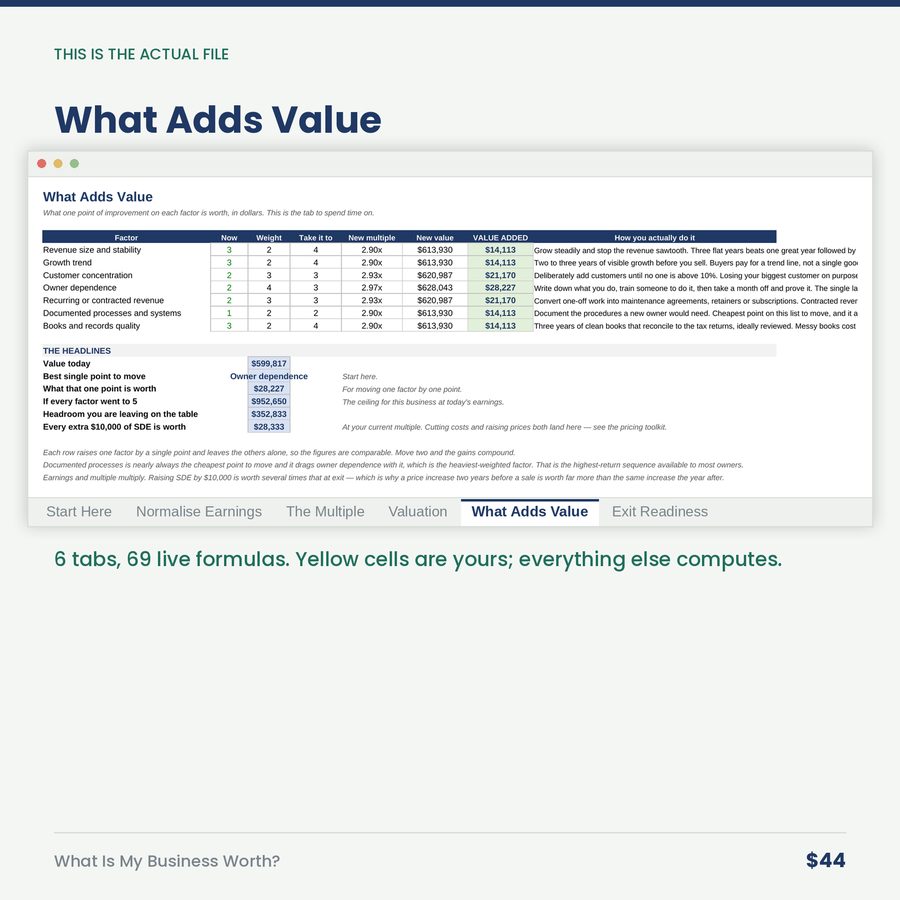
What Adds Value raises each factor by exactly one point, leaves the others alone, and tells you what it's worth in dollars:
| Improve this by one point | Adds |
|---|---|
| Owner dependence | $28,227 |
| Customer concentration | $21,170 |
| Recurring revenue | $21,170 |
| Documented processes | $14,113 |
And the number that reframes the whole exercise: $352,833 of headroom between what the business is worth today and what the same earnings would fetch with every factor at 5.
Plus this: every extra $10,000 of SDE is worth $28,333 at sale. Earnings and multiple multiply, which is why raising prices two years before you sell is worth several times more than raising them the year after.
Twelve documents, and the one that matters most
The last tab is what a serious buyer asks for in the first two weeks. Three years of returns that reconcile to your books. Every add-back with a receipt behind it. Contracts for any recurring revenue you claim. A lease confirmed as transferable.
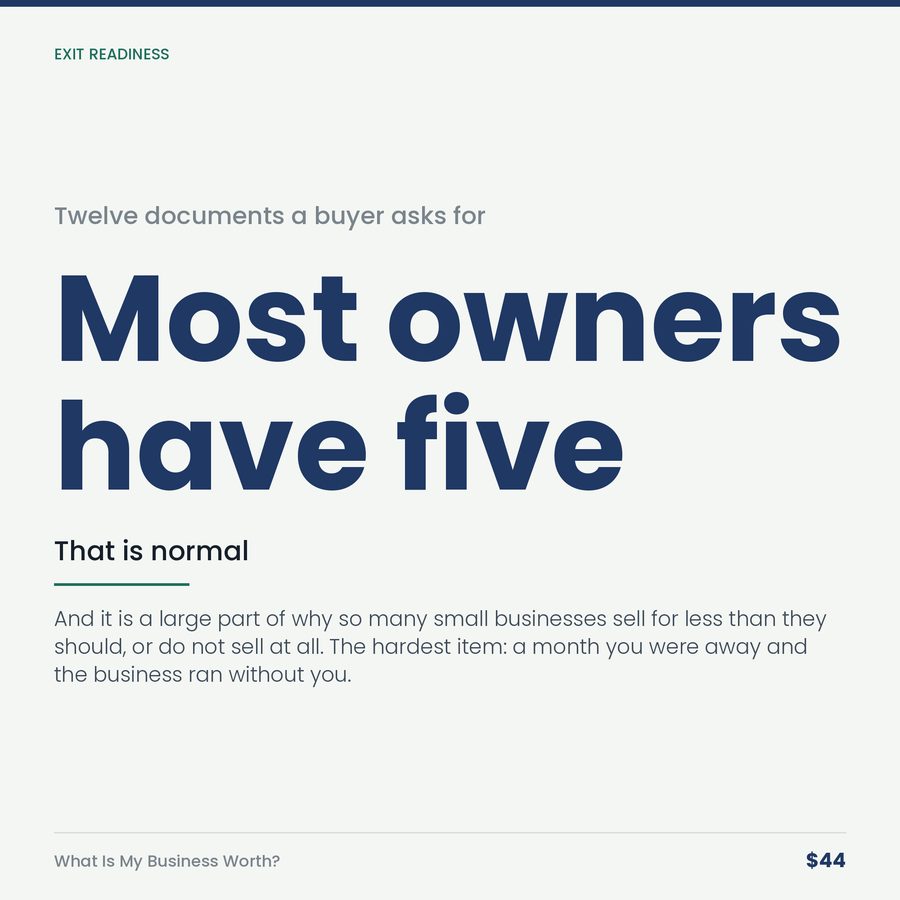
Most owners can produce four or five. That's normal — and it's a large part of why so many small businesses sell for less than they should, or don't sell at all.
The hardest item on the list is also the most persuasive: a month you were away, and the business ran without you. It takes a year to arrange and it proves in one stroke what every other document only claims.
Read this before you buy
This is an estimate for planning, not an appraisal. A valuation for a sale, a divorce, an estate or a bank needs a qualified appraiser who will examine your books, contracts and market. The multiple here is a transparent 1.5×–4.5× scale that moves with your risk score — real transactions vary by industry and by year, and a broker with recent comparable sales in your trade will beat it every time.
Use it to see direction and sensitivity, and to answer the question that's actually worth asking: what would make it worth more, and can I start now?
Built for
Owners five years out from selling · anyone weighing an unsolicited offer · succession and family transitions · partners buying each other out · anyone who wants to know whether the last twenty years built an asset or a job.
What you get
One .xlsx file, six tabs, instant download. Excel, Google Sheets, Apple Numbers, LibreOffice. No macros, no add-ins, no subscription.
A realistic small service business is loaded as a worked example. Type over it.
A look inside
More in Big Money Decisions
Buy, Finance, Lease or Rent? Equipment Calculator
Every dealer has a confident answer. Every one of them sells something.
$29
Should We Add This Service Line?
Every new service line looks good in your head. Here's what this one looks like on paper.
$32
Rental Property Per-Door Dashboard
Rent minus the mortgage is not your profit. Find out what each door actually pays you.
$34