Tools · Big Money Decisions
Should We Add This Service Line?
Every new service line looks good in your head. Here's what this one looks like on paper.
$32 one-off
Buy — $32Should-We-Add-This-Service-Line.xlsx · 5 tabs, 44 live formulas, no macros
Instant download, nothing ships. Works in Excel, no subscription. If it does not do what you needed, tell me and I will make it right.
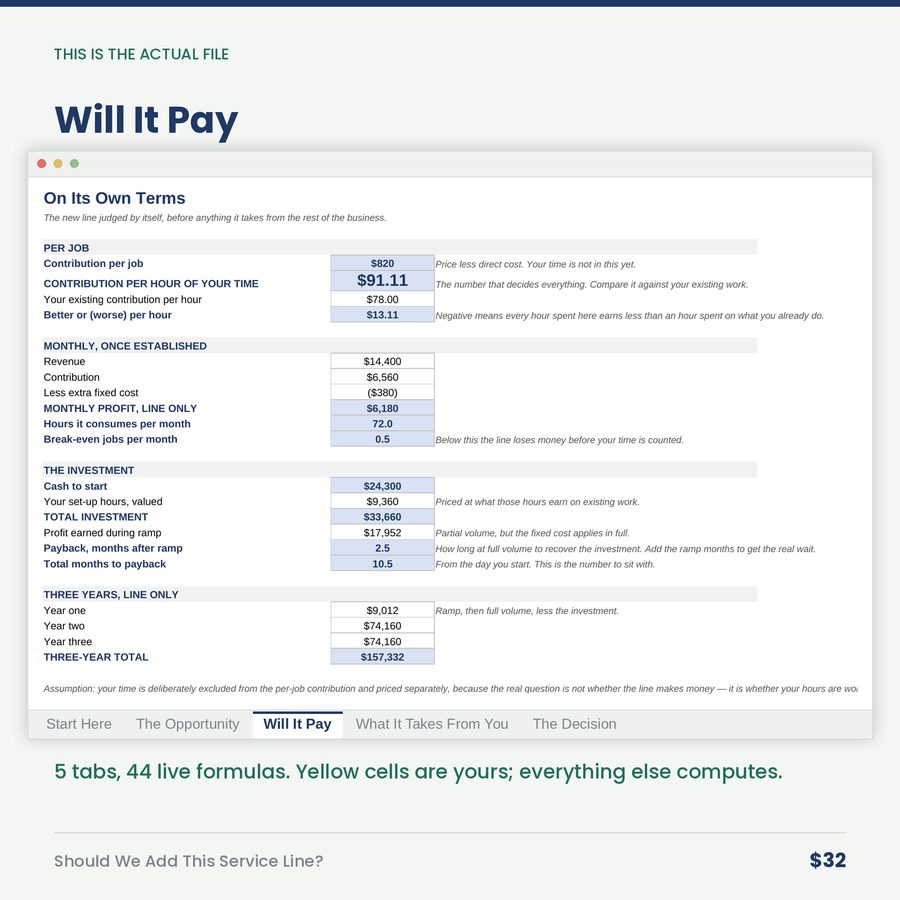
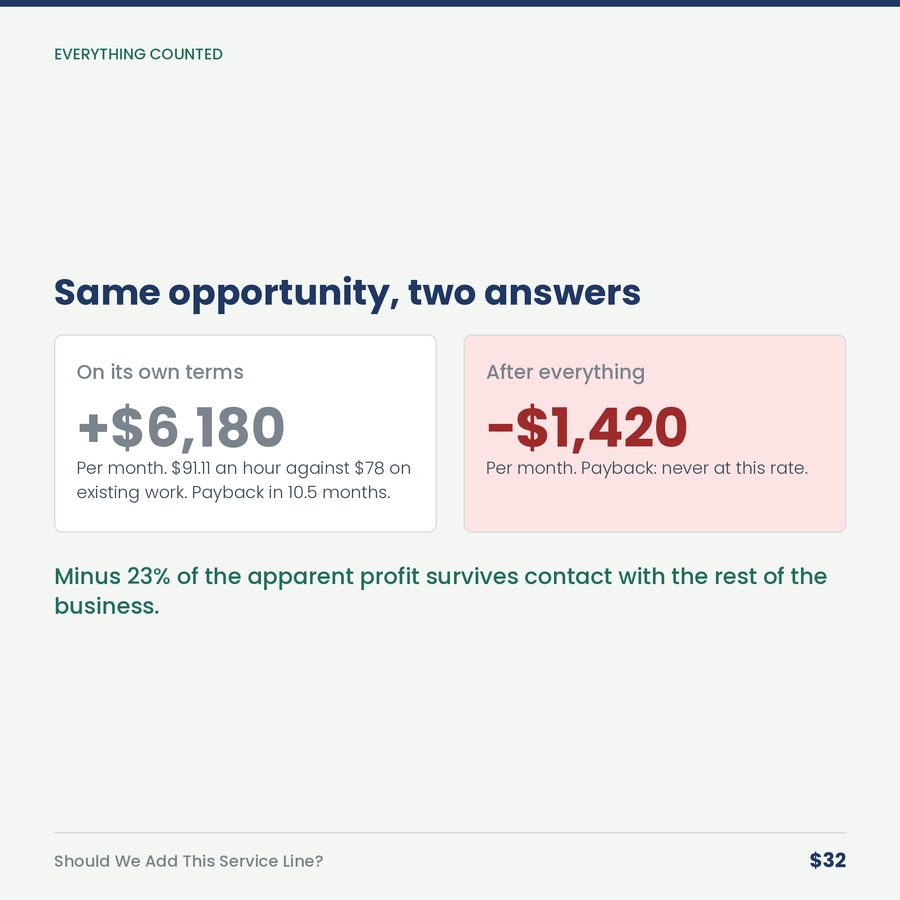
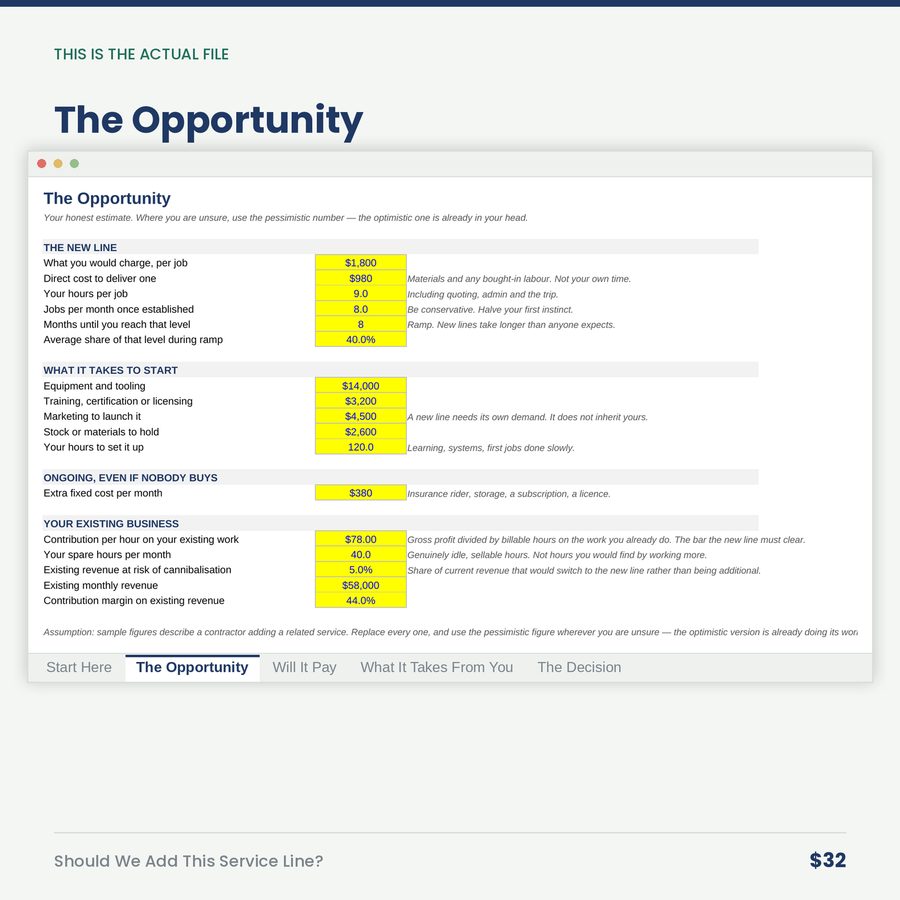
The example loaded in this file is a genuinely attractive opportunity. $1,800 a job, $820 of contribution, nine hours of your time. That's $91.11 an hour — better than the $78 you make on your existing work. Eight jobs a month once established. $6,180 of profit a month. A $33,660 investment paid back in 10.5 months.
Most owners would say yes to that. Most owners would be wrong.
Here's what the arithmetic misses.
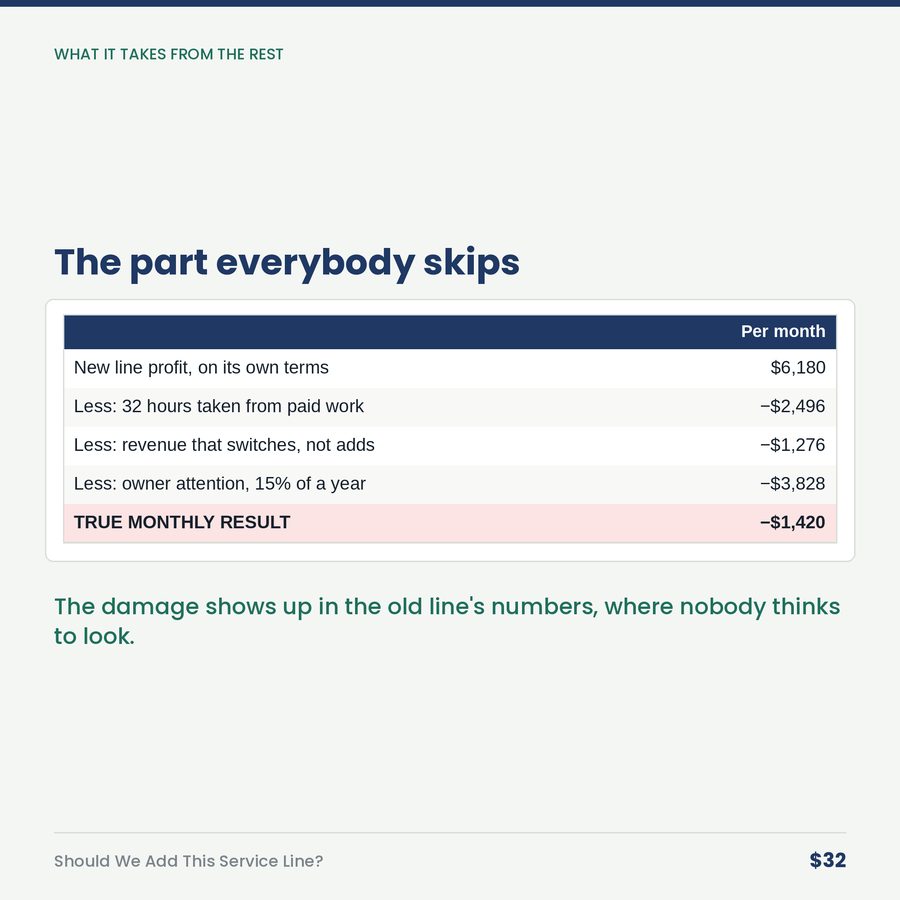
The line needs 72 hours a month. You have 40 genuinely spare. The other 32 come out of work you're already being paid for — −$2,496 a month, every month.
Five percent of your existing revenue switches to the new line rather than being additional. That's not growth, it's rearrangement — −$1,276.
And your attention. Fifteen percent of a year is realistic for a new line, and it costs −$3,828 a month in a business your size.
> ## True monthly result: −$1,420 > ## Payback: never at this rate
Minus 23% of the apparent profit survives contact with the rest of the business.
Why this happens, and why it keeps happening
The failure is almost never that a new line loses money on its own terms. It's that it takes hours, attention and cash away from a proven line to feed an unproven one — and the damage shows up in the old line's numbers, where nobody thinks to look for it.
The test to apply before any of this
Could you get the same result by doing more of what you already do?
Raising prices. Improving your close rate. Keeping more of the customers you have. Filling the hours already sitting idle. All of them are cheaper, faster and far less risky — and most owners reach for the new line because it's more interesting, not because it's better.
If a ten percent price rise on your existing work would deliver more profit than this line will, that's your answer, and it takes an afternoon rather than a year.
What you get in the workbook
- Contribution per hour on the new line, against your existing work — the number that decides everything
- Break-even jobs, monthly profit, and three years on the line's own terms
- Full investment including your set-up hours, priced at what those hours earn today
- Realistic ramp — partial volume for the months it takes to get established, with fixed costs applying in full
- Displaced hours, cannibalised revenue and diverted attention, each costed
- The true monthly gain, the true payback, and a plain verdict
And eight questions the arithmetic can't settle
Has a customer actually asked for this, with money attached — or does it just seem like a good idea? Who does the work when you're not there? What does it stop you doing? If it works, can you deliver ten a month, or does it break at three?
Plus the one owners skip and regret: can you kill it? Name the date and the number at which you'd stop. Write it down now, while you're clear-headed, and stopping becomes an agreement with yourself rather than an admission of failure.
And the honest one: would you still want to do this if it made the same money as your existing work rather than more? If yes — that's a perfectly good reason. Just call it what it is, and size the investment accordingly rather than dressing it up as a business case.
Built for
Contractors adding a trade · agencies adding a service · shops adding a product category · practices adding a treatment · anyone with a good idea and a nagging sense they should check it properly first.
What you get
One .xlsx file, five tabs, instant download. Excel, Google Sheets, Apple Numbers, LibreOffice. No macros, no add-ins, no subscription.
A realistic contractor expansion is loaded as a worked example. Type over it.
A look inside


More in Big Money Decisions
Buy, Finance, Lease or Rent? Equipment Calculator
Every dealer has a confident answer. Every one of them sells something.
$29
What Is My Business Worth?
Your tax return says you made $62,000. A buyer would say you made $211,700.
$44
Rental Property Per-Door Dashboard
Rent minus the mortgage is not your profit. Find out what each door actually pays you.
$34