Tools · Pricing & Quoting
What a Discount Really Costs
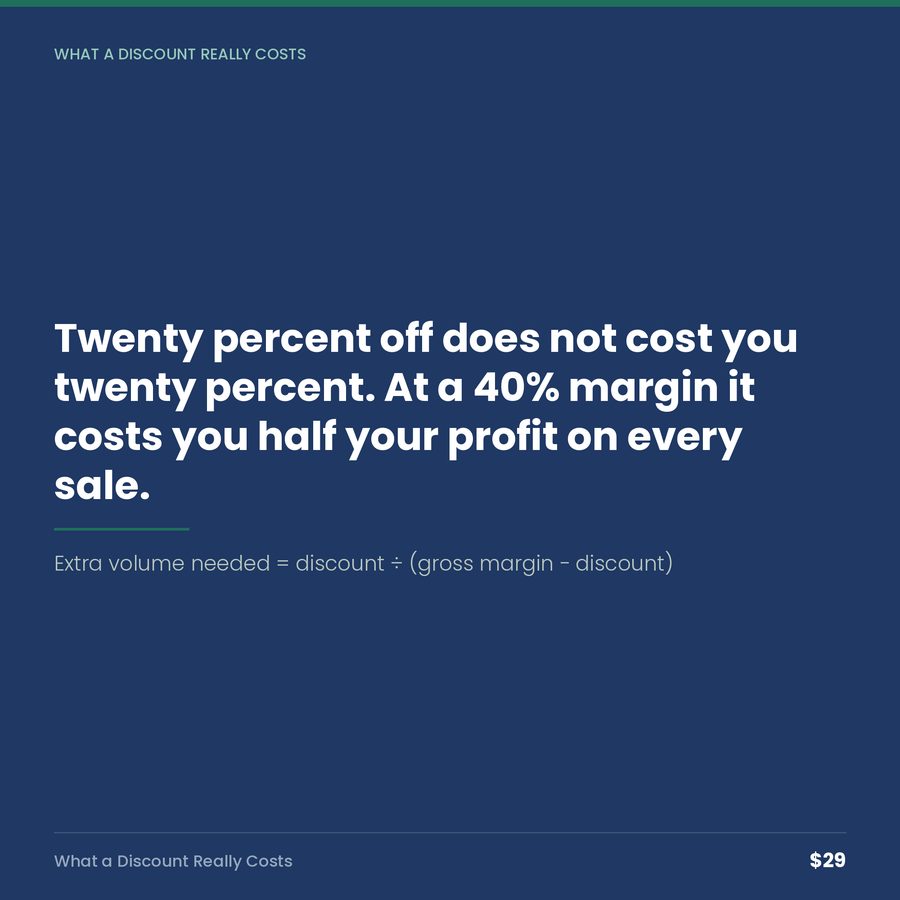
Twenty percent off doesn't cost you twenty percent. At a 40% margin, it costs you half your profit on every sale.
$29 one-off
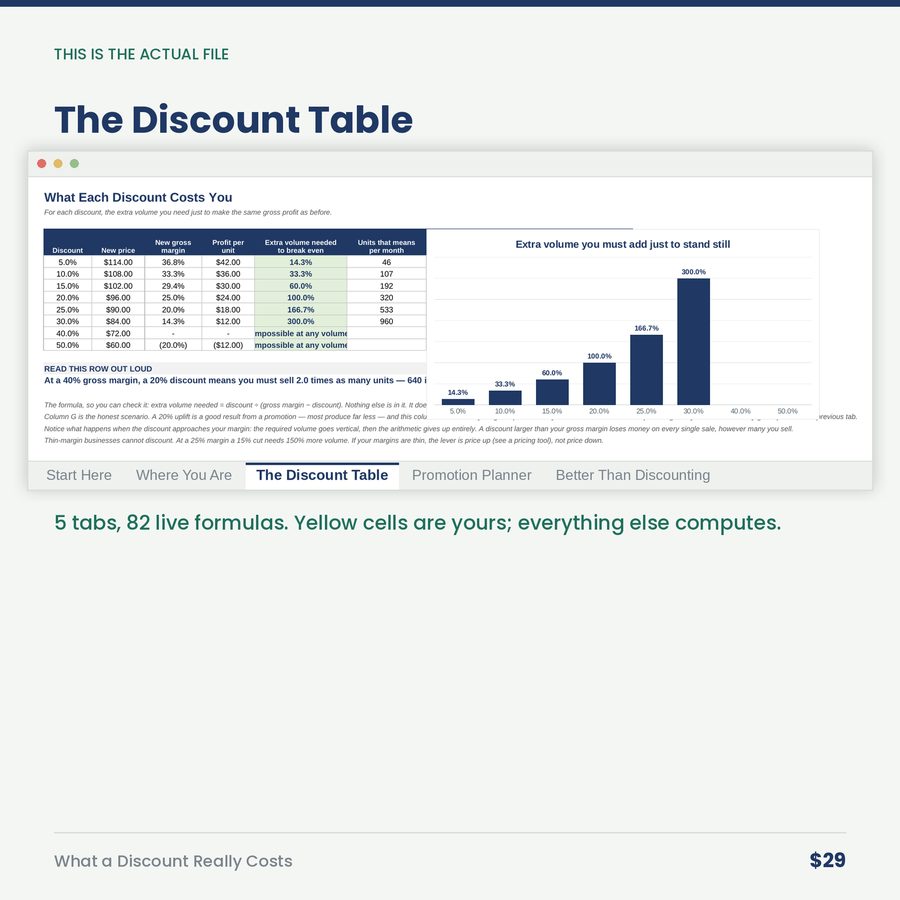
Buy — $29What-a-Discount-Really-Costs.xlsx · 5 tabs, 82 live formulas, no macros
Instant download, nothing ships. Works in Excel, no subscription. If it does not do what you needed, tell me and I will make it right.
A discount comes entirely out of profit. The materials still cost what they cost. The labor still costs what it costs. The rent doesn't fall because you ran a sale. Every dollar off the price is a dollar off the only part that was ever yours.
Here's what that means in practice:
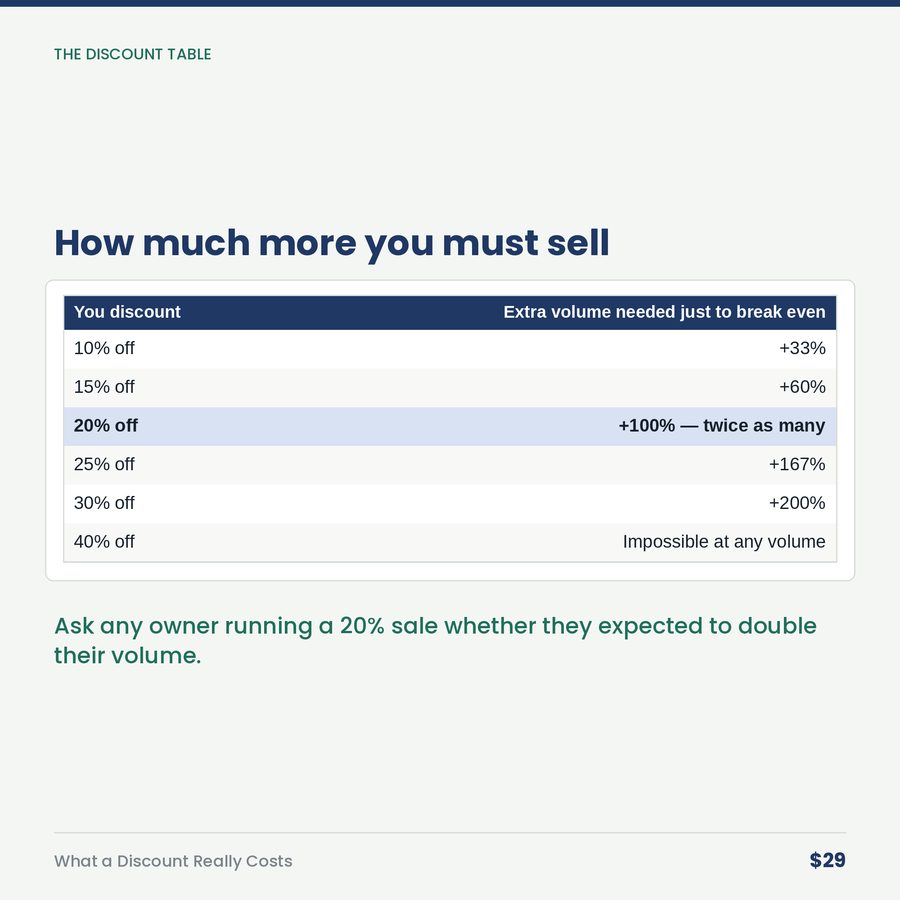
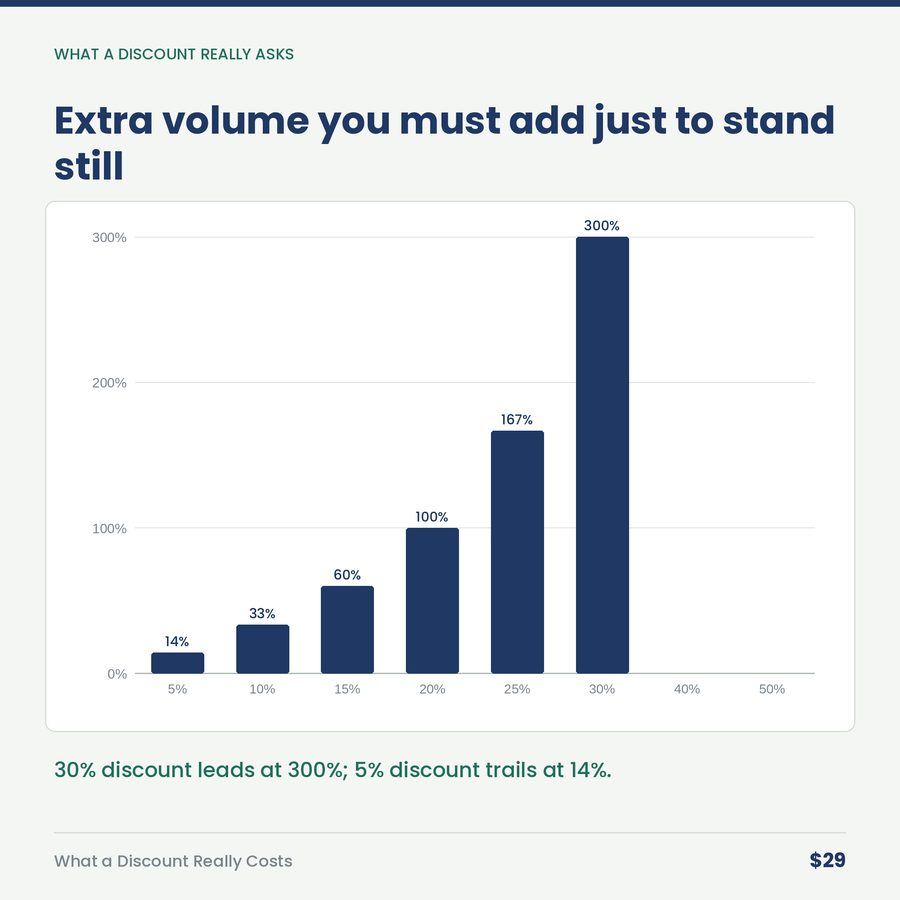
| You discount | You must sell this much more just to break even |
|---|---|
| 10% off | +33% |
| 15% off | +60% |
| 20% off | +100% — twice as many |
| 25% off | +167% |
| 30% off | +200% |
| 40% off | Impossible at any volume |
Ask any owner running a 20% sale whether they were expecting to double their volume.
Then it costs out your actual promotion.
Enter the discount, how long it runs, the uplift you expect, and what you'll spend advertising it. The planner charges you for the two things nobody counts:
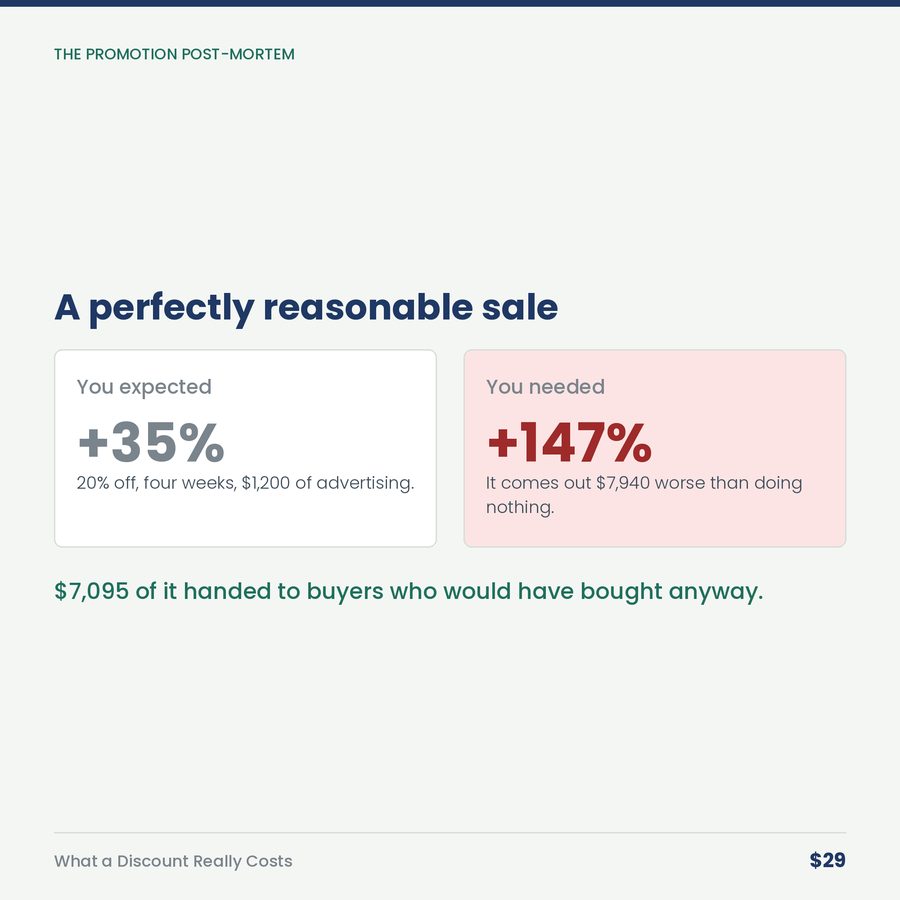
The discount handed to people who would have bought anyway. In the example, $7,095 — your normal volume, sold cheaper, for nothing in return. It's almost always the largest single line in a promotion.
The sales you pull forward from next month. Revenue you'd have earned at full price anyway. Borrowed, not gained.
The example looks like a perfectly reasonable sale: 20% off, four weeks, expecting a 35% lift, $1,200 in advertising.
It comes out $7,940 worse than doing nothing — and the workbook tells you the lift you'd actually have needed was 147%.
And then twelve things to offer instead.
Every one of them gives the customer something worth having without cutting your price:
- More of what you already sell — a free extra costs you your cost, not your margin
- A faster date — free when the calendar has a gap, and often the thing they actually wanted
- A longer warranty — costs you the claim rate, not the price, and signals confidence
- Free delivery or setup · a payment plan · a bundle at the same total price · priority scheduling · a loyalty credit toward the next purchase
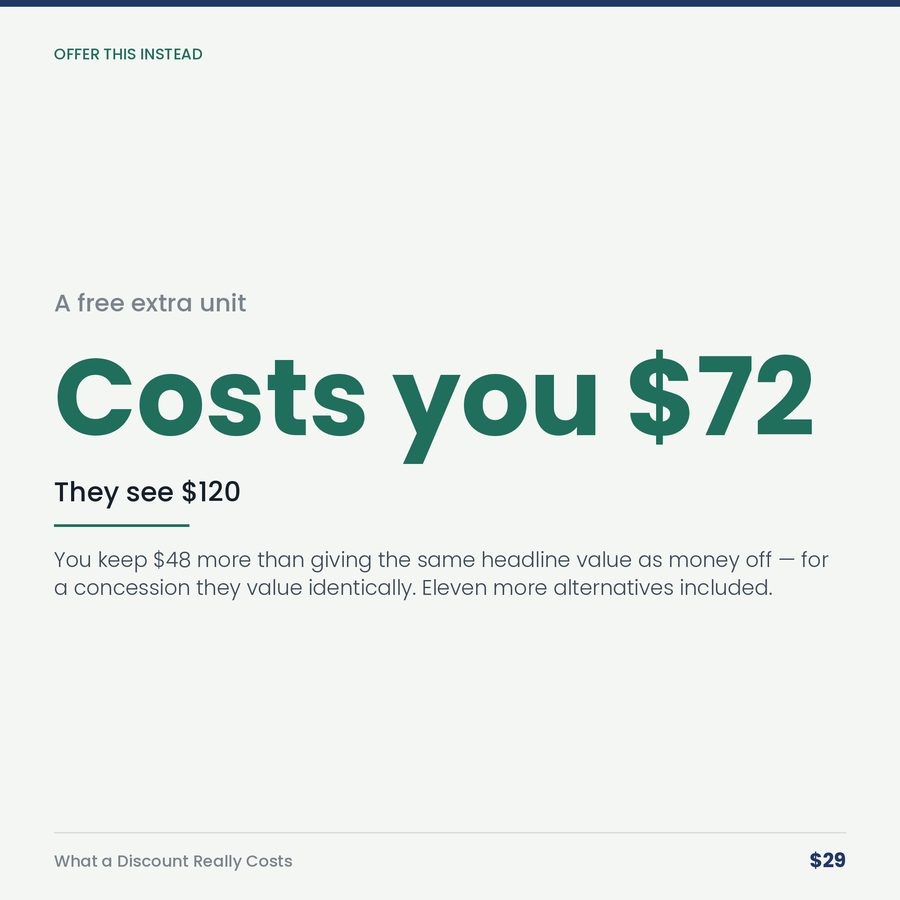
With the arithmetic behind the strongest one: a free unit is worth $120 to the customer and costs you $72. You keep $48 more than giving the same value as money off — for a concession they value identically.
(And the honest limit: that advantage equals your gross margin. Below about 50% margin, giving away a whole unit costs more than half its price — offer something smaller instead. Buy-one-get-one is a 50% discount by another name, and at thin margins it loses money on every transaction.)
When a discount IS the right answer
This isn't an argument against ever discounting. There are four good reasons: clearing stock that costs you money to hold, filling genuinely idle capacity, buying a first purchase from a customer who'll come back, and meeting a competitor on a deal you can't afford to lose.
What the numbers are against is the habitual discount. The standing 10% off. The sale run every quarter because it's that time of year. The price cut given on the phone because the silence got uncomfortable.
Those aren't decisions. They're a slow leak.
Built for
Retail and e-commerce · trades and home services · salons, clinics and studios · restaurants and cafés · anyone about to run a sale, or already running one they've never checked.
What you get
One .xlsx file, five tabs, instant download. Excel, Google Sheets, Apple Numbers, LibreOffice. No macros, no add-ins, no subscription.
A realistic 40%-margin product is already loaded. Type over it.
A look inside
More in Pricing & Quoting
Job Quoting & Bid Calculator
You are probably quoting off the wrong labor rate. Almost every contractor is.
$34
Quote Follow-Up & Pipeline Tracker
You didn't lose that job to a cheaper bid. You lost it because nobody called.
$27