Tools · Pricing & Quoting
Price Increase Toolkit
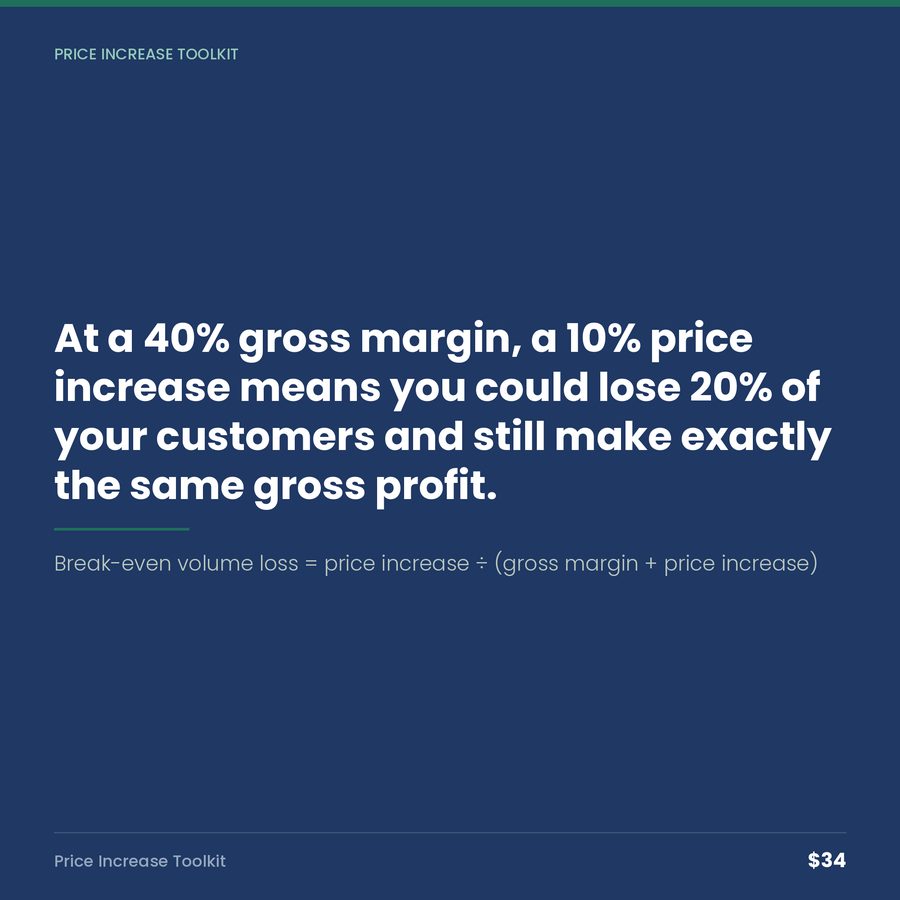
You can lose 20% of your customers and make exactly the same money.
$34 one-off
Buy — $34Price-Increase-Toolkit.xlsx · 6 tabs, 162 live formulas, no macros
Instant download, nothing ships. Works in Excel, no subscription. If it does not do what you needed, tell me and I will make it right.
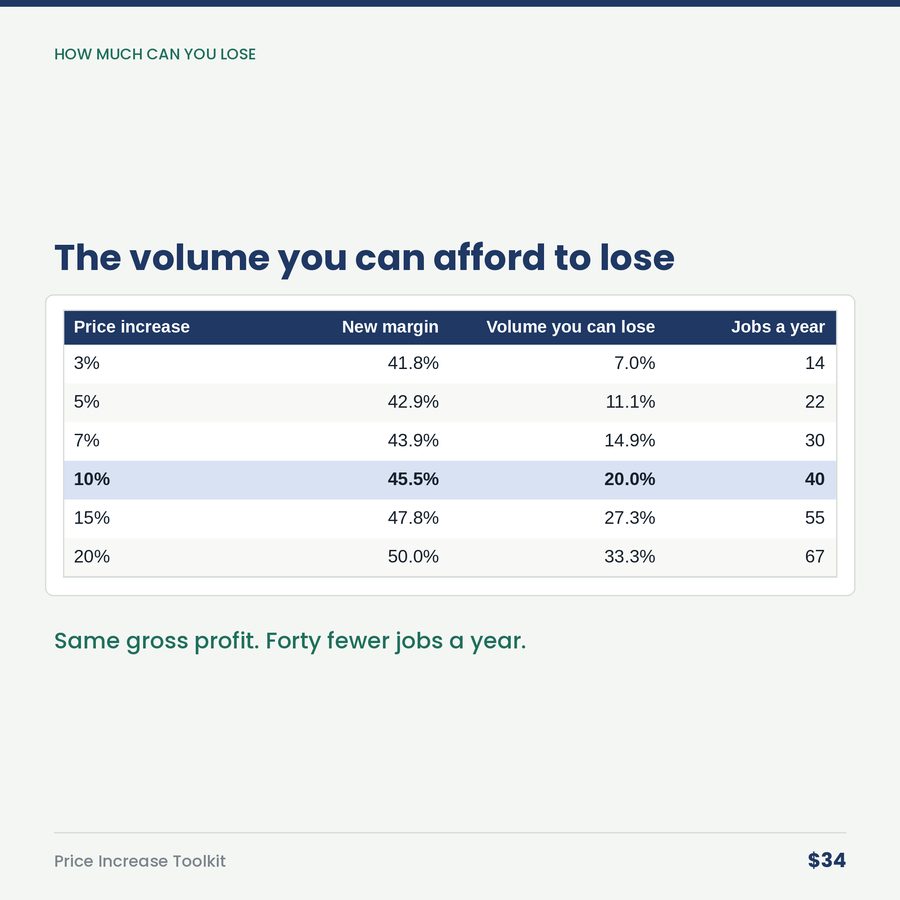
At a 40% gross margin, raise prices 10% and you could lose one customer in five — 40 jobs out of 200 — and finish the year with identical gross profit. Fewer jobs. Less wear on the truck. Less time on the road. Same money in the bank.
Most owners have never seen that number. That is the real reason prices don't go up — not courage, not competition. Nobody did the arithmetic.
Here it is, done.
Five numbers in. Revenue, variable costs, fixed costs, number of jobs, hours of capacity. That's the whole setup.
Then the table that changes the conversation. For every price increase from 3% to 20%, how much volume you could lose and still break even — and what your gross profit becomes if you lose only half that, which is closer to what actually happens.
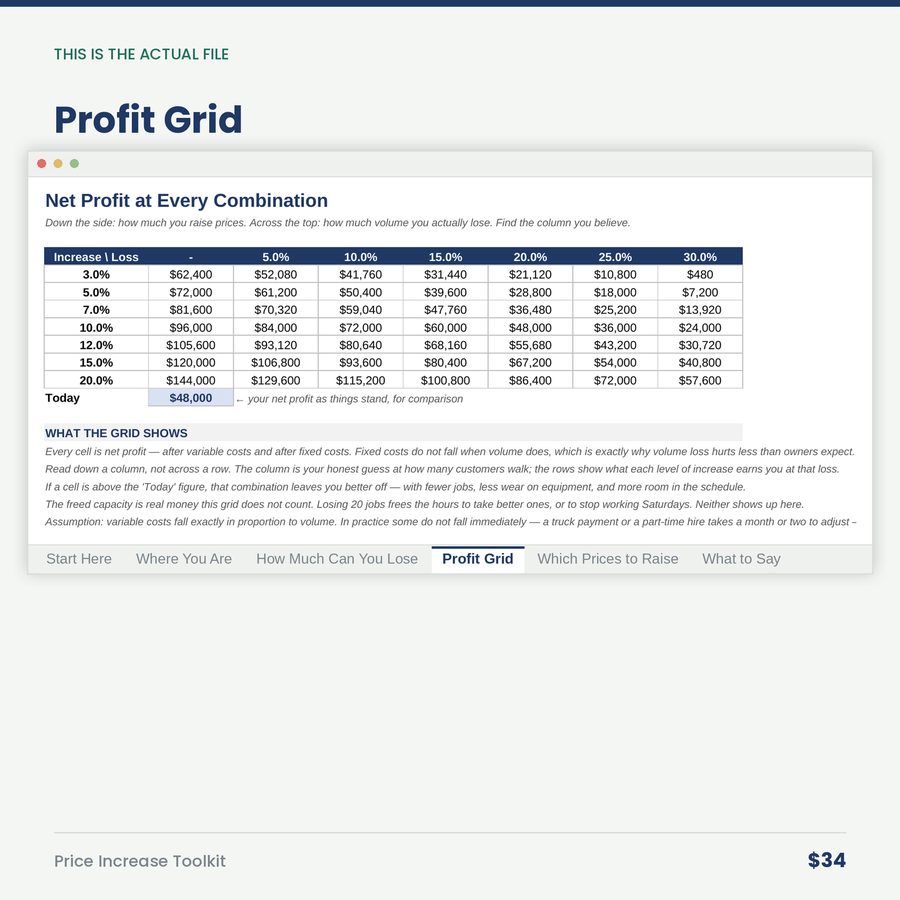
Then the grid. Forty-nine outcomes: seven levels of price increase against seven levels of customer loss, every cell showing your real net profit, with today's figure underneath for comparison. Find the column you honestly believe. Read across. Decide.
Then the part that saves you money you'd otherwise leave behind.
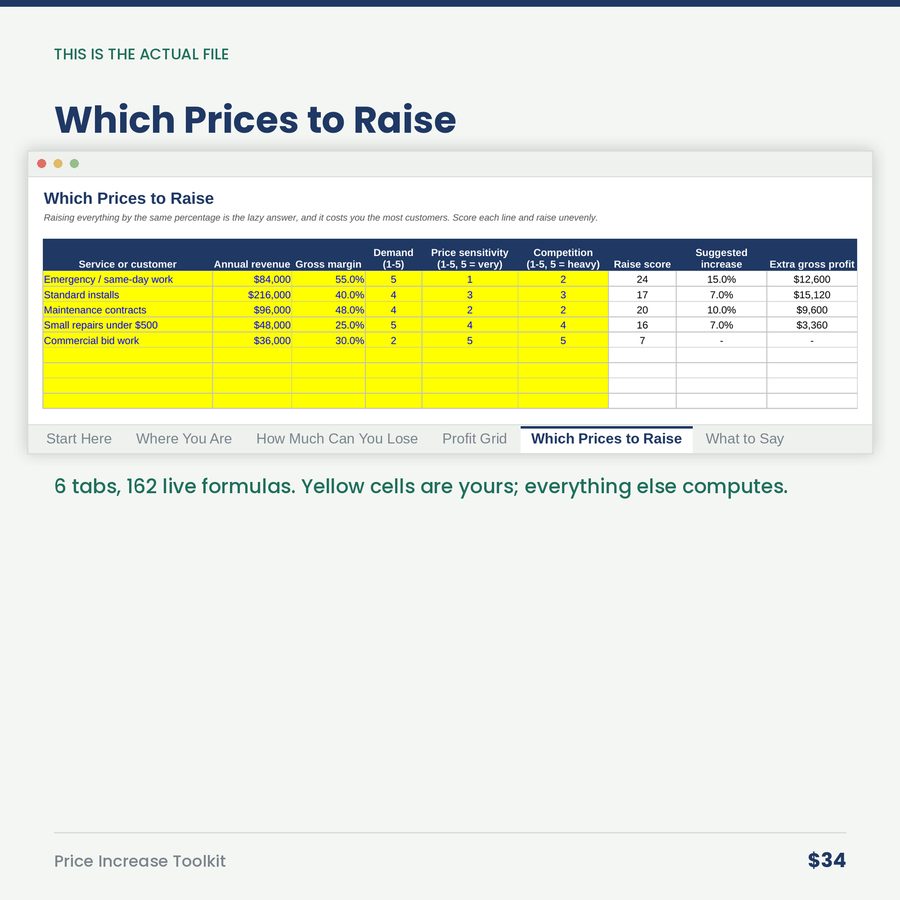
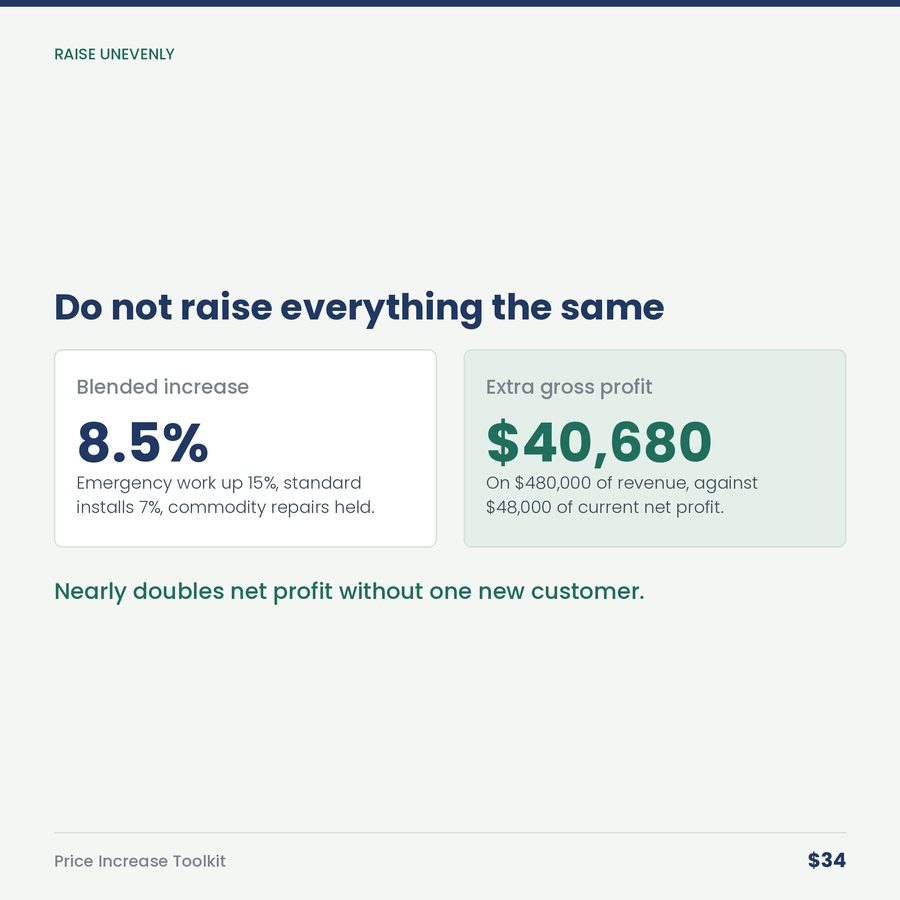
Raising everything by the same percentage is the lazy answer, and it loses you the most customers. Score each service on demand, price sensitivity, and competition, and the workbook tells you which lines to raise hard and which to leave alone.
In the example loaded in the file, that uneven approach produces an 8.5% blended increase worth $40,680 in a business currently netting $48,000. It nearly doubles net profit without one new customer.
And then the part everyone actually loses sleep over: what to say.
- Five rules — including the two most owners break
- A complete announcement letter, with the reason each line is there explained
- Four scripted responses to the pushback you'll get: "that's a big jump," "can you keep my old rate," "I'll get other quotes," "we've been with you for years"
- The two things never to do — either one will cost you good customers
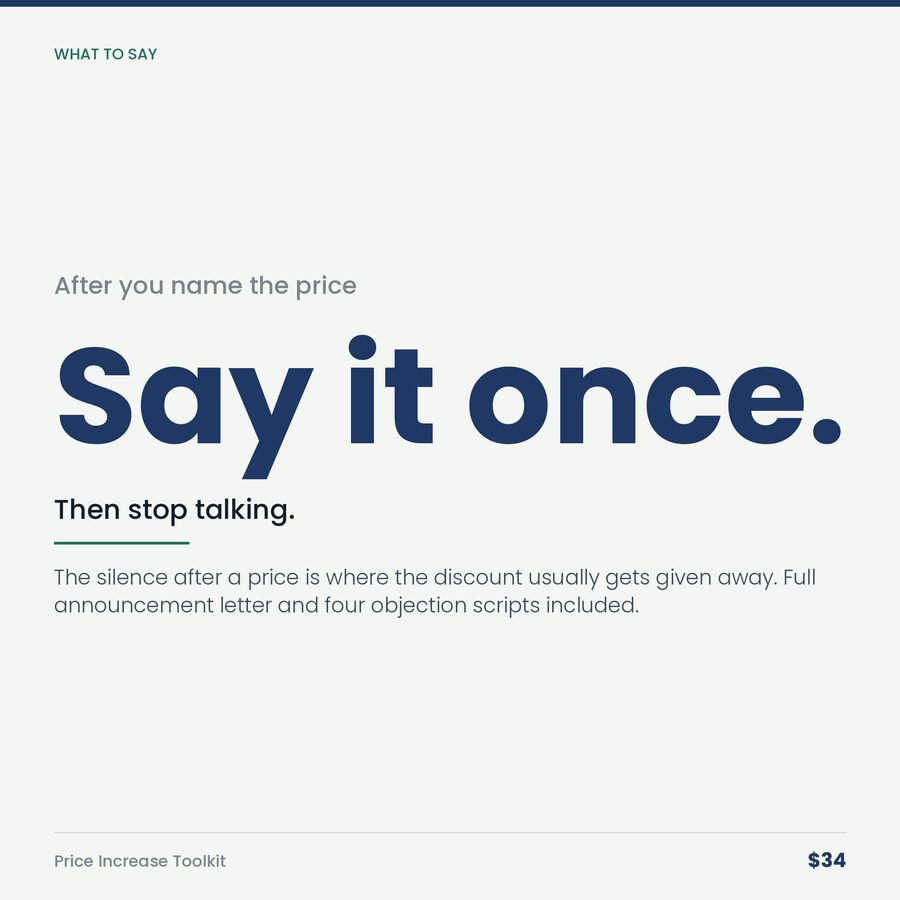
The single most useful line in it: say the sentence, then stop talking. The silence after a price is where the discount usually gets given away.
One honest warning, on page one
Do not raise prices to fix a business that's losing money because of how it delivers the work. Fix delivery first, then price. This workbook will make a well-run business considerably more profitable. It will not rescue a badly-run one, and it says so.
Built for
Contractors and trades · cleaning, landscaping and home services · salons, clinics and practices · agencies and consultancies · repair shops · anyone who has held their prices too long and knows it.
What you get
One .xlsx file, six tabs, instant download. Excel, Google Sheets, Apple Numbers, LibreOffice. No macros, no add-ins, no subscription.
Realistic sample data is already loaded so you can see it working, then type over it.
A look inside
More in Pricing & Quoting
Job Quoting & Bid Calculator
You are probably quoting off the wrong labor rate. Almost every contractor is.
$34
Quote Follow-Up & Pipeline Tracker
You didn't lose that job to a cheaper bid. You lost it because nobody called.
$27
What a Discount Really Costs
Twenty percent off doesn't cost you twenty percent. At a 40% margin, it costs you half your profit on every sa
$29