Tools · Customers & Retention
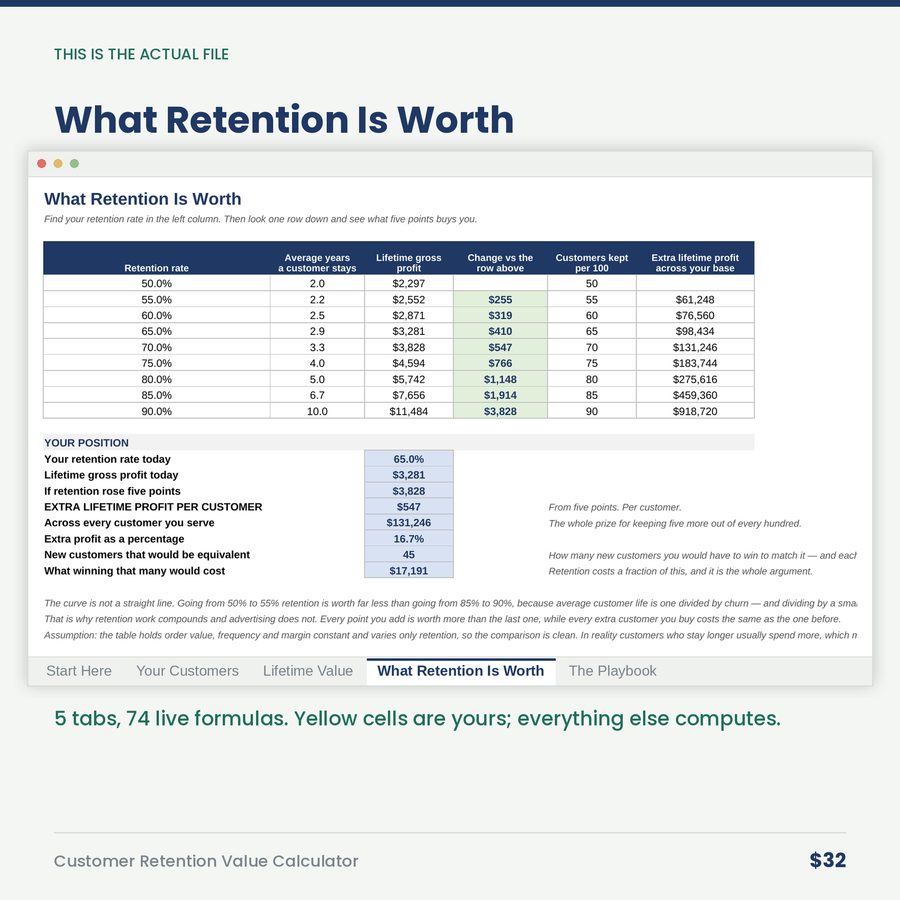
Customer Retention Value Calculator
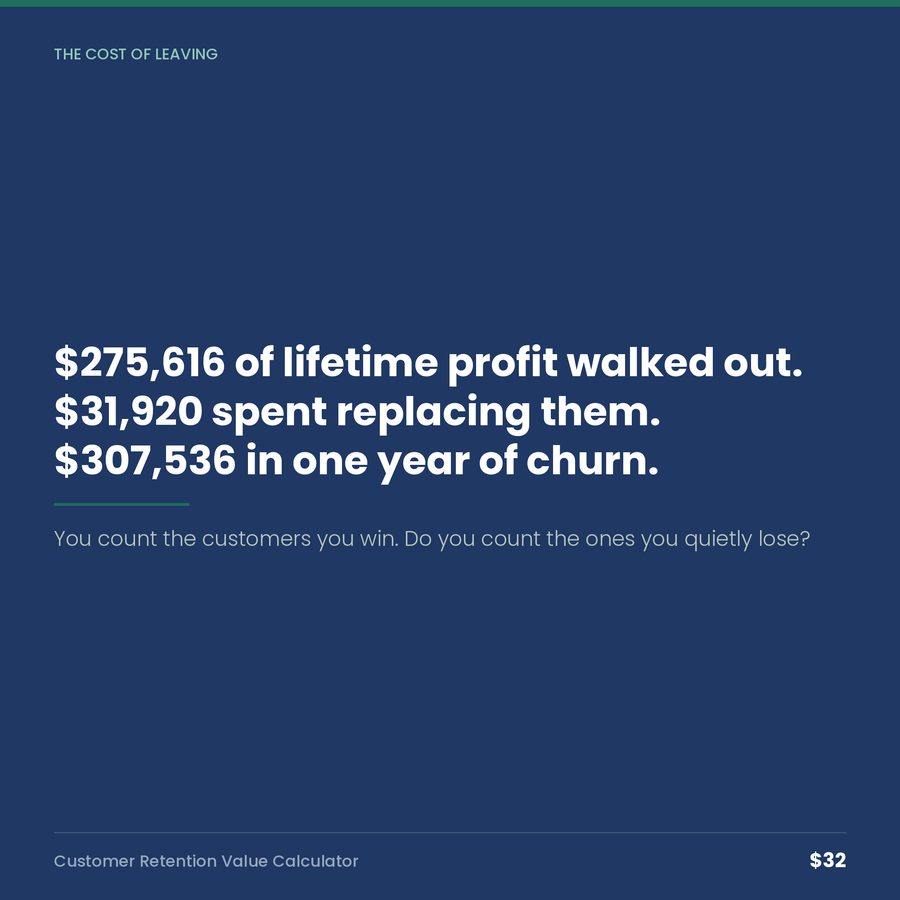
You count the customers you win. Do you count the ones you quietly lose?
$32 one-off
Buy — $32Customer-Retention-Value-Calculator.xlsx · 5 tabs, 74 live formulas, no macros
Instant download, nothing ships. Works in Excel, no subscription. If it does not do what you needed, tell me and I will make it right.
Almost no small business does. So the marketing budget grows, the customer count stays flat, and nobody can quite explain it.
Here's what that leak costs.
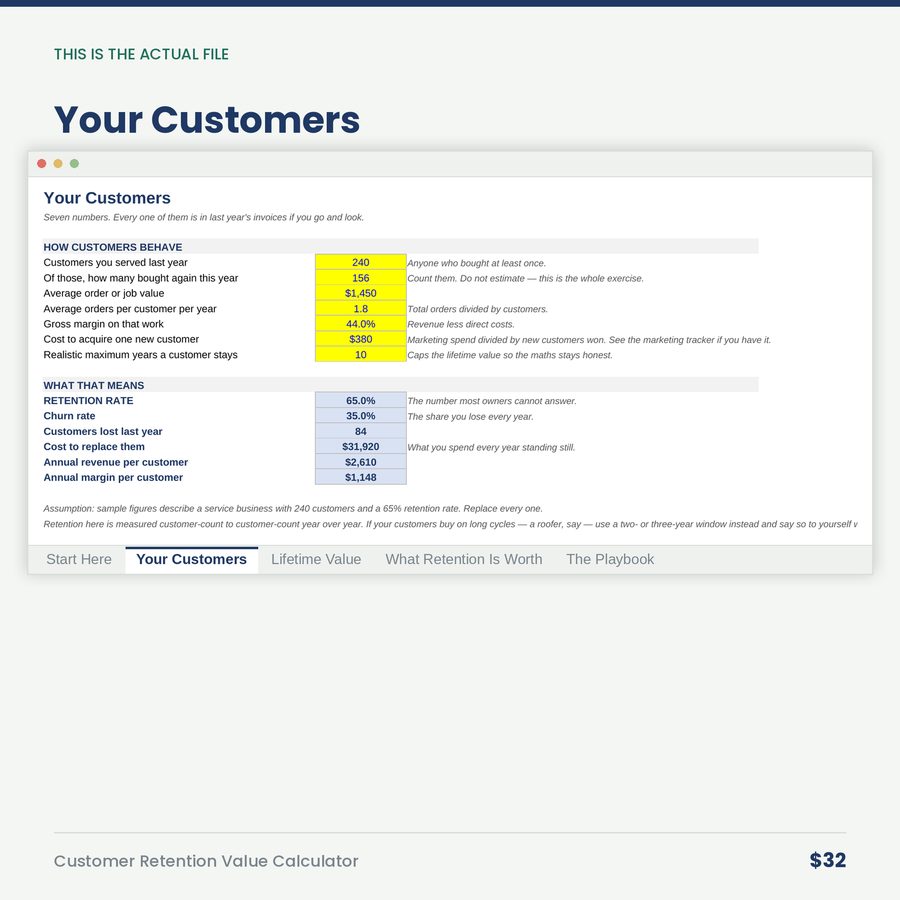
The example in this file: 240 customers, 156 came back, 65% retention.
Those 84 who left didn't just cost you last year's invoices. They cost you $275,616 of lifetime profit that walked out the door — plus $31,920 spent winning replacements just to stand still.
$307,536. That's one year of churn in a business doing under a million.
Now here's the part nobody expects.
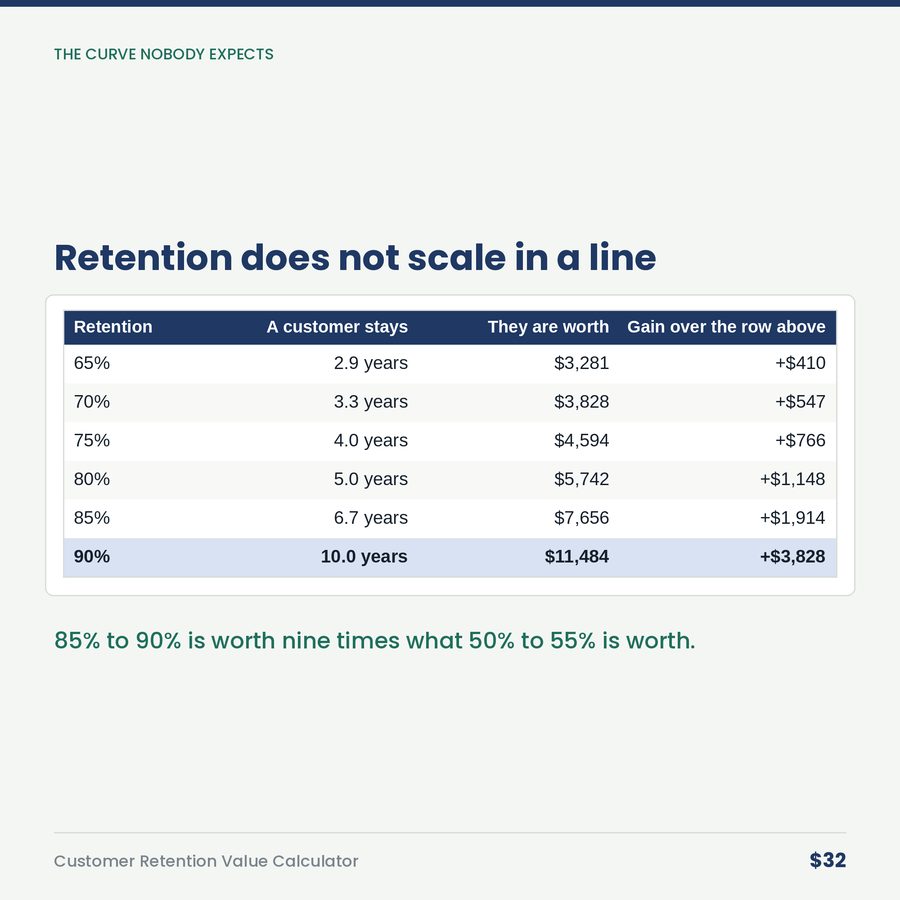
Average customer life is one divided by your churn rate. Which means the value of retention isn't a straight line — it accelerates, hard:
| Retention | A customer stays | They're worth |
|---|---|---|
| 65% | 2.9 years | $3,281 |
| 70% | 3.3 years | $3,828 |
| 80% | 5.0 years | $5,742 |
| 90% | 10.0 years | $11,484 |
Moving 85% → 90% is worth nine times as much as moving 50% → 55%.
That's why retention compounds and advertising doesn't. Every point of retention you add is worth more than the last one. Every extra customer you buy costs exactly what the last one cost.
What five points would be worth to you
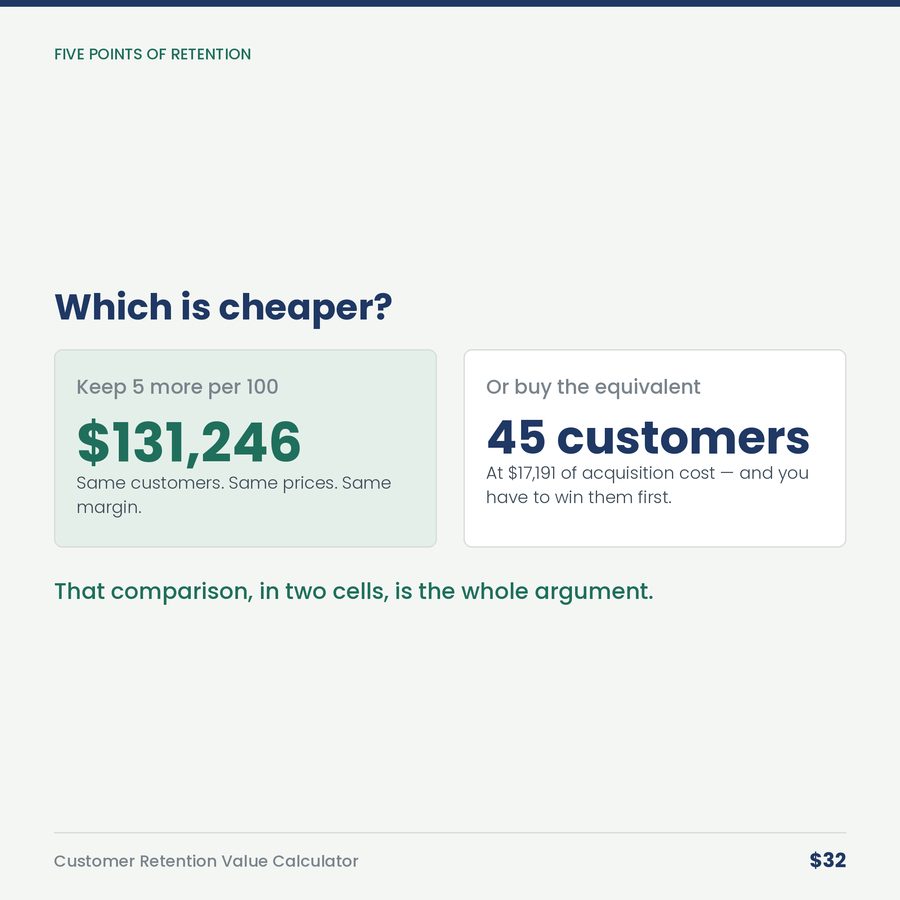
In the example, lifting retention from 65% to 70% — keeping five more customers out of every hundred — is worth $131,246 across the customer base. Same customers. Same prices. Same margin.
To get the same result by winning new business, you'd have to acquire 45 new customers at a cost of $17,191.
That comparison, in two cells, is the whole argument.
And then twelve things to actually do about it
Ranked cheapest first, with a column to commit:
- Call every customer 30 days after the job — costs nothing, nobody does it, and it catches small problems before they become the reason someone leaves
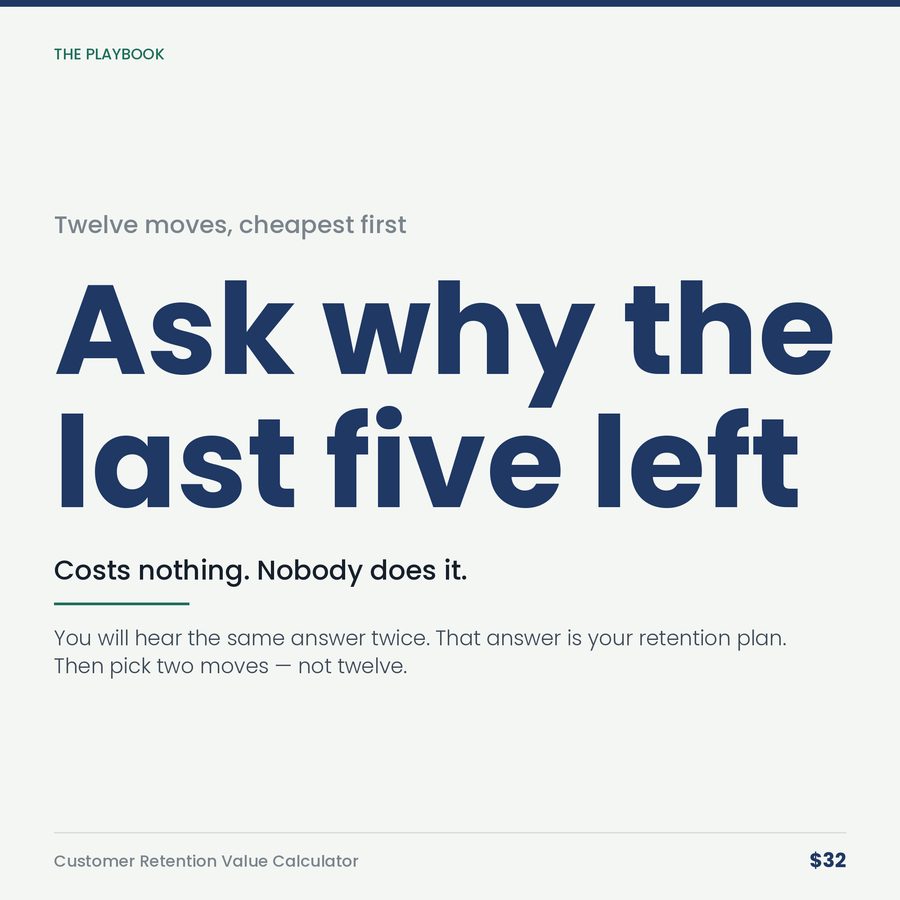
- Ask why the last five leavers left — you'll hear the same answer twice, and that answer is your retention plan
- Fix the one thing they all mention — retention work is usually one operational fix, not a loyalty program
- Book the next appointment before you leave — a date in the diary converts far better than an intention
- Send a reminder when the next service is due — most repeat business is lost to forgetting, not to a competitor
- Call last year's lapsed customers, once, honestly — the cheapest new business available, and almost nobody makes the call
Plus six more. And one instruction: pick two. Not twelve.
It also tells you what it can't do
The lifetime-value calculation is the standard steady-state formula — annual margin divided by churn. It assumes customers behave consistently, which is right enough for planning and gets optimistic at very high retention rates. So there's a cap on how many years you'll credit a customer, and you set it. At 90% retention the raw formula implies a ten-year customer; most businesses should say so out loud before believing it.
Built for
Contractors and trades · salons, clinics and practices · agencies and consultancies · anyone with repeat customers, a marketing budget, and a nagging sense that they're refilling a bucket with a hole in it.
What you get
One .xlsx file, five tabs, instant download. Excel, Google Sheets, Apple Numbers, LibreOffice. No macros, no add-ins, no subscription.
A realistic 240-customer service business is already loaded. Type over it.
A look inside
More in Customers & Retention
Which Customers Actually Make You Money
Your biggest customer is not necessarily your best one. One of them might be costing you money.
$34
What Would a Maintenance Plan Be Worth?
Money that arrives on the first of the month, whether or not the phone rang.
$34
Should I Take This Big Customer?
They'd be a third of your business. The margin is squeezed, the terms are net-60, and they can leave in 30 day
$29