Tools · Financial Health
Small Business Bookkeeping & Tax-Prep Organizer
Most small businesses do their bookkeeping in March, for the year that ended in December, out of a carrier bag.
$24 one-off
Buy — $24Small-Business-Bookkeeping-and-Tax-Prep-Organizer.xlsx · 8 tabs, 1,323 live formulas, no macros
Instant download, nothing ships. Works in Excel, no subscription. If it does not do what you needed, tell me and I will make it right.
It takes a miserable weekend. It produces numbers nobody trusts. And it means every decision made during the year was made blind.
Here's the other way: ten minutes a week.
Friday afternoon, bank feed open, enter the week, set aside the tax, close the file.
What makes this different from the other bookkeeping templates
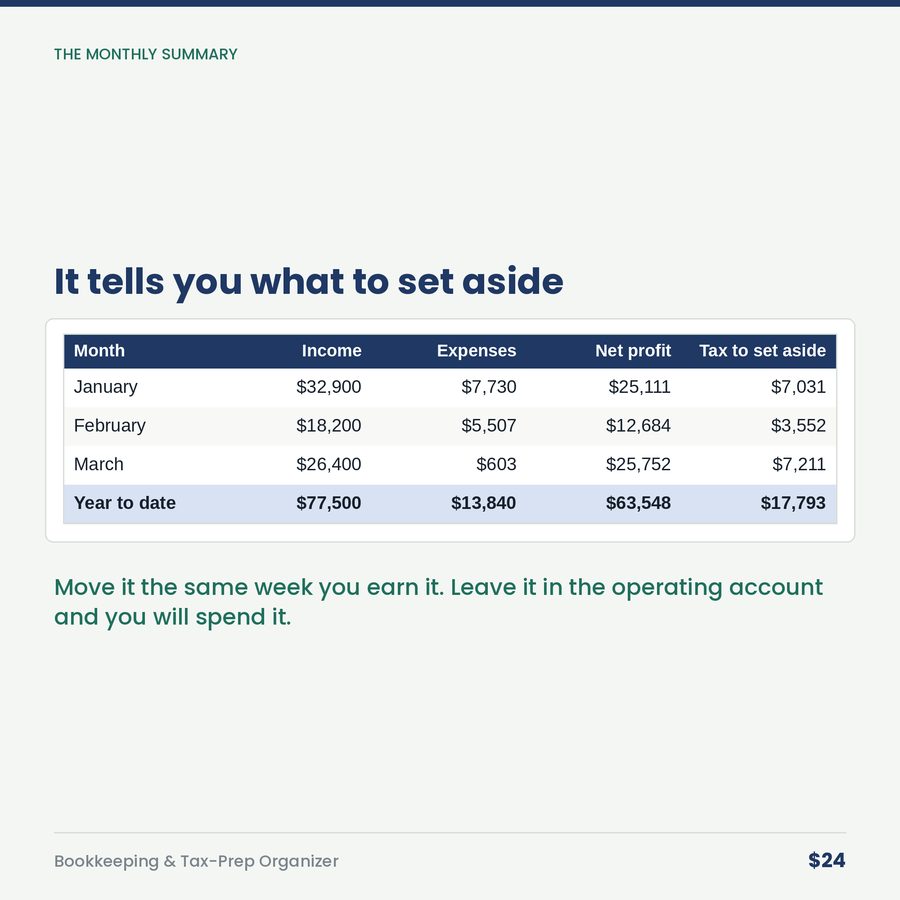
It tells you how much to set aside for tax — every month. Not a total at year end. A monthly figure, calculated on your profit at the percentage your accountant gives you, with a running total against what you've already paid.
In the example: $63,548 of profit → $17,793 to set aside.
Move it to a separate account the same week you earn it and a tax bill stops being an event. Leave it in the operating account and you'll spend it — because it looks exactly like your money right up until it isn't.
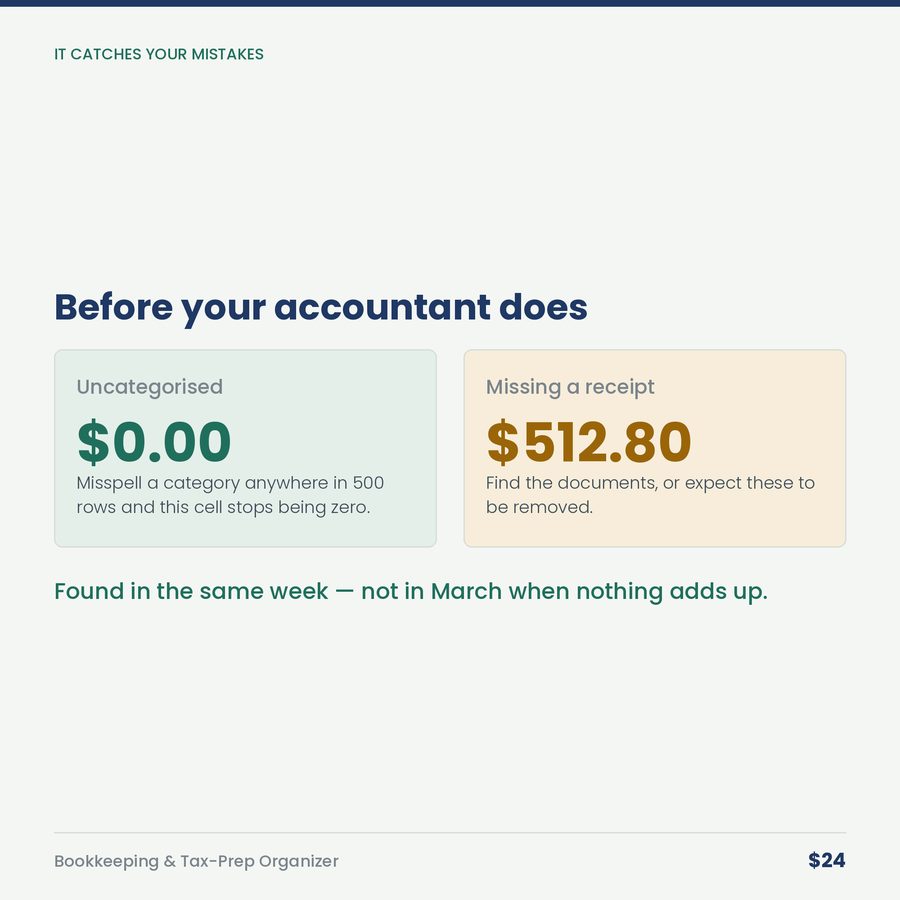
It catches your mistakes before your accountant does. The Categories tab has a cell labeled "UNCATEGORISED — must be zero." If you misspell a category anywhere in 500 expense rows, that cell stops being zero. You find it in the same week, not in March when nothing adds up and you can't remember what half the entries were.
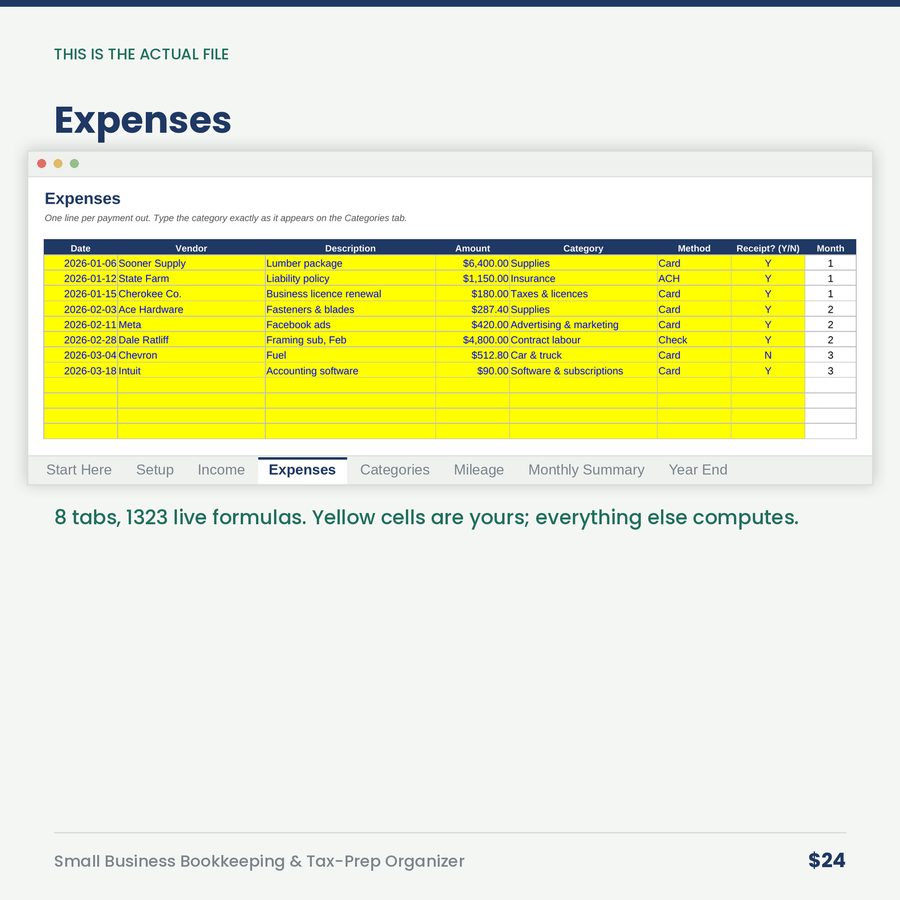
It tracks receipts honestly. A Y/N column per expense, and a live total on the summary: "Expenses missing a receipt: $512.80." Find the documents or expect them to be removed. A Y you typed without keeping the document is worse than an honest N.
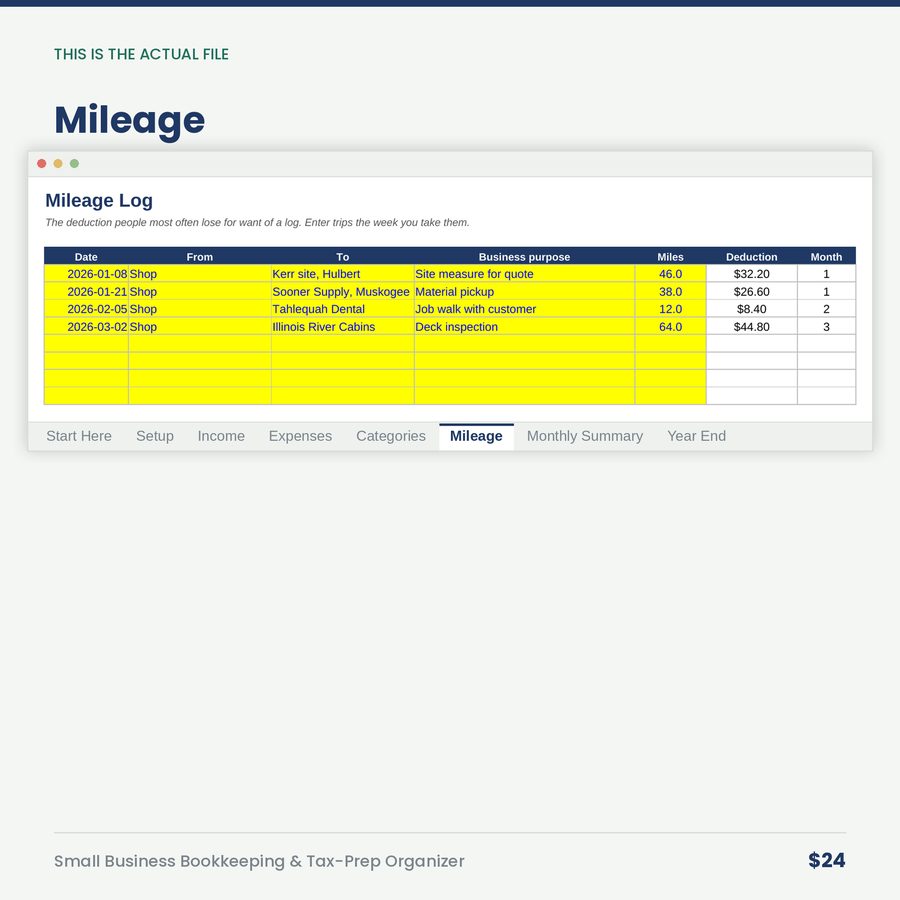
It has a real mileage log — 200 trips, with a business-purpose field and automatic deduction at whatever rate you enter. This is the deduction people most often lose simply for want of a record. Four words written at the time — "site measure for quote" — beats a reconstruction a year later.
And a year-end checklist in the order your accountant will ask. Twelve items, including the one that catches everybody: collect contractor tax details before you pay them. Chasing somebody in January, after the work is done and the cheque has cleared, is a genuinely unpleasant job.
What's inside
- 300 income rows and 500 expense rows, with the month tagged automatically
- 18 expense categories following common small-business headings, with year totals
- A 200-trip mileage log
- Twelve months of income, expenses, profit, tax reserve and running totals
- A year-end checklist you can hand to your accountant
Please read this before buying
This is an organizer, not tax advice and not accounting software. The categories follow the common headings a small business return uses, but what is deductible, at what rate, and how you must substantiate it depends on your business, your entity type and your jurisdiction — those are questions for your accountant.
The tax reserve percentage and the mileage rate are cells you fill in. Ask your accountant for the first. Check the current official rate for the second. Both change, and a template that hard-codes them will be wrong within a year.
Built for
Sole traders and single-member LLCs · contractors and trades · freelancers and consultants · Etsy and online sellers · anyone whose bookkeeping currently lives in a shoebox and a bank app.
What you get
One .xlsx file, eight tabs, instant download. Excel, Google Sheets, Apple Numbers, LibreOffice. No macros, no add-ins, no subscription, no monthly fee.
A partial year of realistic sample data is loaded so you can see it working. Delete it and start.
A look inside


More in Financial Health
Small Business Financial Health Dashboard
Stop guessing whether your business is actually making money.
$29
If Revenue Drops: The Downturn Playbook
If your revenue dropped 30% next month, what would you cut first? And second? And how long would you have?
$29