Tools · Financial Health
If Revenue Drops: The Downturn Playbook
If your revenue dropped 30% next month, what would you cut first? And second? And how long would you have?
$29 one-off
Buy — $29If-Revenue-Drops-Downturn-Playbook.xlsx · 5 tabs, 149 live formulas, no macros
Instant download, nothing ships. Works in Excel, no subscription. If it does not do what you needed, tell me and I will make it right.
Most owners have a rough idea. Almost none has it written down — and the difference matters enormously, because the decisions get made under pressure, in the wrong order, and usually too late.
The pattern is always the same. Revenue softens. You wait a month to see whether it recovers. It doesn't. You cut the small things first, because they're easy and they don't hurt anybody. Two months later you make the large decision you should have made at the start — from a much weaker position and with far less cash.
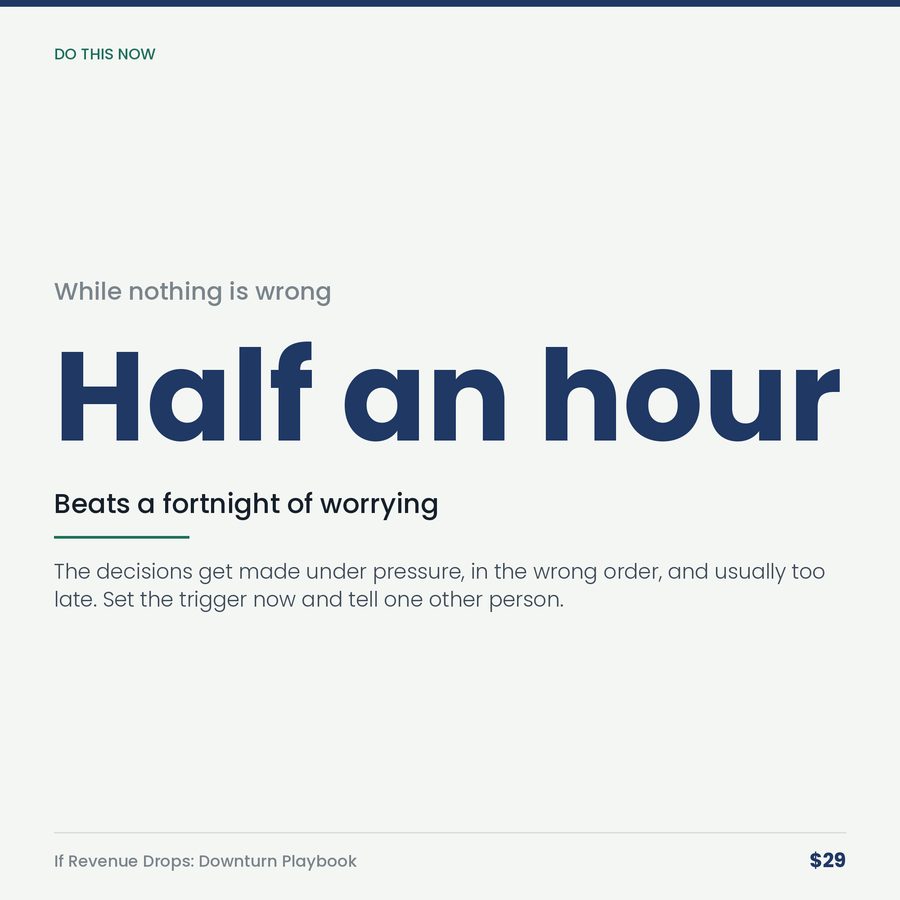
Half an hour now, with the numbers in front of you and nobody's job on the line, produces a better plan than two weeks of worrying will.
First, what actually happens.
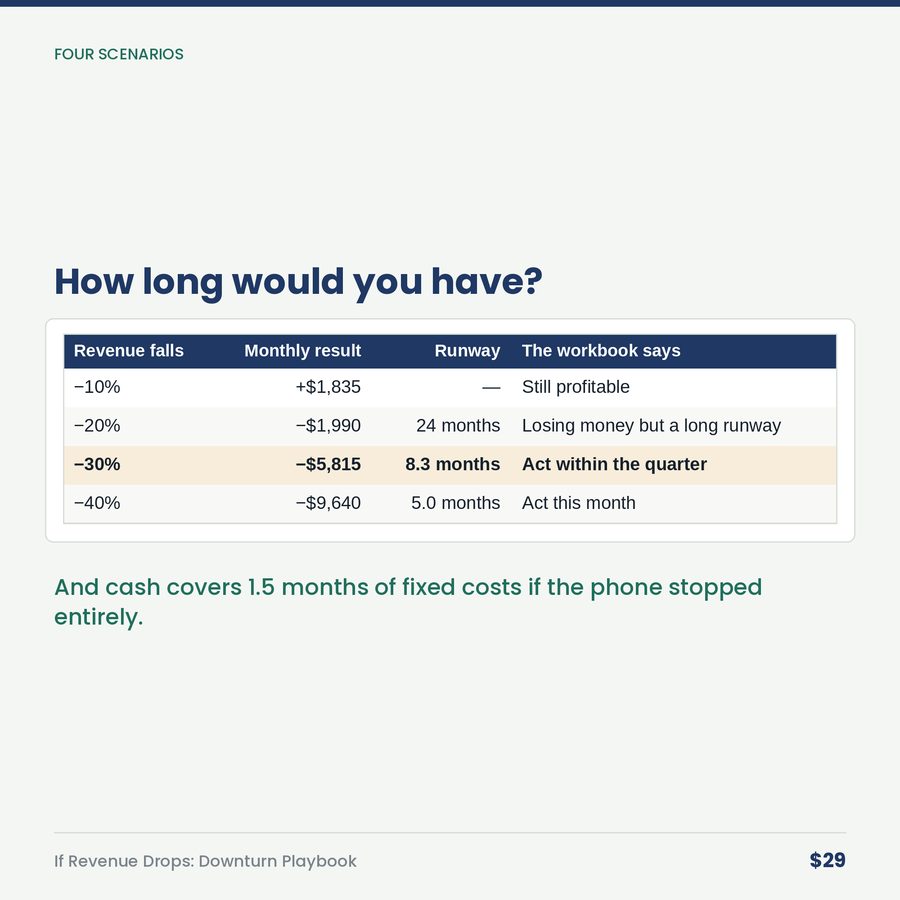
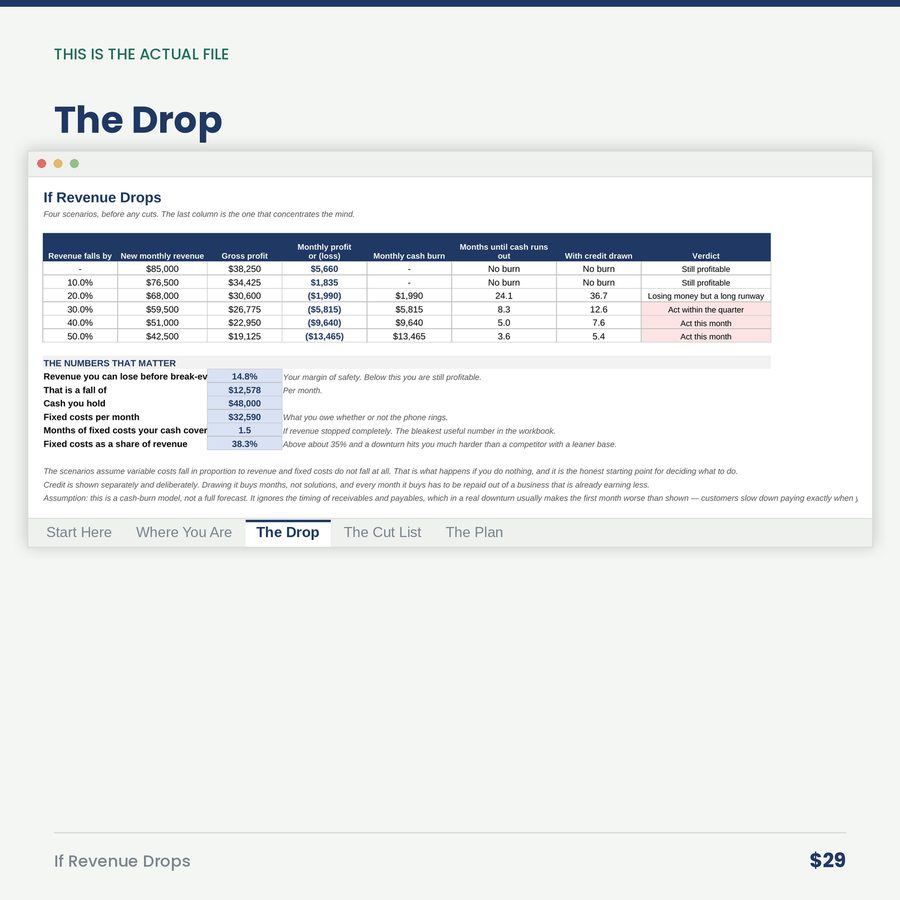
Enter your revenue, your variable cost percentage, your cash, and every fixed cost as its own line. Six scenarios come back:
| Revenue falls | You'd be | Runway | The workbook says |
|---|---|---|---|
| −10% | +$1,835/mo | — | Still profitable |
| −20% | −$1,990/mo | 24 months | Long runway |
| −30% | −$5,815/mo | 8.3 months | Act within the quarter |
| −40% | −$9,640/mo | 5.0 months | Act this month |
Plus the number nobody likes: in the example, cash covers 1.5 months of fixed costs if revenue stopped completely.
Then, what to cut — in order.
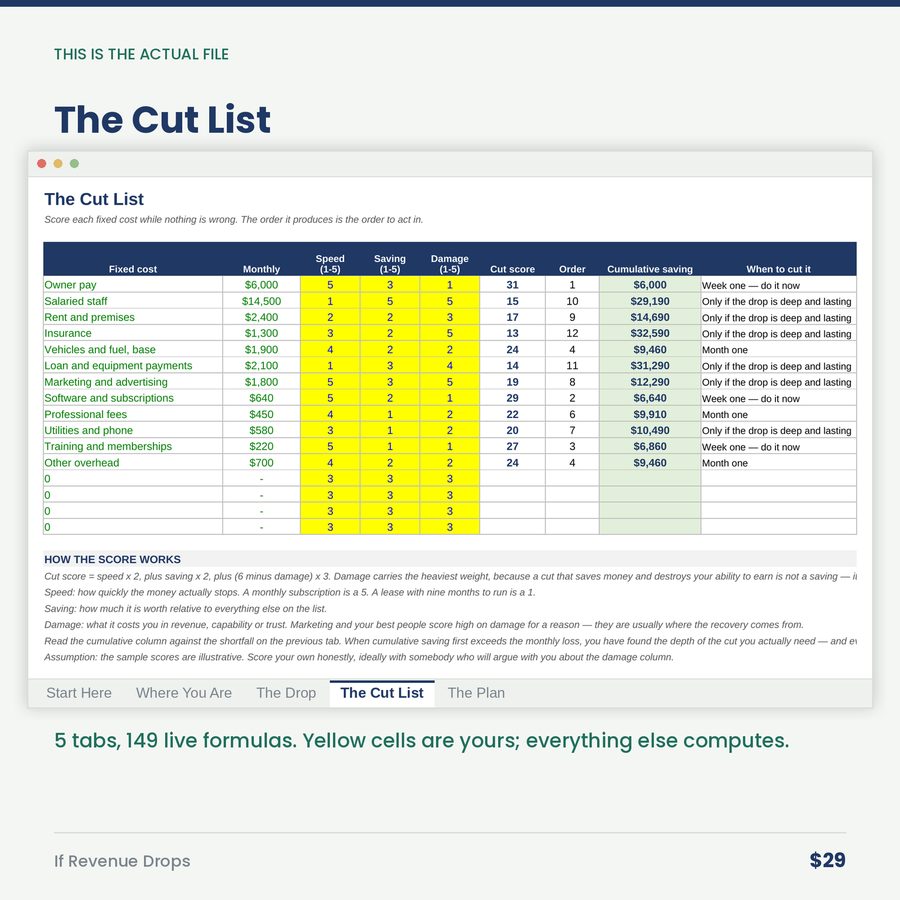
Score every fixed cost on three things: how fast the money actually stops, how much it saves, and how much damage it does. Damage carries the heaviest weight, because a cut that saves money and destroys your ability to earn isn't a saving. It's a slower version of the same problem.
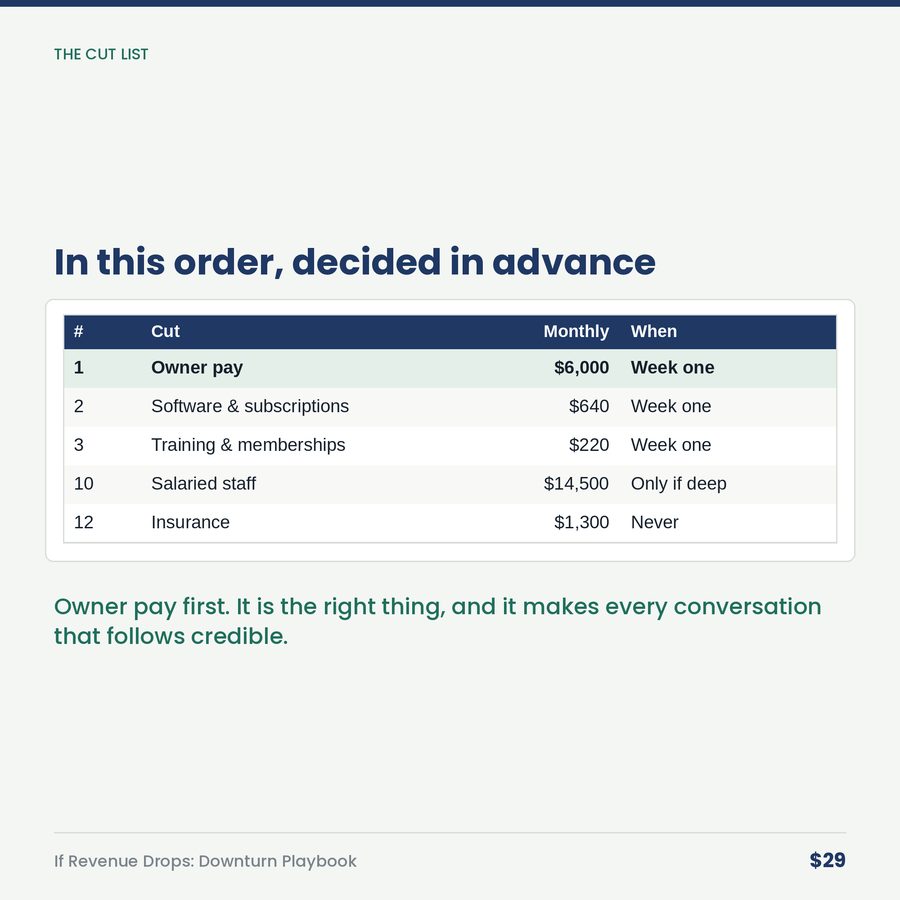
The workbook produces the order, and a cumulative saving column you read against the shortfall. When cumulative saving first exceeds the monthly loss, you've found the depth of cut you actually need — and everything below that line can wait.
In the example the first cut is owner pay. That's not an accident. Reduce your own pay before anybody else's: it's the right thing, and it makes every conversation that follows credible.
Insurance sorts dead last. Marketing and your best people sort near the bottom. They're the biggest numbers and the easiest to cut, and they're usually where the recovery comes from.
Then the plan itself.
Set a trigger now — two consecutive months below a number you choose — and tell one other person. The point is to remove the judgement call from the moment you're least able to make it well.
Week one: stop discretionary spend, call every overdue customer yourself, talk to your bank before you need to (a facility arranged from strength costs less and is far easier to get than one requested in month three), and ask suppliers for extended terms early and honestly.
Month one: make the top cuts in one round, not two. Two rounds of small cuts destroys more confidence than one honest round, and everybody spends the gap between them waiting for the other shoe.
Month three, if it hasn't recovered: the hard decisions, made once — and a question worth sitting with: is the drop the market, or is it you? If competitors are busy, the answer isn't on this page.
And the one thing not to do: don't cut price to chase volume. It's the fastest way to turn a bad quarter into a bad year. The volume rarely arrives, the margin certainly goes, and the price is very hard to get back once your market has learned it moves.
Built for
Contractors and trades · agencies and consultancies · retail and hospitality · clinics and practices · any owner-operator who has been through one downturn and would like the next one to be less improvised.
What you get
One .xlsx file, five tabs, sixteen fixed-cost lines, instant download. Excel, Google Sheets, Apple Numbers, LibreOffice. No macros, no add-ins, no subscription.
A realistic small business is already loaded. Type over it.
A look inside

More in Financial Health
Small Business Financial Health Dashboard
Stop guessing whether your business is actually making money.
$29
Small Business Bookkeeping & Tax-Prep Organizer
Most small businesses do their bookkeeping in March, for the year that ended in December, out of a carrier bag
$24