Tools · Financial Health
How Much Can I Pay Myself?
How much are you actually paying yourself per hour?
$27 one-off
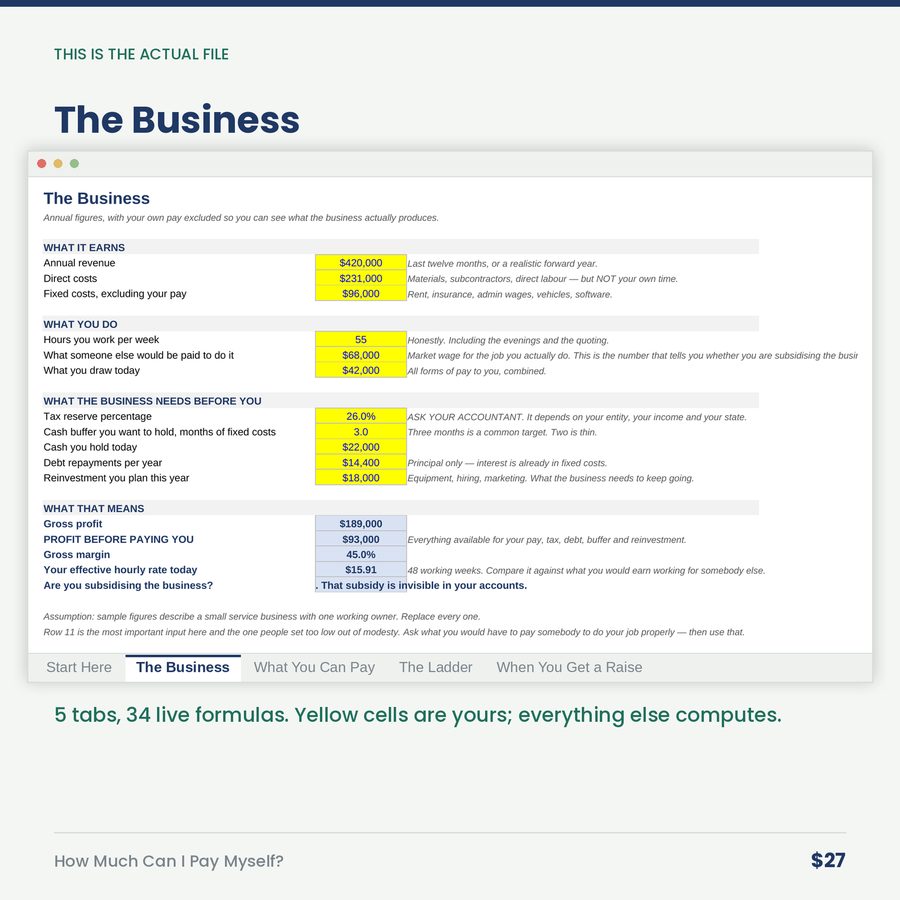
Buy — $27How-Much-Can-I-Pay-Myself.xlsx · 5 tabs, 34 live formulas, no macros
Instant download, nothing ships. Works in Excel, no subscription. If it does not do what you needed, tell me and I will make it right.
In the example loaded in this file: a $420,000 business, a 45% gross margin, and an owner drawing $42,000 for a 55-hour week.
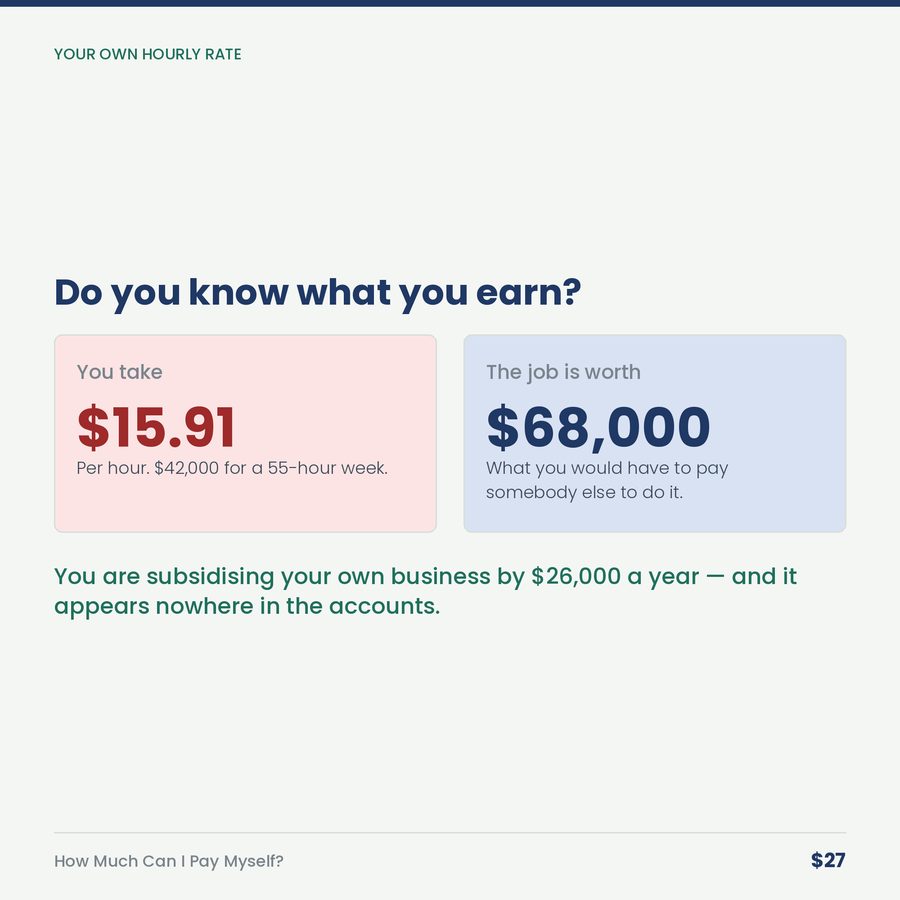
That's $15.91 an hour.
Someone else doing that same job would be paid $68,000. Which means the owner is subsidising their own business by $26,000 a year — and that subsidy appears nowhere in the accounts.
The two ways this goes wrong
Paying yourself too little is the commoner mistake and the more damaging one. The business looks profitable because your labor is free, so nobody fixes the pricing, and after four years you've built a job that pays less than the one you left — with all of the risk added on top.
Paying yourself too much is the faster failure. The draw goes out on a good month, the slow month arrives, and the money that should have covered payroll went into a personal account in March.
Both come from the same place: no number. Just whatever's in the account when the mortgage is due.
Here's the number.
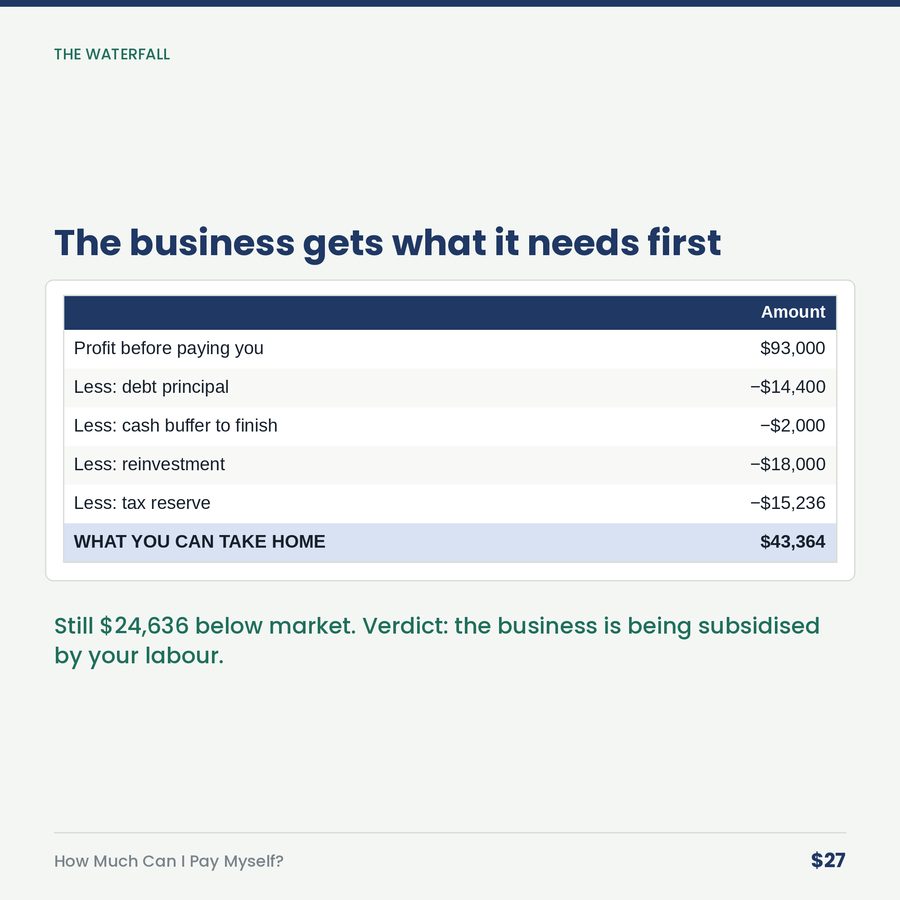
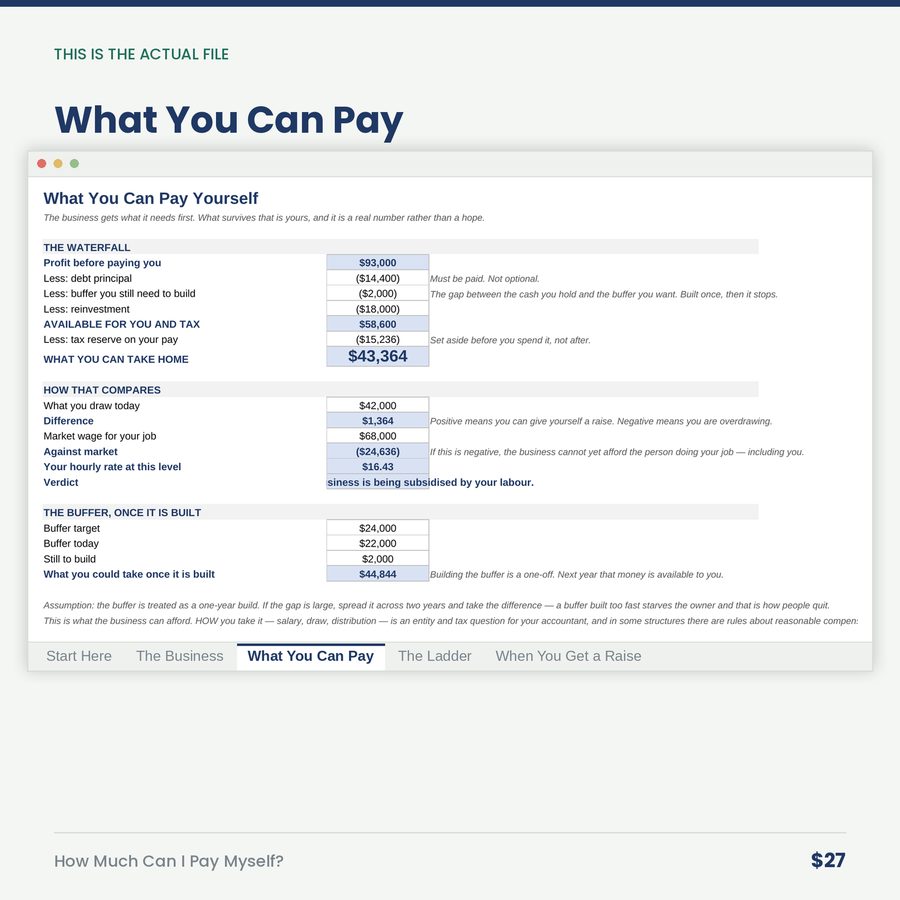
The business gets what it needs first, in order: debt principal, the cash buffer, reinvestment, and the tax reserve. What survives that is genuinely yours.
In the example: $93,000 of profit before owner pay → $43,364 take-home. Which happens to be $1,364 more than they're drawing, and still $24,636 below market.
The verdict cell doesn't soften it: "Below market. The business is being subsidised by your labor."
Then it gives you a ladder, not a single number.
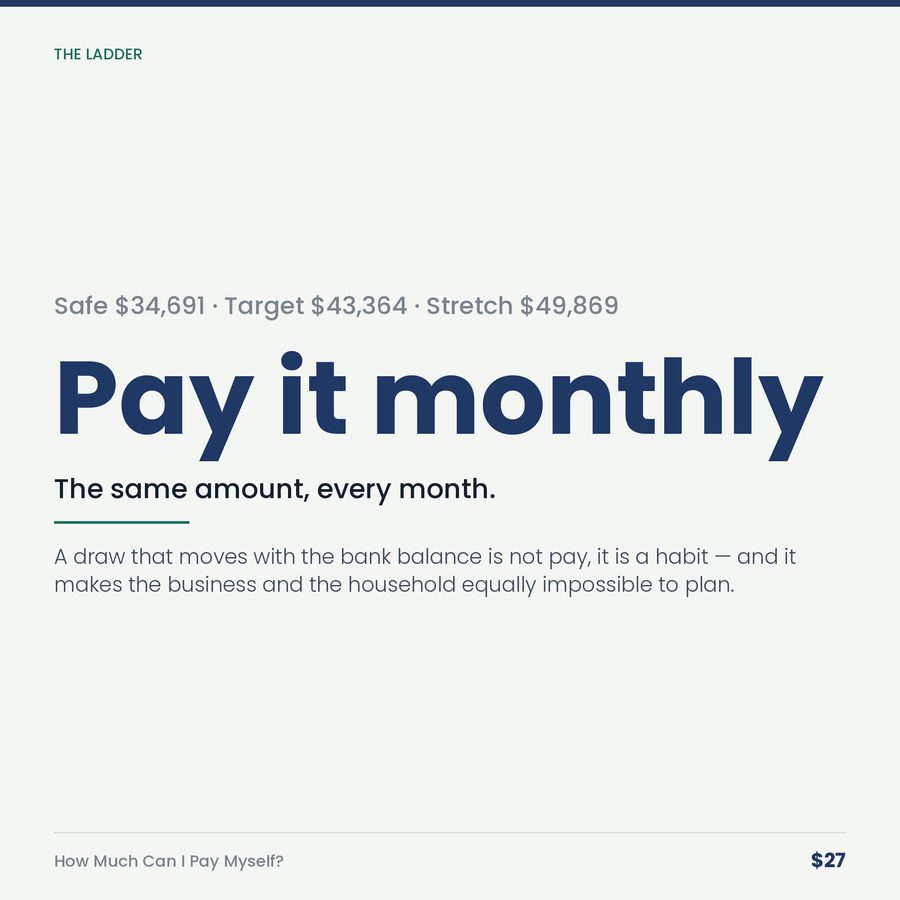
SAFE — 20% below what the numbers allow. For when revenue is uneven or the buffer isn't built. TARGET — exactly what the business can afford. For when the buffer is built and the last three months met plan. STRETCH — 15% above, funded by a genuinely good year. Only after two strong quarters, and taken as a one-off distribution rather than a raise.
With the rule that matters most: pay yourself the same amount every month. A draw that moves with the bank balance isn't pay, it's a habit — and it makes the business and the household equally impossible to plan.
And five conditions for a raise
Cash buffer at target · debt funded · tax reserve fully funded and not borrowed from · last three months met plan · no large known cost in the next two quarters.
Meet all five and take it without agonising. Four out of five is not five — the missing one is your next project, and it's nearly always cheaper to fix than the raise is to take back.
One last thing, and it's the point of the whole workbook
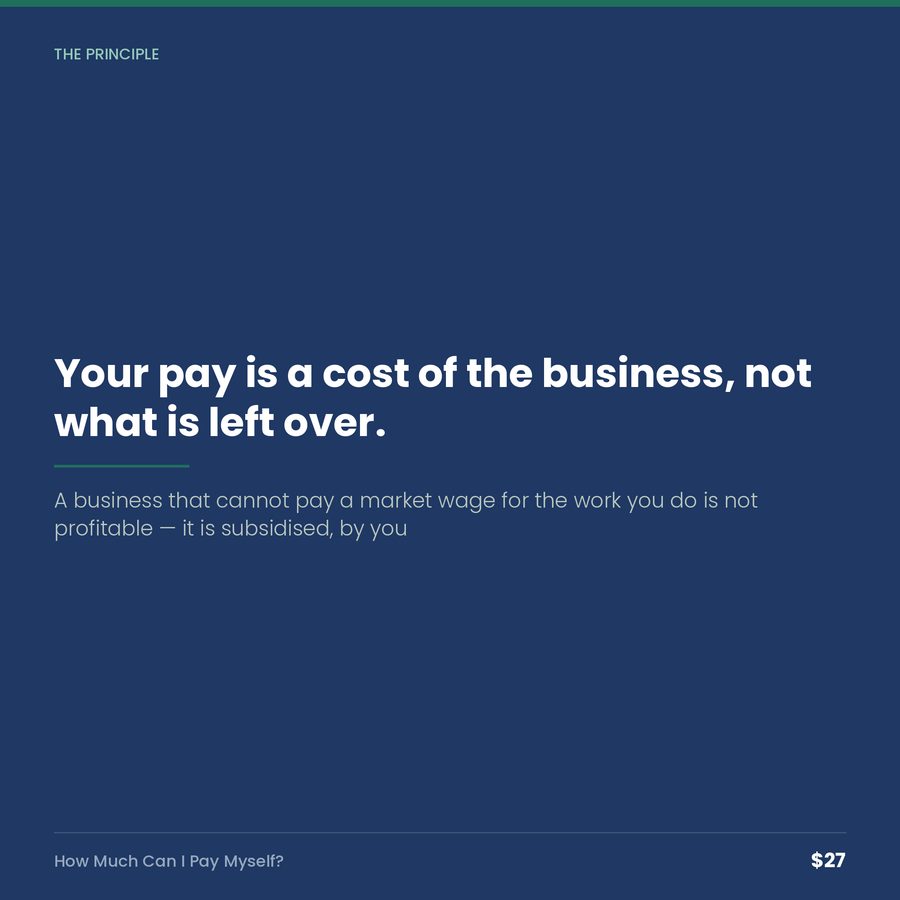
When the numbers say you can: take it. Owners who chronically underpay themselves don't build stronger businesses. They build businesses that depend on an unsustainable subsidy — and those are the ones that quietly fail in year six.
Read this before buying
This calculates what the business can afford to pay you. It does not decide the form your pay should take. Salary, draw, distribution, dividend — the right structure depends on your entity type and jurisdiction, carries tax consequences, and in some structures there are rules about reasonable compensation.
Take the number to your accountant and let them tell you how to pay it. This is a planning tool, not tax, legal or accounting advice.
Built for
Owner-operators of every kind · contractors and trades · consultancies and agencies · anyone who has never worked out their own hourly rate, or is afraid of the answer.
What you get
One .xlsx file, five tabs, instant download. Excel, Google Sheets, Apple Numbers, LibreOffice. No macros, no add-ins, no subscription.
A realistic small service business is loaded as a worked example. Type over it.
A look inside
More in Financial Health
Small Business Financial Health Dashboard
Stop guessing whether your business is actually making money.
$29
Small Business Bookkeeping & Tax-Prep Organizer
Most small businesses do their bookkeeping in March, for the year that ended in December, out of a carrier bag
$24
If Revenue Drops: The Downturn Playbook
If your revenue dropped 30% next month, what would you cut first? And second? And how long would you have?
$29